
A local listings management platform is the system of record used to control location data across Google, Apple Maps, Bing, Yelp, Facebook, directories, and other discovery surfaces. In 2026, the best choice depends on who operates it: agencies need client separation, franchises need governance, and in-house teams need scalable control. Every platform below has a real limitation.
Editorial disclosure: Synup is a featured platform in this comparison. It is evaluated alongside the other vendors using the same buyer-fit, pricing-transparency, coverage, workflow, and exit-term criteria. This article does not present any platform as the universal best choice.
If you are still deciding whether you need a platform at all, start with what is local listing management. If you specifically want the singular software shortlist rather than this platform-and-switching-cost view, use the best local listing management software guide.
Quick verdict by buyer type:
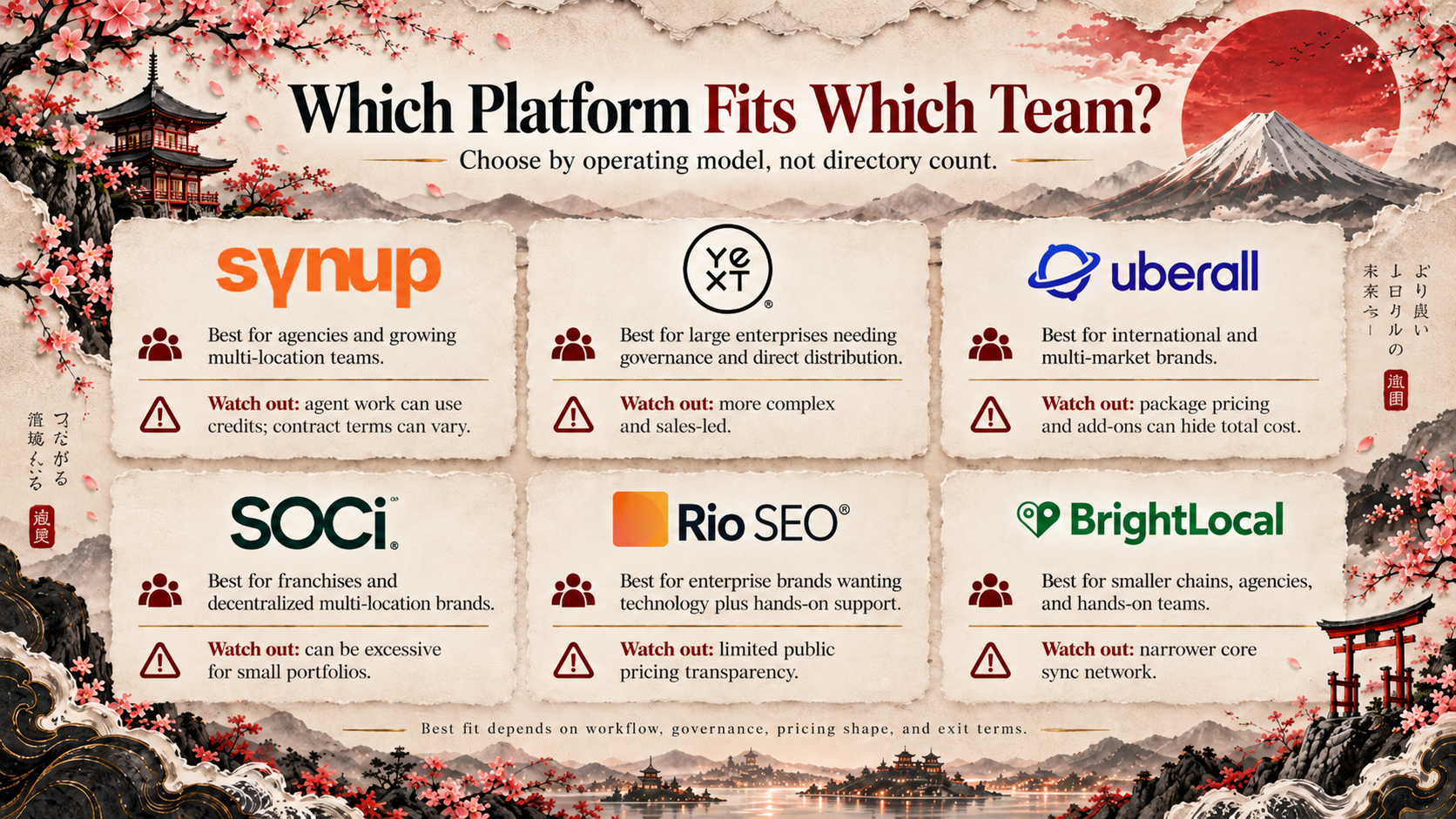
| Platform | Best fit | 2026 pricing signal | Main limitation |
|---|---|---|---|
| Synup | Agencies and growing multi-location teams | Pricing scales by locations and capabilities; current site says pricing is visible before sales | AI agent usage can introduce credit metering, and contracted cancellation terms can vary |
| Yext | Large enterprises needing data governance and broad direct distribution | Custom / sales-led | Power and governance can be more complex than smaller teams need |
| Uberall | International and multi-market brands | Request pricing | Advanced capabilities are split across packages and add-ons |
| SOCi | Franchises and decentralized multi-location brands | Demo / quote-led | Built for large multi-location operations, so it can be excessive for smaller portfolios |
| Rio SEO | Enterprise brands wanting technology plus hands-on support | Custom quote | Less self-serve pricing transparency and a more enterprise service model |
| BrightLocal | Smaller chains, agencies, and hands-on local SEO teams | Manage starts at $54/month for 1 location | Active Sync focuses on a smaller core publisher set rather than acting as a broad enterprise system of record |
How does a local listings management platform differ from software or a tool?
A local listings management platform is broader than a single-purpose tool because it becomes the operating layer for location data, permissions, publishing, monitoring, and reporting across many locations. Vendors still use the words platform, software, and tool loosely, so the useful distinction is operational: a platform should support repeatable governance and multi-location workflows, not merely submit a few directory updates.
A tool may solve one job, such as auditing citations, scheduling Google Business Profile posts, or checking duplicate exposure. Software may sync listings and track status. A true platform is expected to coordinate a larger program: approved source data, user roles, bulk changes, publisher exceptions, reporting, and lifecycle events such as openings, moves, and closures.
This distinction is why publisher count alone is a weak buying metric. One platform may claim hundreds of destinations while another deliberately focuses direct sync on Google, Apple, Bing, Facebook, and Yelp. The real question is whether the platform controls the publishers, fields, and workflows that matter to your operating model.
Practical buying test: ask whether the product can act as your approved source of truth, control who can change sensitive fields, show which publisher accepted each update, and preserve a useful audit trail. If the answer is no, you may be buying a listings utility rather than a listings platform.
Who is each platform for?
The six platforms below serve different buyers rather than one identical market. Synup is strongest when agencies or growing teams want listings beside broader local marketing. Yext fits complex enterprise governance. Uberall fits international networks. SOCi fits franchise execution. Rio SEO suits enterprise teams wanting managed support. BrightLocal fits hands-on teams that value transparent pricing and listing ownership.
1. Synup
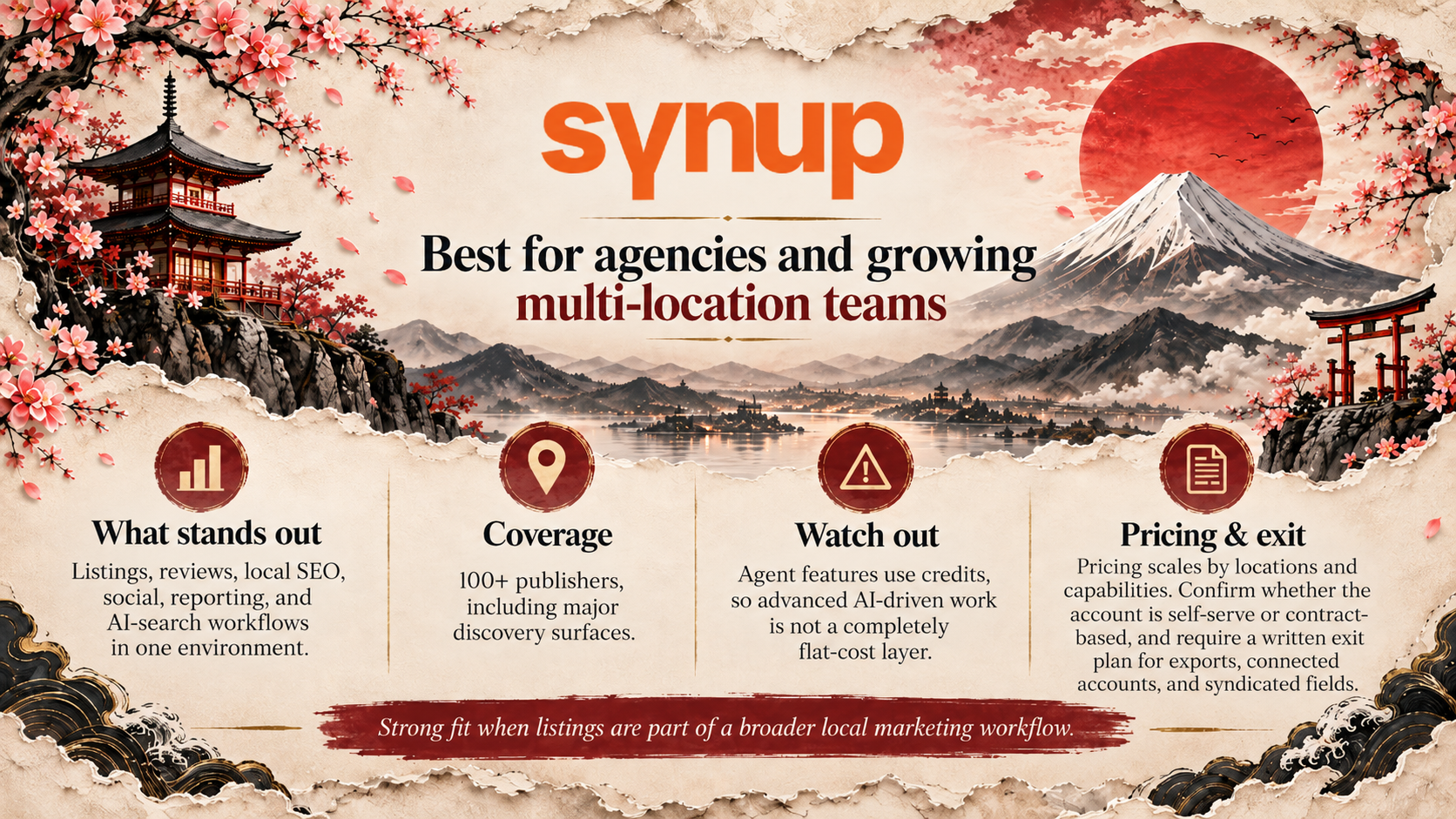
Best for: Agencies and growing multi-location brands that want listings, reviews, local SEO, social, reporting, and AI-search workflows in one environment.
Synup positions its current platform around multi-client and multi-location execution. Its live site says listings sync to 100+ publishers including Google Business Profile, Apple Business Connect, Bing, and Facebook, while its help center documents a master location record, publishing status, account connections, and separate publisher-specific fields.
The fit is strongest when listings are not the only local marketing job. Agencies can keep clients separated, use white-label presentation, and run recurring work across listings, reviews, social, SEO, and AI visibility. That reduces the number of separate systems an agency or lean in-house team has to coordinate.
Potential limitation: Synup's agent features use credits, so advanced AI-driven work is not a completely flat-cost layer. Its help documentation also says contracted accounts can have contract-specific cancellation charges, even though the current self-serve experience promotes a trial and cancel-anytime path. Buyers should confirm which commercial model applies to their account before signing.
Switching note: the public cancellation documentation explains account deactivation and location archiving at the end of term, but it does not provide a universal publisher-by-publisher revert promise. Require a written exit plan covering location exports, connected accounts, and what happens to syndicated fields after service ends.
2. Yext
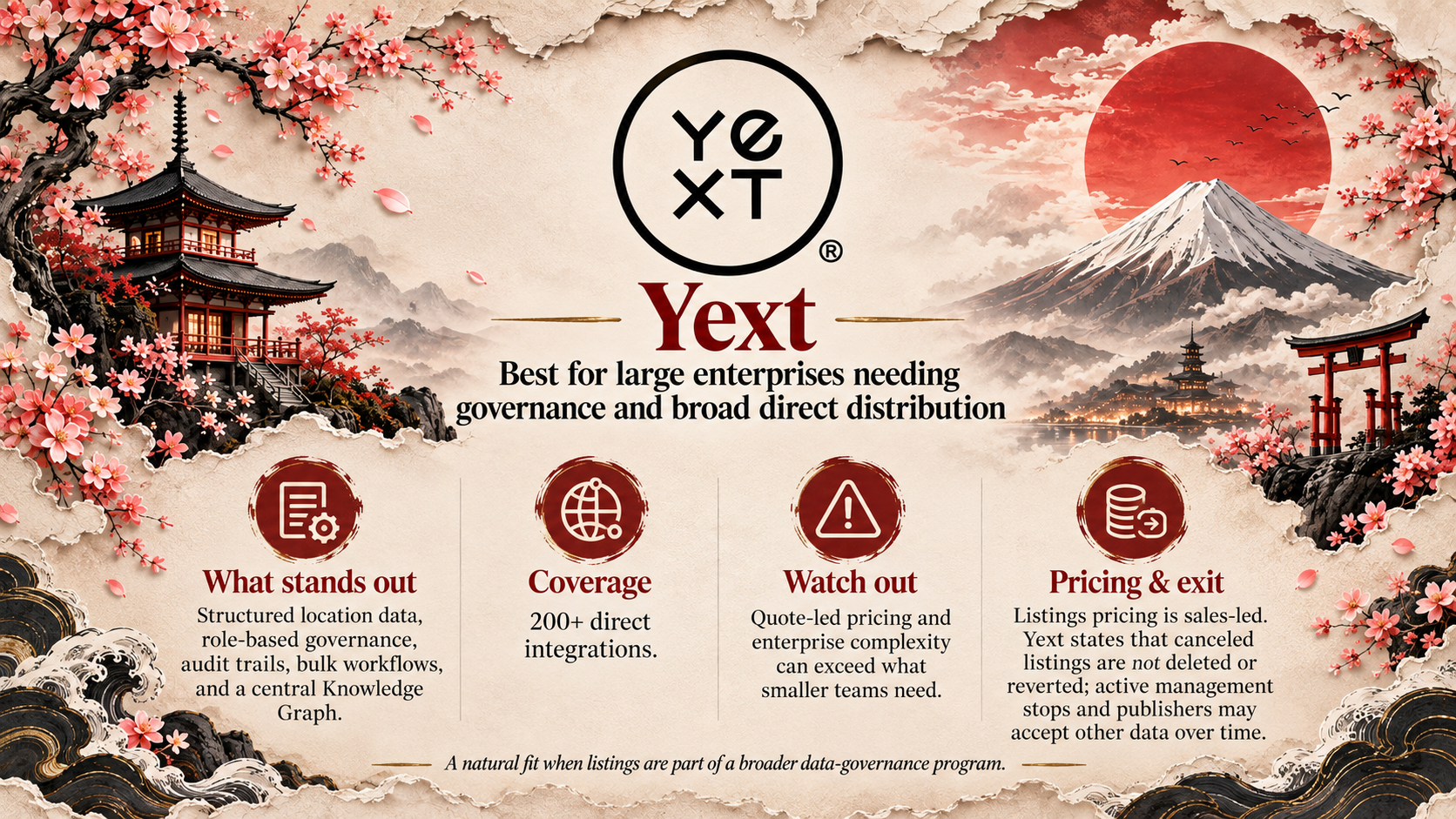
Best for: Large enterprises that need structured location data, role-based governance, auditability, and one of the broadest direct publisher networks.
Yext's current Listings product page states that it has 200+ direct integrations and is built to push verified brand data across publishers and AI discovery surfaces. The platform also emphasizes bulk workflows, role-based access, audit trails, structured data, and a central Knowledge Graph.
That makes Yext a natural fit for organizations where listings are part of a broader data-governance program. Large retailers, financial institutions, healthcare networks, and global enterprises often need stable entity IDs, permissions, integrations, and controlled change processes more than they need a low monthly card.
Potential limitation: Yext does not publish a simple numeric Listings price on its current product page, and the enterprise feature set can be more operationally complex than a smaller brand needs. Buyers should model implementation, integrations, user governance, and ongoing administration rather than comparing only the subscription quote.
Switching note: Yext explicitly says it does not delete or revert a listing when a customer cancels. It stops managing the listing, removes Yext-specific fields and controls where applicable, and the publisher may later accept data from other sources. That is a stronger public exit statement than many competitors provide, but brands still need a post-cancel monitoring plan because data can drift.
3. Uberall
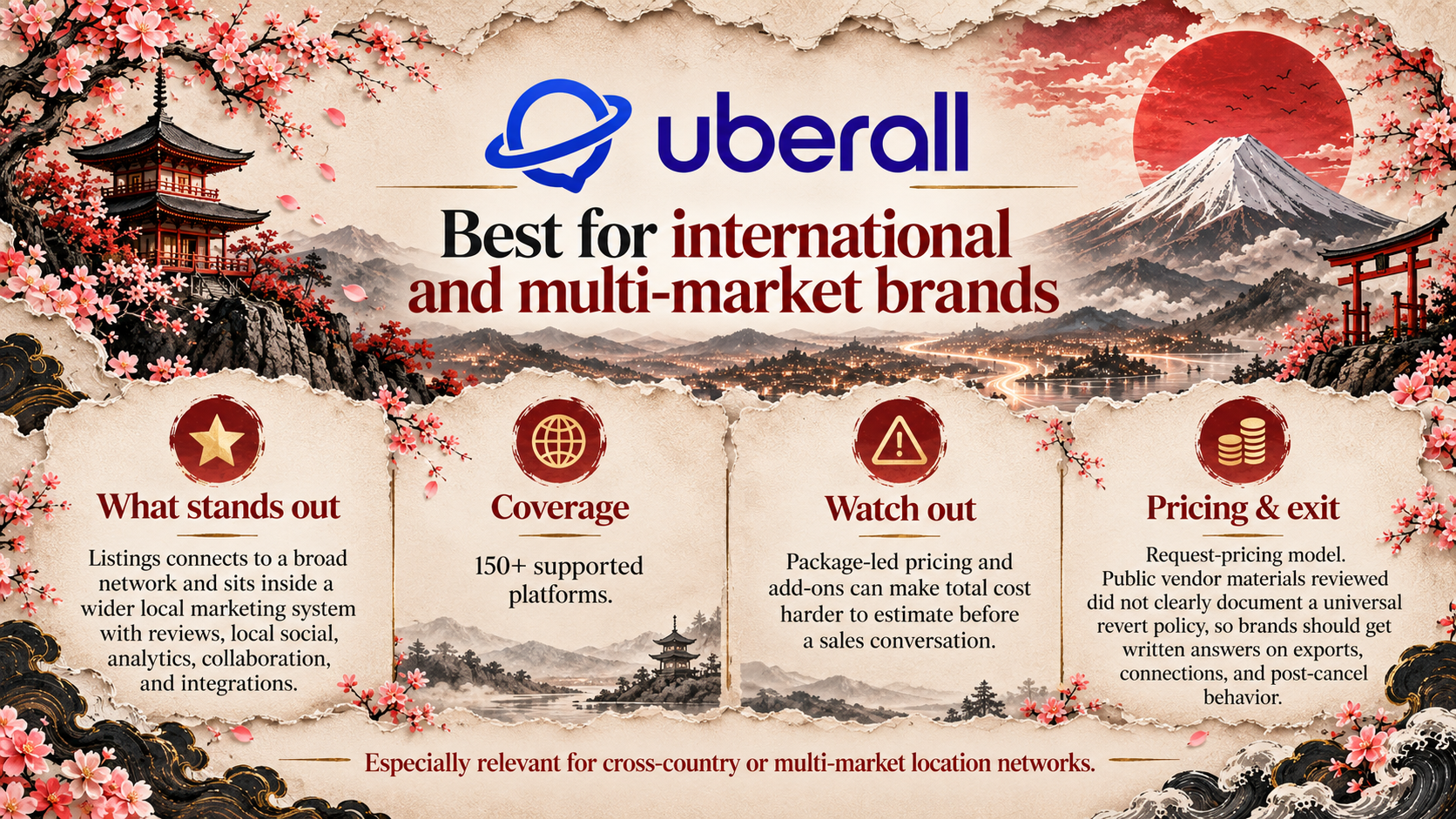
Best for: International and multi-market brands that need a broad listings network plus reviews, local social, integrations, and location-level collaboration.
Uberall's current Listings page says the platform connects to 150+ supported platforms and supports bulk editing by spreadsheet or API. Its broader product stack adds reviews, local social, analytics, collaboration, and integrations for enterprise teams.
The platform is especially relevant when a brand operates across countries or wants listings to sit inside a connected local marketing system. The directory network and integration model are designed for multi-location brands rather than a single storefront.
Potential limitation: Uberall's public pricing page is package-led rather than a clear per-location card, and capabilities such as advanced analytics or collaboration can appear as add-ons depending on the package. That makes total cost harder to estimate before a sales conversation.
Switching note: a clear public listing-revert policy was not located in the current vendor materials reviewed for this article. Ask whether publisher data remains as last submitted, which connections are disconnected, what data can be exported, and whether any profile-level enhancements depend on an active subscription.
4. SOCi
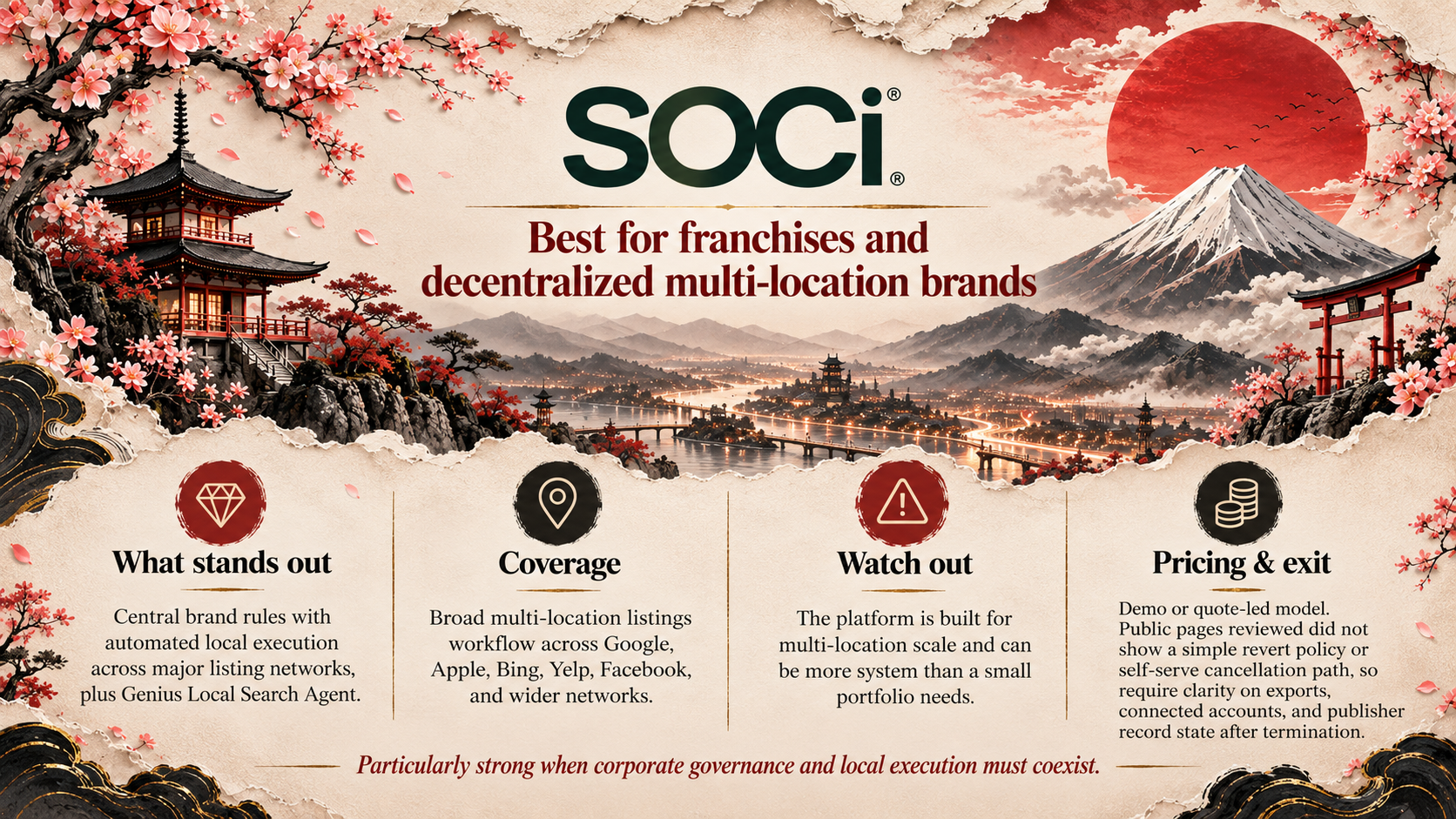
Best for: Franchises, retail networks, and decentralized enterprises that want central brand rules with automated local execution.
SOCi's current business listings management page presents listings as an always-on workflow across Google, Apple Maps, Bing, Yelp, Facebook, and a broader network. Genius Local Search Agent is designed to monitor, correct, and optimize listings at scale while allowing brands to control approval rules.
That operating model fits franchises particularly well. Corporate teams can centralize approved data and governance while allowing some local participation, then use automation to handle repetitive optimization or correction tasks across many locations.
Potential limitation: SOCi is built around multi-location scale and a broad local marketing suite. For a 10-location business that mainly needs straightforward directory synchronization, the platform can be more system than the team needs. AI-driven automation also makes approval design important, especially for regulated or tightly controlled brands.
Switching note: SOCi does not publish a simple public revert policy or self-serve cancellation path for Listings in the current pages reviewed. Treat exit terms as a contract item and require clarity on exports, connected accounts, location data, and the state of publisher records after termination.
5. Rio SEO

Best for: Enterprise brands that want listings technology combined with hands-on support and a broader local experience program.
Rio SEO's Local Listings product page says it publishes location data to hundreds of directories, applications, and platforms and combines technology with support for claiming, verification, duplicate resolution, and ownership conflicts. Its wider Local Experience platform also covers local pages, reviews, reporting, and related enterprise workflows.
Rio SEO is therefore a different purchase from a purely self-serve listings tool. The vendor is relevant when an enterprise wants people as well as software, especially during migrations, cleanup projects, complex location hierarchies, or ongoing exception handling.
Potential limitation: the high-touch enterprise model comes with limited public pricing transparency. Teams that want immediate self-serve setup, simple per-location math, or a lightweight agency reseller experience may find the buying process heavier than necessary.
Switching note: public product pages reviewed for this article do not state a universal cancellation or revert rule. Because Rio SEO can combine managed service with platform work, buyers should separate data-export rights, publisher ownership, open support cases, and any managed-service deliverables in the exit clause.
6. BrightLocal
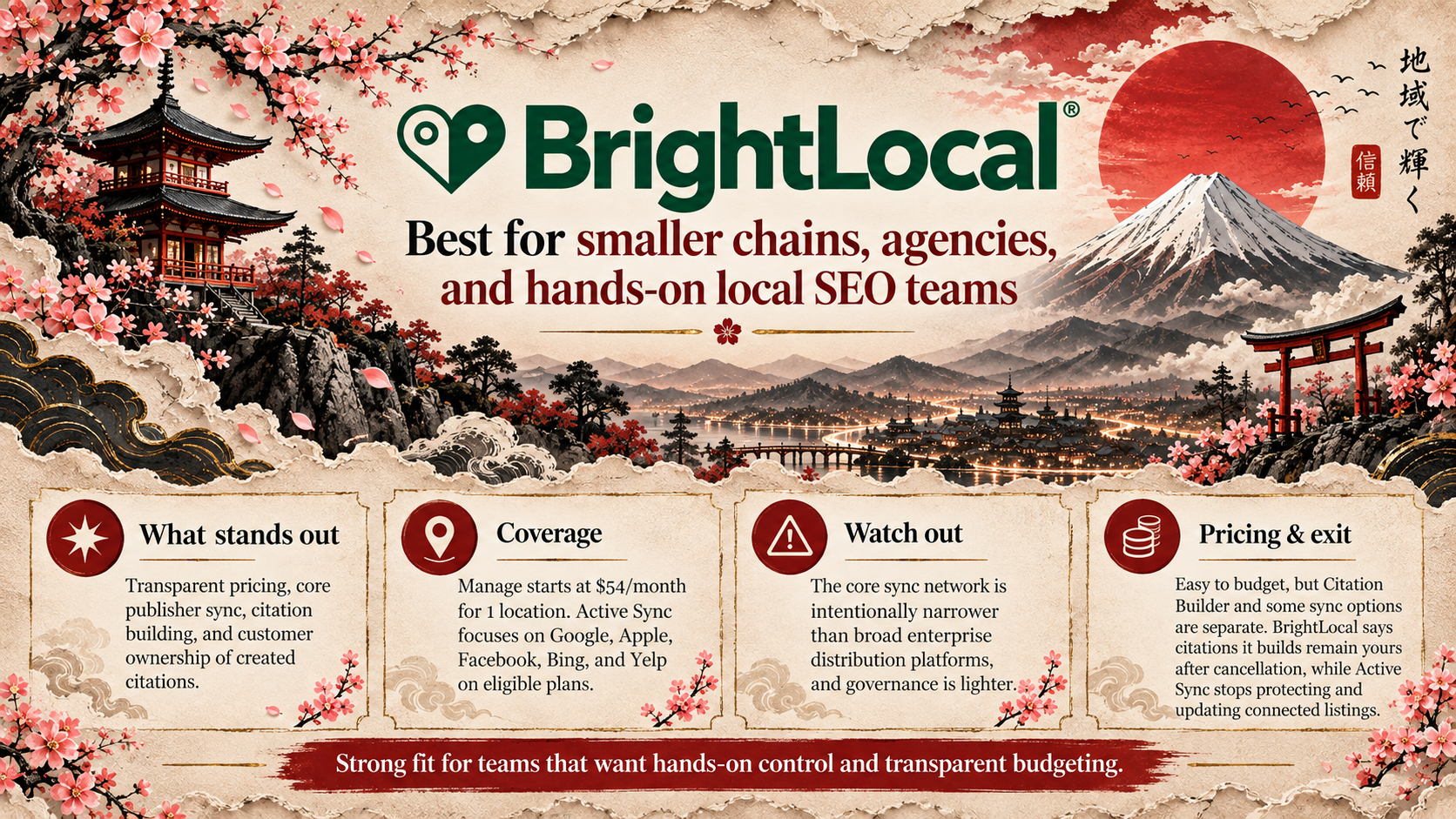
Best for: Smaller chains, agencies, and local SEO teams that want transparent pricing, core publisher sync, citation building, and ownership of created listings.
BrightLocal's Listings Management page separates direct Active Sync from Citation Builder. Active Sync focuses on Google Business Profile, Apple Maps, Facebook, Bing, and Yelp for eligible plans, while Citation Builder handles additional citation creation and cleanup. BrightLocal also states that citations it builds remain owned by the customer after cancellation.
That structure is attractive to teams that do not need an enterprise master-data platform. You can pay for the listings work you need, keep hands-on control, and pair directory management with BrightLocal's broader local SEO auditing and reporting tools.
Potential limitation: BrightLocal deliberately concentrates Active Sync on a smaller core set of high-value publishers, so it is not the same kind of broad direct-distribution network claimed by Yext, Uberall, Rio SEO, or Synup. Larger organizations may also outgrow its lighter governance model.
Switching note: BrightLocal provides unusually clear ownership language: citations it builds do not disappear when you cancel. Active Sync stops protecting and updating connected listings, so the brand still needs a new process for future changes.
What is the real weakness of every named vendor?
Every platform makes a tradeoff. Synup adds breadth and agency workflow but introduces credit-metered agent usage and contract variation. Yext offers governance and direct distribution but can be expensive and complex. Uberall has broad multi-market capabilities but less public cost transparency. SOCi is powerful for franchises but heavy for small teams. Rio SEO is service-rich but enterprise-led. BrightLocal is transparent but intentionally narrower.
| Platform | Real weakness | Who should care most |
|---|---|---|
| Synup | Agent work can consume credits; contracted cancellation terms may vary | Agencies forecasting variable AI usage or comparing flat-cost tools |
| Yext | Quote-led enterprise sale and governance overhead | Smaller brands without dedicated operations or integration resources |
| Uberall | Packages and add-ons make total cost less visible upfront | Procurement teams comparing all-in cost before demos |
| SOCi | Enterprise/franchise orientation can be excessive for small portfolios | Hands-on teams that only need listings sync |
| Rio SEO | High-touch enterprise model with limited public pricing | SMBs and teams that want self-serve buying |
| BrightLocal | Core sync network is narrower than enterprise distribution platforms | Global brands needing one broad system of record |
What does a 2026 pricing snapshot show?
The 2026 pricing market splits into two groups: transparent self-serve or location-band pricing, and enterprise quote-led pricing. BrightLocal publishes detailed location bands. Synup says pricing scales by locations and capabilities and is visible before sales. Yext, Uberall, SOCi, and Rio SEO are primarily sales-led for the platform scope evaluated here. Compare total operating cost, not the lowest headline number.
| Platform | Public pricing signal checked Sep. 16, 2026 | Coverage claim | Buying implication |
|---|---|---|---|
| Synup | Pricing scales by location count and capabilities; current site says transparent pricing is available before sales | 100+ publishers | Model agent credits and confirm whether your account is self-serve or contract-based |
| Yext | Custom / contact sales for Listings | 200+ direct integrations | Budget for implementation, governance, and integrations as well as subscription |
| Uberall | Request pricing | 150+ supported platforms | Price the exact package and add-ons, not just Listings |
| SOCi | Demo / quote-led | Hundreds of networks | Best compared as a multi-location execution suite, not a cheap sync utility |
| Rio SEO | Custom quote / request demo | Hundreds of directories and platforms | Managed support can be part of the value, so compare service scope too |
| BrightLocal | Manage: $54/month for 1 location; larger bands published | Active Sync covers Google, Apple, Facebook, Bing, plus Yelp with Plus | Easy to budget, but Citation Builder and some sync options are separate |
Pricing context: the cheapest public card is not necessarily the cheapest operating model. A quote-led enterprise platform may replace manual governance or other tools, while a lower-cost product may require more staff time or separate products. For a dedicated pricing breakdown, see local listings management cost in 2026.
What switching costs and revert terms should buyers check?
Switching cost is not just the new subscription. It includes exporting location data, reconnecting Google and Facebook accounts, remapping categories, rebuilding permissions, recreating workflows, training users, monitoring duplicate behavior, and proving that publisher records did not drift during the handoff. Revert terms matter because platforms differ on what they keep controlling after cancellation and what publishers may change later.
Before buying, get written answers to these questions:
- Can we export every location field, publisher URL, status, category mapping, and location ID in a usable format?
- Who owns the Google Business Profile, Apple Business Connect, Facebook, Bing, and Yelp accounts and connections?
- When the subscription ends, does the vendor stop syncing only, or does any enhanced content disappear?
- Does the vendor send old data, delete listings, or attempt to revert fields after cancellation?
- Which publisher protections, duplicate-suppression controls, or profile locks stop when the license ends?
- How long do we retain dashboard access, reports, audit logs, and open support cases?
- Are there early termination fees, notice periods, minimum terms, or auto-renewal windows?
- Can the incoming platform overlap temporarily with the outgoing platform without creating competing feeds?
Yext is the clearest example of why this needs to be explicit. Its help documentation says canceled listings are not deleted or reverted, but active Yext management stops and publishers may accept other data sources over time. BrightLocal says its built citations remain yours after cancellation. For Synup, Uberall, SOCi, and Rio SEO, buyers should insist on account-specific written exit terms because the public documentation is less complete.
If you want a broader buying checklist before demos, use the site's local listing management software evaluation. For a criteria-first comparison of coverage, control, integrations, and exit conditions, see local listing management software compared.
Conclusion: which local listings management platform should you choose?
Choose a local listings management platform by operating model, not by the biggest directory count. Synup fits agencies and growing teams that want a broader local marketing workspace. Yext fits enterprise data governance. Uberall fits international networks. SOCi fits franchise execution. Rio SEO fits high-touch enterprise programs. BrightLocal fits smaller, hands-on teams that value transparent pricing and listing ownership.
Before signing, compare three things side by side: the exact publishers and fields you need, the real weakness you are willing to accept, and the written exit terms. A platform that looks strong during onboarding can become expensive to leave if location exports, profile ownership, category mappings, or publisher behavior are unclear.
Frequently asked questions
The most useful questions about local listings management platforms concern buyer fit, publisher coverage, pricing, and what happens when you switch. These answers keep the page focused on the platform category rather than repeating the site's singular software ranking.
What is the best local listings management platform in 2026?
There is no single best platform for every buyer. Synup is a strong fit for agencies and growing multi-location teams, Yext for enterprise governance, Uberall for international networks, SOCi for franchises, Rio SEO for high-touch enterprise programs, and BrightLocal for smaller hands-on teams.
Which listings platform is best for multi-location US brands?
For US multi-location brands, the best fit depends on governance and team structure. Brands with complex enterprise data often shortlist Yext, franchise systems may prefer SOCi, growing teams may prefer Synup, and smaller regional operators may find BrightLocal easier to budget and operate.
How do listings platforms differ from tools?
A platform should coordinate source data, permissions, bulk updates, publisher status, reporting, and lifecycle workflows across many locations. A tool may handle only one job such as citation building, auditing, duplicate research, or Google Business Profile posting.
What should I check before buying a listings platform?
Check publisher coverage, field support, permissions, bulk workflows, integrations, reporting, pricing shape, contract term, export rights, ownership of connected profiles, and what happens to listings after cancellation. Require answers in writing for any exit behavior that affects publisher data.
Do listings disappear when you cancel a platform?
Not necessarily. Yext explicitly says it does not delete or revert listings when a subscription ends, while BrightLocal says citations it builds remain owned by the customer. Other vendors may have account-specific terms, so do not assume the behavior is identical across platforms.
Is publisher count the most important buying criterion?
No. Publisher count matters only if the network includes the destinations and fields your business needs. Direct control of Google, Apple, Bing, Yelp, Facebook, category-specific directories, permissions, and reliable exception handling can matter more than a larger headline number.