What does local listing management include?
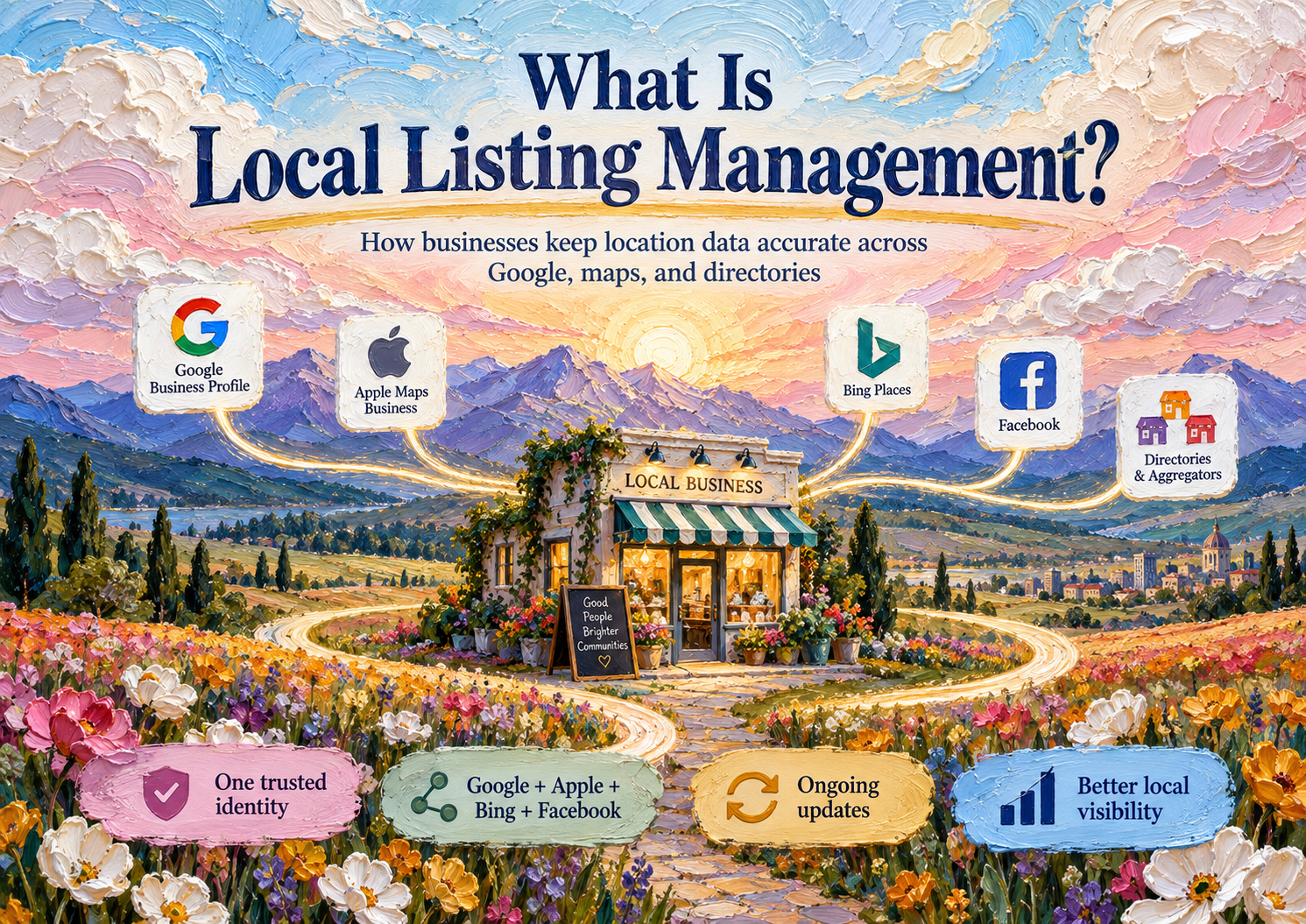
Local listing management is the practice of creating, updating, and maintaining business profiles on maps, search, social, and directory platforms so core details stay accurate. Teams claim missing profiles, correct errors, publish operational changes, and watch for unwanted public edits. The outcome is one consistent identity per location, not conflicting directory versions.
In the US, that work usually starts with Google Business Profile and extends to Apple Maps via Apple Business, Bing Places for Business, Facebook, and aggregator-fed directories. Hours, categories, attributes, photos, and website URLs need the same discipline as NAP. Google’s Business Profile Help states that businesses with complete and accurate information are more likely to show up in local search results, and that inaccurate info can keep a profile from appearing for relevant searches (Tips to improve your local ranking on Google, retrieved 10 September 2026).
Which profiles count as local listings in the US?
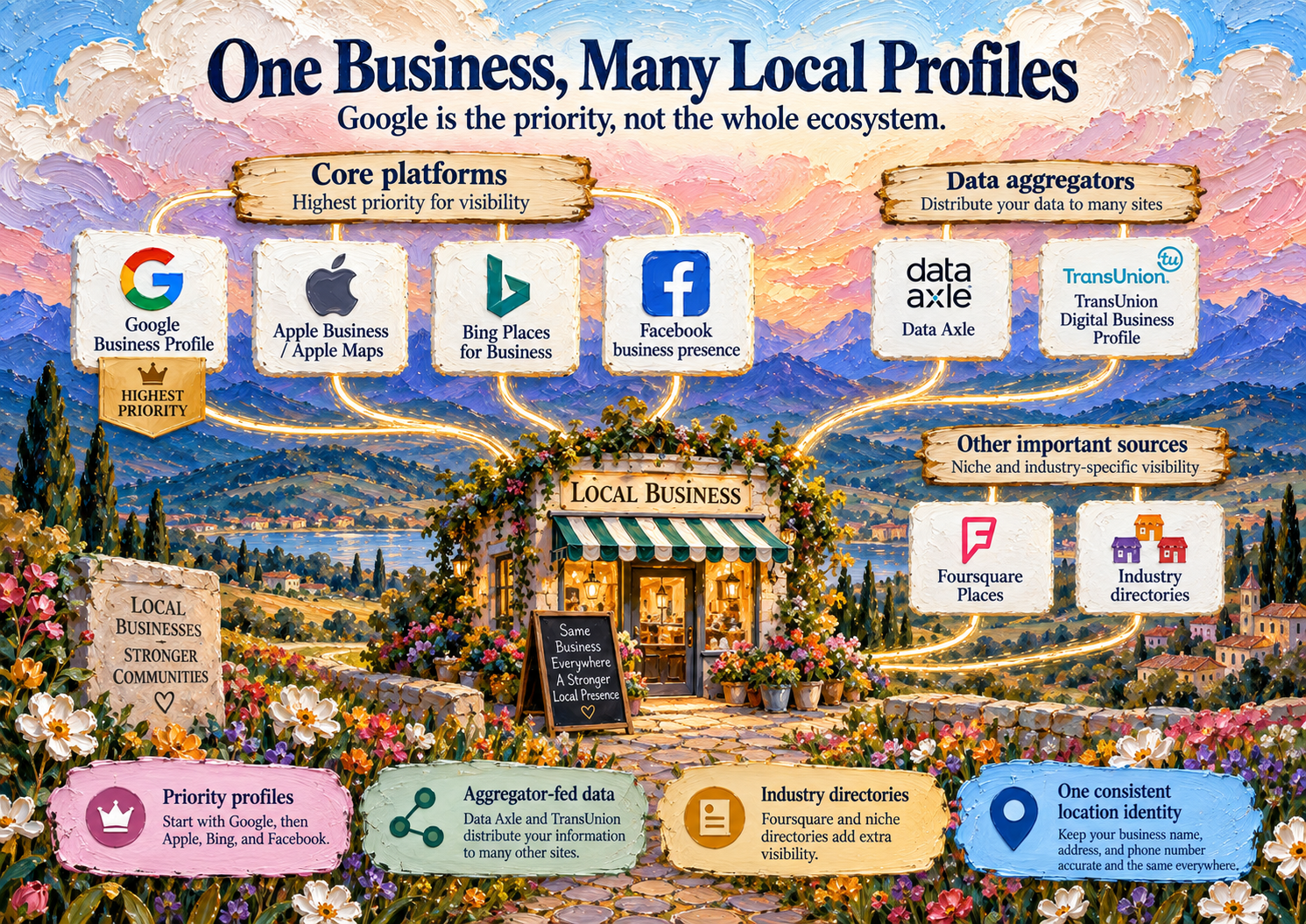
In the United States, the highest-priority local listings are usually Google Business Profile, Apple Business place cards on Apple Maps, Bing Places for Business, and the Facebook Page used as a local business surface. Major data aggregators also count, because they distribute NAP to many directories you rarely edit by hand. Use these current official names when you inventory profiles:
- Google Business Profile on Google Search and Maps
- Apple Business for brands and locations on Apple Maps (brand management tools previously available in Apple Business Connect now sit inside Apple Business, per Apple’s March 2026 announcement)
- Bing Places for Business on Bing Search and Bing Maps
- Facebook business presence (Meta business tools / Facebook Page)
- Major aggregators, commonly including Data Axle, Foursquare Places, and TransUnion Digital Business Profile (formerly Neustar Localeze), as summarized in BrightLocal’s aggregator overview
BrightLocal Learn groups Google Maps, Apple Maps, Bing, and Facebook as the four “powerhouses” for local consumer engagement (retrieved 10 September 2026). Moz Learn frames listing management across Google Business Profile, Facebook, Yelp, and other directories. Add industry directories when audits show they carry your NAP.
How does NAP accuracy work in practice?
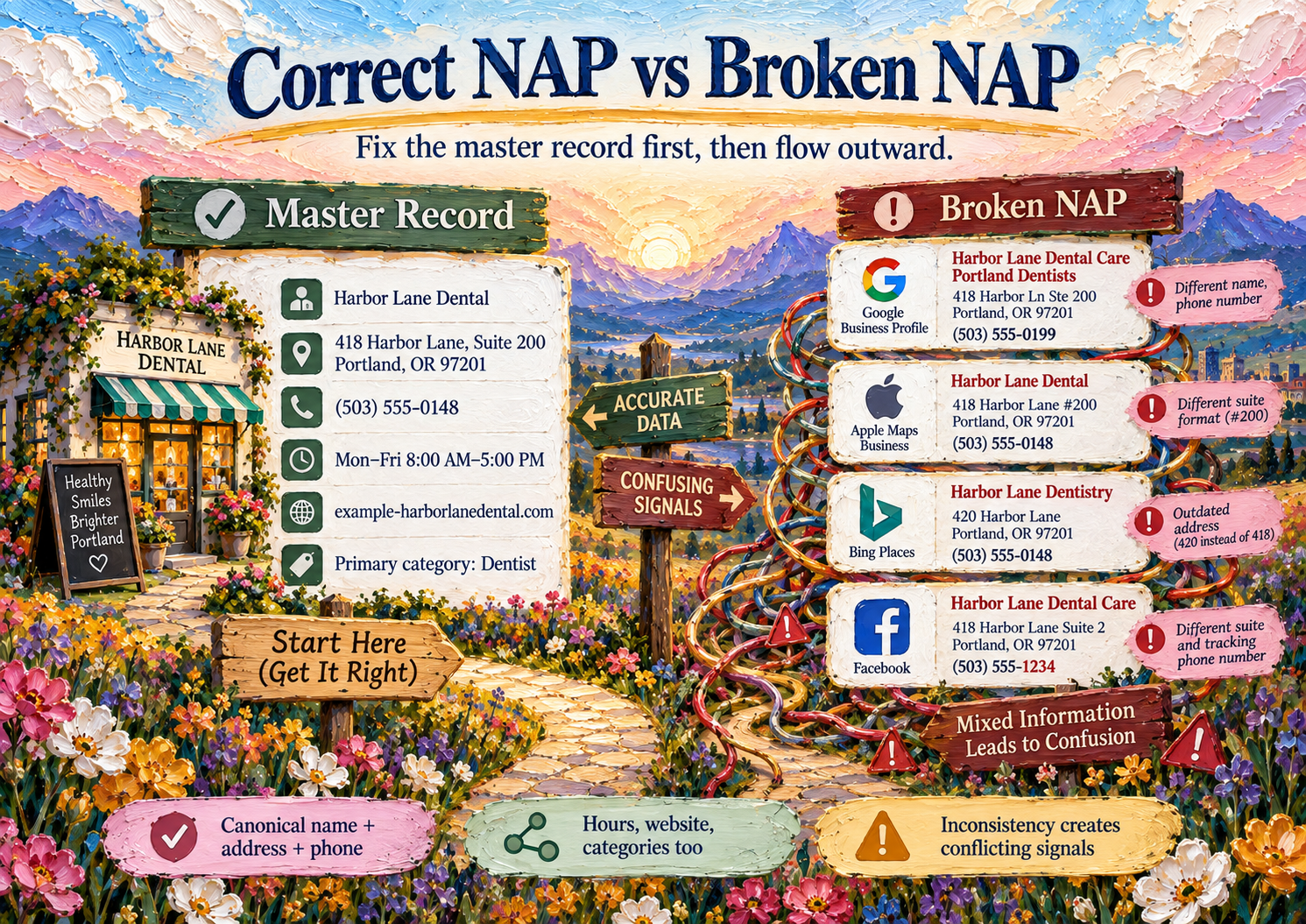
NAP accuracy means your business Name, Address, and Phone use one canonical format everywhere they appear. In practice you also lock hours, website, categories, and attributes to the same master record. Small formatting drift, such as Street versus St or mismatched suite labels, creates conflicting signals for customers and for systems that cross-check sources.
Google’s guidelines for representing your business ask businesses to represent themselves as they are consistently recognized in the real world, and to keep address or service-area details accurate and precise (retrieved 10 September 2026). BrightLocal Learn notes that exact consistency remains best practice even when engines can often parse common abbreviations.
Illustrative correct example (fictional business):
- Name: Harbor Lane Dental
- Address: 418 Harbor Lane, Suite 200, Portland, OR 97201
- Phone: (503) 555-0148
- Hours: Mon-Fri 8:00 AM-5:00 PM
- Website: https://example-harborlanedental.com
- Primary category: Dentist
Illustrative broken example for the same location:
- Google: Harbor Lane Dental | 418 Harbor Lane #200 | (503) 555-0148
- Apple Maps: Harborlane Dental LLC | 418 Harbor Ln Ste 200 | (503) 555-0199
- Bing: Harbor Lane Family Dentistry | 418 Harbour Lane, Suite 200 | (971) 555-0148
- Facebook: Harbor Lane Dental Portland Downtown | old suite after a move | tracking number that does not match the master phone
The broken set mixes a legal suffix, a keyword-stuffed name, street spelling variants, and two phone numbers. Fixing only Google while aggregator-fed directories stay wrong often lets bad data return, so management starts from one master NAP and flows outward. For audit steps, see How to Audit Business Listings.
What does a monthly local listing management workflow look like?
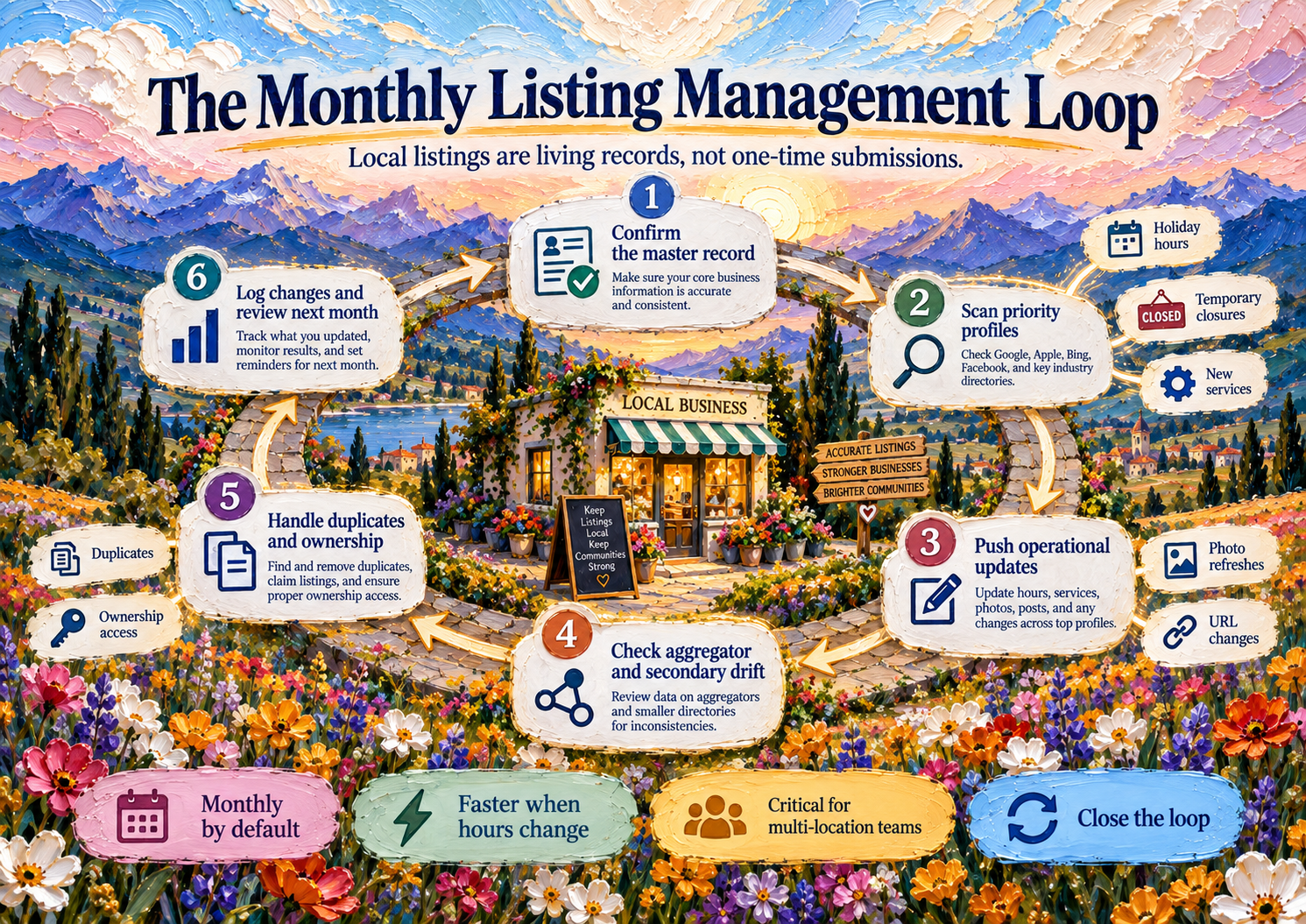
A practical monthly workflow is a repeating loop: confirm the master record, audit priority profiles, publish operational updates, check secondary drift, handle duplicates, and log what changed. Single-location shops can run a lighter version. Multi-location brands usually need owners, roles, and a change log.
- Confirm the master record. Lock public name format, address punctuation, primary phone, website URL, primary category, and attributes.
- Scan priority profiles. Compare Google Business Profile, Apple Business (Apple Maps), Bing Places for Business, and Facebook to the master.
- Push operational updates. Holiday hours, temporary closures, new services, photo refreshes, and URL changes belong on every priority surface, not only Google.
- Check aggregator and secondary drift. Search old phone numbers and former addresses. Spot-check aggregator-fed directories and high-traffic industry sites.
- Handle duplicates and ownership. Merge or request removal of extras. Confirm the right people still have access after staff changes.
- Close the loop. Log pending items and review calls, direction requests, and completeness the next month.
BrightLocal Learn recommends treating listings as living documents and auditing at least quarterly, with faster updates when hours, contact details, or services change (retrieved 10 September 2026). Monthly is a safer default when hours change often or you manage more than one location. Operators who need the longer playbook can use the Local Listings Management Guide.
When is software required instead of a spreadsheet?
Software becomes necessary when manual edits no longer keep pace with location count, change frequency, or publisher drift. A spreadsheet can store a master NAP for one or a few locations. It cannot reliably detect public edits, push one update across many publishers, or show network status without heavy staff time. Moz Learn notes that listings can be managed manually, but the work is time-consuming, and multi-location enterprises often need automation (retrieved 10 September 2026). Buyer demand also shows up for local listing management software and services, so software choice usually follows the definition rather than replacing it.
Consider software when you manage many locations or client accounts, change hours or phones often, see duplicates return after cleanup, need publisher status or role-based access, or cannot finish monthly audits without skipping secondary sites. Keep the spreadsheet as the source of truth. Use software as the distribution and monitoring layer.
Which local listing management tools do US teams compare?
US teams usually shortlist platforms that sync location data to major publishers, then differ on reviews, reporting, agency features, and pricing shape. Common peers in that comparison set include Yext, Uberall, BrightLocal, Moz Local, Semrush Local, and Synup. None of them replaces a clean master NAP. They distribute and monitor it.
Treat vendors as peers, not as a ranked “best of” on this definition page. A genuine operational limit on Synup is credit metering: when credits run out, agent-style automation can pause until you buy more, while core presence tasks that are not credit-metered keep running (per Synup’s public pricing FAQ, retrieved with the cost research on 10 September 2026). Yext and Uberall are often contact-sales. Moz Local (and Semrush Local) publish clearer self-serve cards for smaller footprints. BrightLocal is mixed: Citation Builder and Managed SEO show public dollars, while Track / Manage / Grow platform tiers are price on request.
For buyer-fit detail, use Local Listing Management Software Compared, Best Local Listing Management Software, and How Much Does Local Listings Management Cost in 2026?. For marketplace scanning, G2’s local listing management category and vendor Help pages remain useful secondary checks.
How is citation building different from ongoing listing management?
Citation building creates or claims mentions of your business NAP on directories and platforms. Ongoing listing management keeps those mentions accurate, complete, and aligned after the first publish. Building expands coverage. Management protects trust and prevents data drift over time. BrightLocal Learn draws the distinction clearly: citation building focuses on creating new citations to establish foundational presence, while listings management is ongoing and proactive. Citation building is one activity inside listings management (How to Manage Business Listings Properly, retrieved 10 September 2026).
| Activity | Primary question | Typical cadence |
|---|---|---|
| Citation building | Where should this location exist online? | Project-based or launch / expansion |
| Listing management | Is every existing profile still correct and owned? | Monthly / continuous |
| Aggregator cleanup | Which upstream feed is reintroducing bad NAP? | As drift appears, then monitor |
Skipping management after a citation build is a common failure mode. Directories get created once, then holiday hours, moves, rebrands, and public edits slowly break the set.
Why does local listing management matter for local SEO?
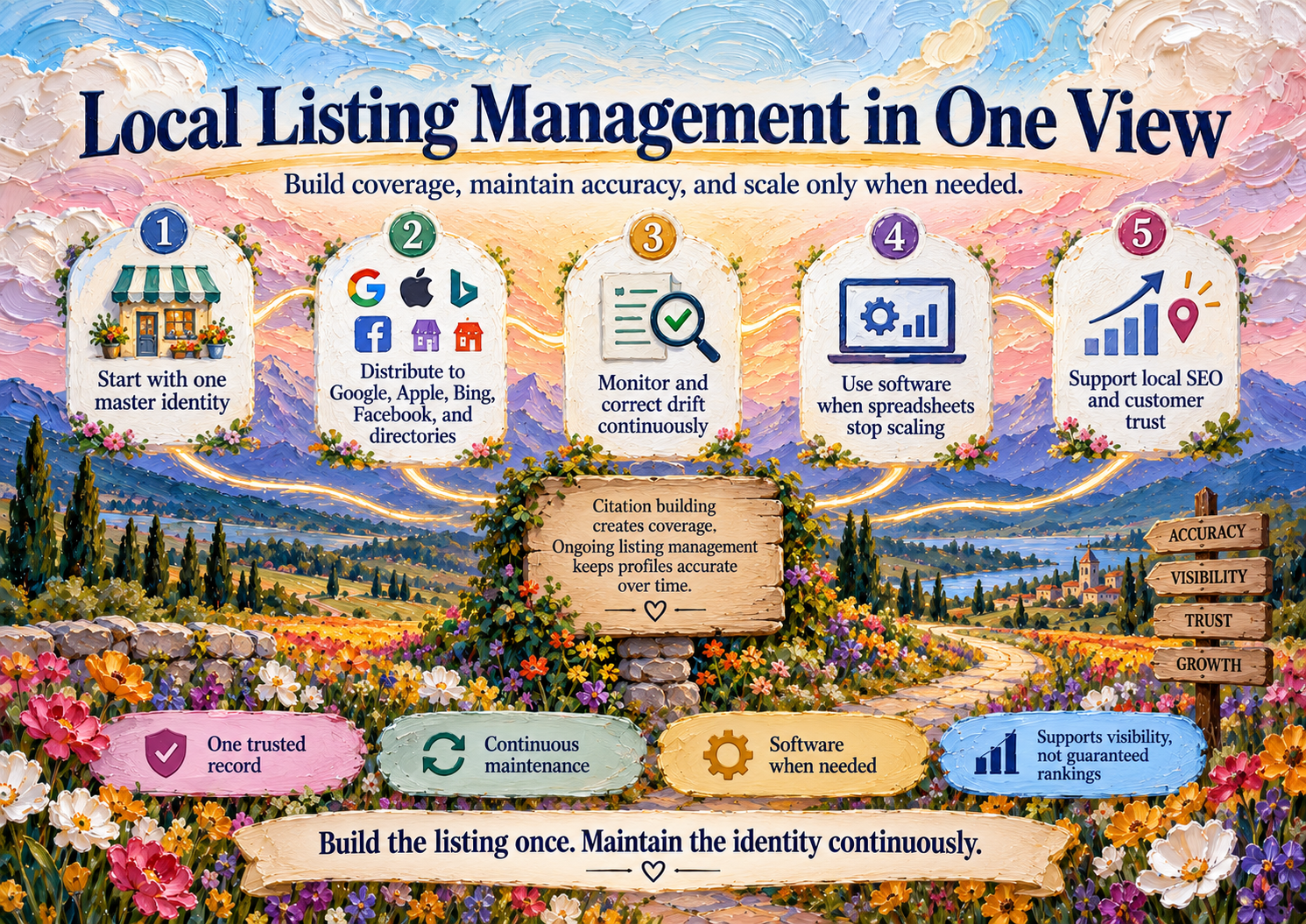
Local listing management supports local SEO by giving maps and search systems a consistent business identity to match against queries, distance, and prominence (popularity) signals. It also reduces customer friction from wrong hours, wrong phones, and wrong pins. Accurate listings do not replace reviews or a strong website, but weak listings undermine those efforts.
Google explains that local results are mainly based on relevance, distance, and prominence (Tips to improve your local ranking on Google, retrieved 10 September 2026). Help pages do not publish a guaranteed ranking lift for “perfect NAP,” so treat consistency as table stakes and measure outcomes with profile insights and audit diffs.
FAQ
Is Google Business Profile enough for local listing management?
No. Google Business Profile is usually the most important US local listing, but Apple Maps, Bing Places for Business, Facebook, aggregators, and category directories also matter. Managing only Google leaves conflicting NAP elsewhere. See also Google Business Profile vs business listings.
Does local listing management include reviews?
Often yes in practice. Core management covers identity fields (NAP, hours, categories, attributes). Many US workflows also monitor and respond to reviews on the same profiles.
How long do listing corrections take to appear everywhere?
It varies by publisher. Direct dashboards can update quickly after review. Aggregator-fed directories may take longer until upstream sources are corrected. Re-audit after material changes.
What should multi-location brands standardize first?
Canonical name format, address punctuation, phone policy per location, primary category rules, and an owner for each profile. Then distribute those standards through Google Business Profile, Apple Business, Bing Places for Business, Facebook, and aggregator submissions.
Is citation building still useful if we already have listing software?
Yes, when coverage gaps remain. Software maintains known listings; citation building still helps for missing industry sites, new markets, or cleanup. Build where needed, then manage continuously. Tools such as Synup, BrightLocal, Moz Local, Yext, Uberall, and Semrush Local can assist distribution, but they still need correct source data.
Can a service-area business skip address consistency?
Not entirely. Service-area businesses may hide a public storefront address on Google when guidelines allow, but phone, name, website, service area, and hours still need one consistent story.
Why is local listing management important?
Local listing management keeps the public location facts customers and local search systems use to find, trust, and visit a business. Without it, wrong hours, phones, and pins leak across Google, Apple Maps, Bing, Facebook, and aggregator-fed directories. It does not guarantee rankings, but it removes a common cause of missed calls and bad directions.
What is local listing management software?
Local listing management software is a platform that stores location data and helps distribute updates across supported publishers, then monitors drift and status. Spreadsheets can hold the master record; software becomes useful when location count or change frequency outruns manual logins. Synup, BrightLocal, Moz Local, Yext, Uberall, and Semrush Local are common peers in that category.