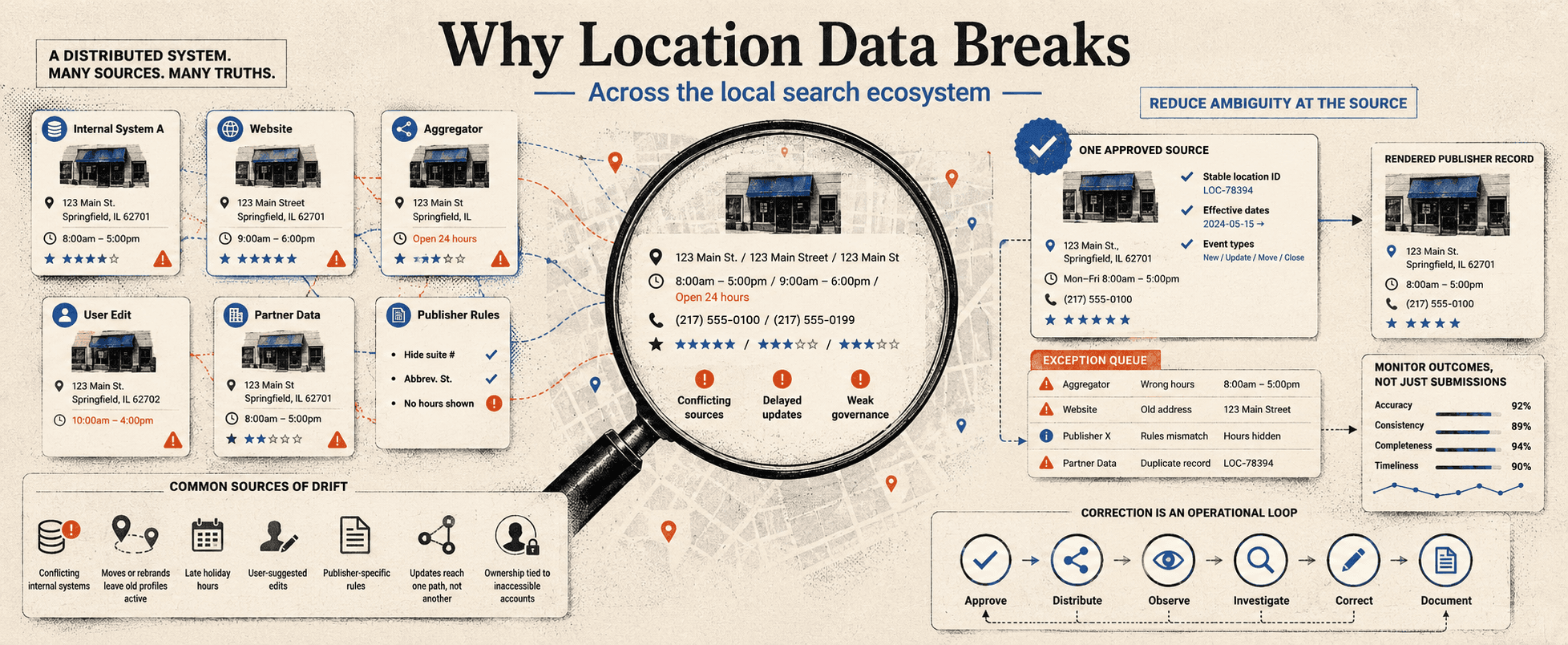
Location data breaks when multiple systems, teams, publishers and public edits compete to define the same business record. The fix is not submitting updates more often. Multi-location brands need one approved source, stable location IDs, field ownership, publisher monitoring and a verified correction loop.
Location data breaks across local search because no single database controls every public business record. Internal systems, business websites, listing platforms, aggregators, publishers and user edits can all provide competing evidence. The most reliable fix is to establish one approved source, assign ownership for every field, distribute changes with stable identifiers and verify the rendered result on each important publisher.
Key takeaways
- Location data is a distributed system. A correct internal record can still conflict with older or independently sourced public information.
- Submission is not verification. A successful API response only proves that a publisher received an update, not that every public field changed.
- Moves, rebrands and department profiles create the highest risk. They introduce new records while old entities may remain discoverable.
- Stable identifiers matter more than publisher counts. They help teams connect the same location across internal systems, feeds and platforms.
- The best operating model is continuous. Approve, distribute, observe, investigate, correct and document every material change.
Teams often use business listing management to describe the same discipline as local listings management.
Why does location data break across search platforms?
Location data breaks because different systems collect, interpret and refresh business information on different schedules. A brand may approve one phone number today while a publisher still trusts an older website crawl, a user suggestion or a third-party feed.
Google explains that Business Profiles must represent real-world locations accurately and applies separate rules to chains, departments and individual practitioners in its Business Profile representation guidelines. Those rules help publishers decide whether a record is eligible, but they do not eliminate conflicts between data sources.
A 100-location brand can easily manage more than 1,000 important field values when names, addresses, phone numbers, categories, hours, URLs and department relationships are counted separately. One uncoordinated change can therefore create dozens of exceptions rather than one obvious error.
Where does location-data drift begin?
Most drift begins before information reaches Google, Apple, Bing or a directory. It starts when the business itself has multiple versions of the truth.
| Failure layer | Typical problem | What customers may see | Best control |
|---|---|---|---|
| Internal systems | CRM, store database and website disagree | Different phone numbers or hours | One approved publishing source |
| Distribution | An update reaches only one feed or account | Correct data on one platform, old data elsewhere | Logged distribution and retry rules |
| Publisher processing | A field is transformed, rejected or delayed | Partial or reverted updates | Publisher-level monitoring |
| Public contributions | Users suggest edits or create duplicates | Wrong hours, categories or map pins | Alerts and duplicate review |
| Organisational change | Move, closure, merger or rebrand is mishandled | Old and new profiles appear together | Event-specific playbooks |
Conflicting internal sources
A location may be represented in a CRM, point-of-sale system, website CMS, support database, analytics platform and listings tool. If those systems do not agree, a publisher receives inconsistent evidence.
The practical question is not “Which record changed most recently?” It is “Which system is authorised to publish this field?” The answer can differ by field. Facilities may own addresses, operations may own hours and marketing may own categories and descriptions.
Moves, closures and rebrands
A routine opening changes from one record to another. A move or rebrand is harder because the old entity may retain reviews, links, citations and user activity.
A single relocation can create at least 3 competing records: the approved new location, the outdated profile and a duplicate generated from a fresh data source. Closing the wrong record can remove visibility or separate the business from its review history.
Public edits and publisher inference
Publishers do not rely only on owner submissions. They may evaluate user suggestions, websites, imagery, government records and other signals.
That is useful when a business neglects its profile, but it also means an approved value can be challenged by stronger or more recent external evidence. Teams should monitor the live result rather than assuming ownership prevents every change.
Publisher-specific rules
The same field is not always accepted in the same format everywhere. Category taxonomies differ. Address formatting changes. Department profiles may require distinct names and customer-facing entrances. Tracking parameters or phone routing can trigger validation rules.
A rejected field is not necessarily a broken integration. It may be incompatible with the destination’s eligibility or formatting requirements.
How do location updates propagate?
Location updates move through a chain of systems, and every handoff can introduce delay or ambiguity.
A simplified flow is:
- A team approves the change.
- The source system assigns it to a stable location ID.
- A listings platform or direct integration sends the update.
- The publisher validates the field against its policies and other evidence.
- The public record changes, remains pending, is transformed or reverts.
- Monitoring detects the actual outcome.
For automotive inventory and other location-linked feeds, identifiers are particularly important. Google’s vehicle advertiser integration guidance explains that a vehicle is associated with a dealership through a store code that matches dealership location data. If the identifier relationship breaks, correct inventory data can still connect to the wrong or invalid location.
A dashboard showing “submitted” only covers step 3. A reliable program verifies steps 5 and 6.
How can a team diagnose a broken listing?
Start with the public symptom, then trace the field backward through every system that supplied it.
Use this sequence:
- Capture the incorrect public value, URL, publisher and timestamp.
- Confirm the approved value and the team that owns it.
- Check the stable location ID and any department or parent relationship.
- Review recent changes, distribution logs and publisher responses.
- Compare the website, structured data and other strong public sources.
- Look for duplicates, moved profiles and unauthorised accounts.
- Correct the source, resubmit only where necessary and verify the rendered result.
- Record the cause and resolution so the same failure becomes a playbook.
For a 50-location business, reviewing the 5 highest-impact fields across 4 major publishers already produces 1,000 field-and-publisher combinations. Teams need exception-based monitoring rather than manually reopening every profile.
What governance prevents repeat failures?
Good governance defines who can change each field, how changes are approved and what evidence proves completion.
A practical location record should include:
- A permanent internal location ID
- Parent, brand and department relationships
- Approved name, address, phone, category, hours and URL
- Field owner and approver
- Effective date and change reason
- Opening, move, closure or rebrand event type
- Distribution status by publisher
- Live verification status
- Exception history and supporting evidence
Review high-risk fields daily or weekly, depending on business impact. Audit the complete portfolio quarterly and before seasonal campaigns, large migrations or ownership changes. Temporary hours should have both a start date and an expiry date.
The operating loop is straightforward: approve, distribute, observe, investigate, correct and document. Teams that preserve resolution history become faster because recurring failures stop being new mysteries.
Does inaccurate location data affect AI search?
Yes. AI discovery systems depend on the same underlying web, map, business-profile and entity signals that support traditional local search. Conflicting names, addresses, categories or status information make it harder to identify a business confidently.
Clean listings alone do not guarantee an AI citation. However, consistent entity information reduces ambiguity. A strong website should reinforce the same business facts through location pages, organisation details, structured data and clear editorial content.
For multi-location brands, the goal is not identical wording everywhere. The goal is a consistent entity: the same location, status, contact details and relationships expressed in formats each platform can understand.
A 30-day correction plan
Days 1-7: establish the approved record
Choose the source of truth, assign field owners and export every active, moved, closed and planned location. Flag missing IDs and conflicting core fields.
Days 8-14: map publishers and accounts
Document which accounts, integrations and partners can publish data. Recover access, connect records by stable ID and identify duplicates or unauthorised profiles.
Days 15-21: correct high-impact exceptions
Prioritise wrong status, address, phone, primary category, hours and map pin issues. Use dedicated move, closure and rebrand workflows instead of bulk overwrites.
Days 22-30: verify and operationalise
Check the rendered result, create an exception queue and record each root cause. Set daily alerts for critical changes, weekly exception reviews and quarterly portfolio audits.
Related reading
- Run a complete business listings audit
- Build a multi-location listings governance model
- Read the practical local listings management guide
- Compare local listing management software
Frequently asked questions
What is location-data drift?
Location-data drift is the gradual difference between a business’s approved record and the information displayed across search engines, maps, directories and AI discovery systems. It usually results from conflicting sources, delayed updates, public edits or unmanaged organisational changes.
Why do corrected listings sometimes revert?
A corrected listing can revert when another trusted source continues publishing the old value, a user submits a competing edit or the publisher’s validation system prefers different evidence. Correct the upstream source and monitor the live record after resubmission.
How often should multi-location listings be audited?
Critical exceptions should be monitored continuously, high-impact fields should be reviewed weekly and the full portfolio should be audited at least quarterly. Moves, rebrands, migrations and holiday periods require additional checks.
Is a listings platform enough to prevent inaccurate data?
No. A platform can distribute and monitor information, but it cannot resolve unclear ownership, conflicting internal systems or poor change processes by itself. Technology works best when paired with stable identifiers, field-level governance and documented correction playbooks.