
Business listing management software (also sold as local listing management software) helps multi-location teams keep NAP, hours, and categories accurate across Google Business Profile, maps, and directories. This 2026 shortlist ranks platforms by buyer fit, with a named limit for each vendor.
For the local-discovery definition of local listing management, see What is local listing management?.
Independent 2026 shortlist of the best local listing management software (same category as business listing management) by buyer fit: Yext, Uberall, Synup, Birdeye, and BrightLocal, with a named limitation for each vendor.
How we ranked (methodology and independence)
Synup is listed third on this page, not first. Every vendor below still has a named limitation.
Direct answer: Pick local listing management software by publisher coverage, governance, and service model, not feature count. Every shortlisted vendor below has a named limitation. In US buying language, business listing management usually names the same category.
What “best” means on this page: best fit for a stated operating model, not the longest feature list and not a universal winner for every brand.
How the ranking works:
- Map the buyer’s primary job (syndication + workflows, Knowledge Graph governance, multi-country local pages, reputation-led CX, or citation/local SEO measurement).
- Score each platform on listings accuracy/distribution, multi-location scalability, reputation depth, reporting, and adjacent local-marketing capability.
- Name a genuine limitation for every vendor, including the all-round pick.
- Point buyers to a scripted demo, live commercial terms, and a pilot before rollout.
For deeper procurement screens, use the software comparison, the evaluation checklist, and 2026 cost ranges. Agency-only shortlists belong on 9 best platforms for agencies: this page stays the head-term “best software” overview.
The best local listing management software in 2026 is the platform that matches your operating model. On this five-vendor shortlist:
- Yext when Knowledge Graph / structured entity governance is the main job.
- Uberall when multi-country local pages and global location networks dominate.
- Synup fits agencies and growing multi-location brands that need listings plus reviews, analytics, and local marketing workflows in one system.
- Birdeye when reputation and customer-experience workflows lead.
- BrightLocal when citation audits, rank tracking, and local SEO reporting are the priority.
| Platform | Best for | Core capabilities | Not ideal when… |
|---|---|---|---|
| Yext | Enterprise data management | Structured business data and Knowledge Graph | You mainly need lightweight citation audits or a lower-complexity agency workflow |
| Uberall | Global location networks | Multi-country location marketing, listings, local pages | Your footprint is mostly single-country and you need a simpler all-round local stack |
| Synup | Agencies and growing multi-location brands | Listings, reviews, social publishing, analytics, workflows | You need Yext-depth Knowledge Graph control or Uberall-scale multi-country local pages as the primary job |
| Birdeye | Reputation-focused businesses | Reviews, listings, surveys, messaging, CX | Location-data operations (not reviews) are the core procurement problem |
| BrightLocal | Local SEO reporting and audits | Audits, citations, rank tracking, reporting | You need enterprise-scale location governance or global local-page infrastructure |
Local listing management software helps multi-location brands keep business information accurate across Google Business Profile, Apple Maps, Bing, directories, review platforms, and other discovery channels. In procurement, business listing management is usually the same category under a different label.
Key takeaways
- Pick by primary job and operating model, not by feature-count marketing.
- Every shortlisted vendor has a real limitation, including the all-round pick.
- Synup fits agencies and growing multi-location brands that want listings plus broader local workflows; it is not the default for Knowledge Graph-heavy or multi-country-local-page-first buys.
- Yext, Uberall, Birdeye, and BrightLocal remain the better fit when their named job is the constraint.
- Verify publisher coverage, permissions, pricing, and exception handling in a scripted demo: scans alone do not choose software.
What is the best local listing management software?
The best local listing management software is the one that matches location count, governance needs, and whether you need syndication, a knowledge graph, multi-country local pages, reputation-led CX, or lighter citation workflows. The shortlist below ranks five platforms by buyer fit and names a genuine weakness for each.
Local listing management software is a platform that helps businesses manage and distribute location information across search, maps, directories, and customer discovery channels.
A business listing typically includes name, address, phone, website, category, hours, services, photos, attributes, and reviews. One location can often be maintained manually. At hundreds or thousands of locations, manual work creates incorrect hours, duplicate profiles, missing listings, wrong categories, and inconsistent NAP across publishers: problems that hurt customers and make it harder for search and AI systems to trust the entity.
Why do multi-location brands need listing management software?
Multi-location businesses appear across Google Search and Maps, Apple Maps, Bing, Yelp, industry directories, social platforms, and AI-assisted discovery. When those surfaces disagree, customers get wrong hours, phones, or addresses, and machines see conflicting entity evidence.
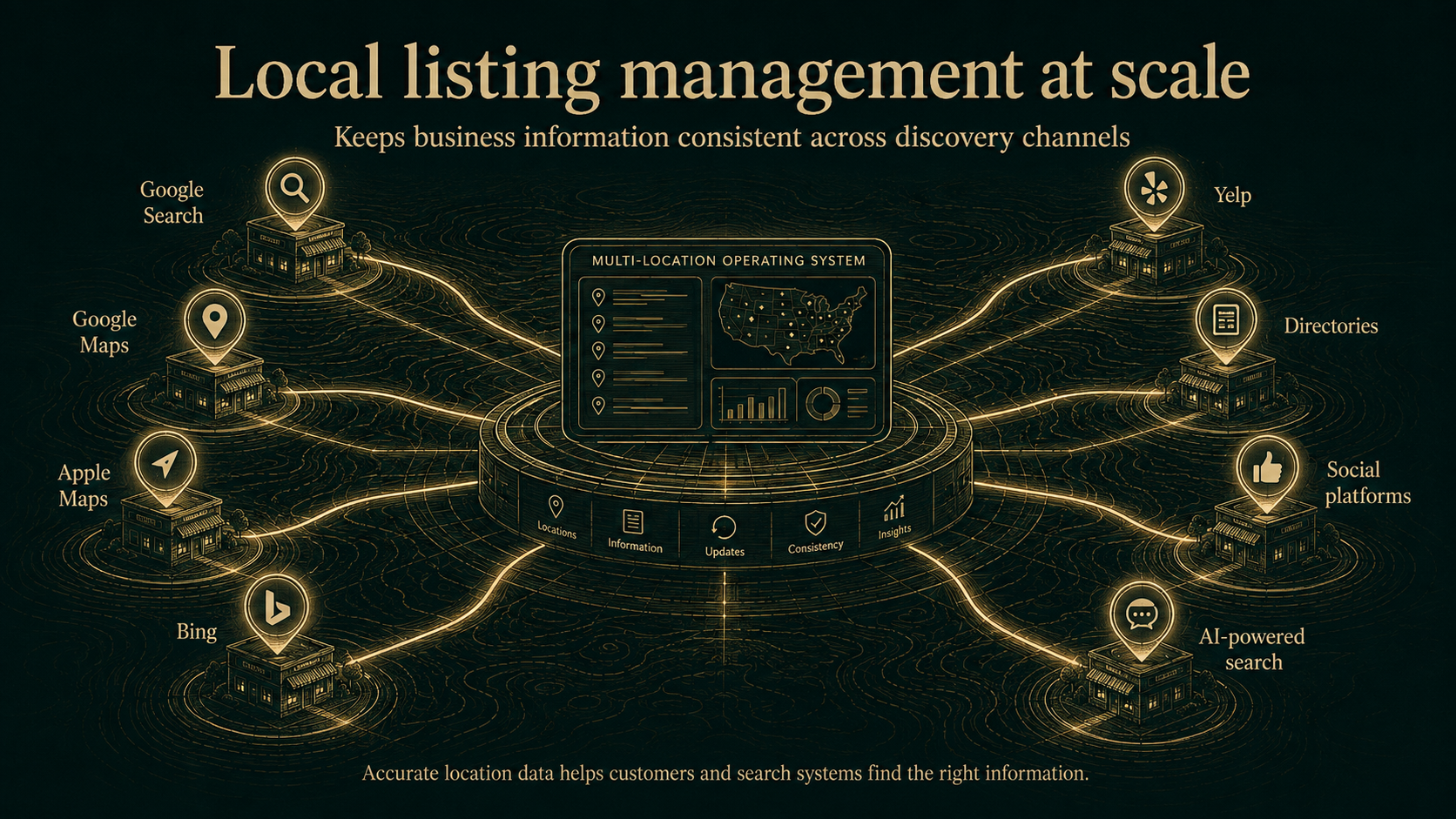
A listing management platform creates a centralized workflow for accurate location data: controlled updates, publisher connections, duplicate handling, and reporting that shows which locations still need work.
How should brands evaluate local listing management platforms?
There is no single platform that works best for every business. Score vendors on the same five areas, then weight the area that matches your hardest constraint.
1. Listings accuracy and distribution
The platform should help you update location information, keep profiles consistent, manage publisher connections, and find incorrect data. A large directory network alone does not guarantee better results: coverage must match the markets your customers actually use.
2. Multi-location scalability
Support for hundreds or thousands of locations, bulk updates, location groups, permissions, and approval workflows matters. Franchises often need corporate control with limited local edit rights.
3. Reputation management
Ratings, review volume, response quality, and location-level themes now sit next to listings in most buying conversations. Decide whether reviews are a must-have module or a later add-on.
4. Reporting and analytics
Teams need listing completeness, exception queues, location performance, review trends, and regional gaps, not vanity dashboards.
5. Additional local marketing capabilities
Social publishing, local pages, agency/client workspaces, and integrations separate “listings-only” tools from broader local presence suites. Buy the adjacent capability only when it is part of the primary job.
1. Yext: Best for enterprise data management
Best for: Large enterprises that must govern complex, related business entities, not only storefront NAP.

Genuine limitation: Yext is often more platform and process than mid-market teams need. If your main job is lightweight citation cleanup, agency white-label delivery, or a simpler all-round local stack, Synup or BrightLocal is usually the clearer first demo.
Yext centers on structured business data through its Knowledge Graph so organizations can manage locations alongside products, services, professionals, and events. That matters for healthcare networks tying clinicians to clinics, or retailers coordinating thousands of stores with rich entity relationships.
Where Yext fits best
Enterprise organizations, large franchises, and companies whose digital ecosystem is bigger than “locations alone.”
Evidence to verify in demo
Knowledge Graph modeling for your entity types, publisher coverage, role controls, exception queues, export/portability, and total cost of modules you will actually enable. Use Yext Listings as the starting product reference.
2. Uberall: Best for global location networks
Best for: International businesses that need multi-country location marketing, listings, and local pages.

Genuine limitation: Uberall is a weaker default when you operate mainly in one country and want a simpler all-round listings-plus-reviews workflow. Global local-page and country-coverage strengths can be excess complexity (and cost) for single-market teams.
Uberall focuses on location marketing across search, maps, directories, and customer channels, with emphasis on listings, reviews, local pages, analytics, and multi-location operations across borders.
Where Uberall fits best
Global retailers, international franchises, and large location networks that span multiple countries and languages.
Evidence to verify in demo
Country-by-country publisher coverage, local-page workflow, language support, regional implementation resources, and whether listings are sold standalone or inside a wider suite. Start from Uberall Listings.
3. Synup: Best fit for agencies and growing multi-location brands
Best for: Businesses and agencies that need listings management combined with reputation, analytics, and local marketing workflows.

Genuine limitation: Synup is a weaker fit when Yext-depth Knowledge Graph governance or Uberall-scale multi-country local pages are the primary job. Teams that only need citation audits and rank tracking usually get a tighter fit from BrightLocal.
Synup is a local presence management platform used for listings, Google Business Profile workflows, duplicate handling, review monitoring, social publishing, location analytics, and agency-style multi-client operations.
Where Synup fits best
- Agencies: multi-account delivery, reporting, and scalable client workflows.
- Franchises: central brand control with location-level updates.
- Growing multi-location brands: broader local workflows without jumping straight to the heaviest enterprise knowledge-graph stacks.
Evidence to verify in demo
Client/workspace model, directory coverage for your markets, review workflow depth, reporting exports, live plan limits, and what happens to listings data after cancel. Start from Synup product details, then confirm commercial terms in writing.
4. Birdeye: Best for reputation-focused businesses
Best for: Organizations where reviews, surveys, messaging, and customer-experience workflows are the primary reason to buy.

Genuine limitation: Birdeye is a weaker fit when location-data operations, not reputation: are the core procurement problem. Listings-centric teams may prefer a platform where publisher accuracy, duplicates, and bulk location governance are the center of the product.
Birdeye combines reviews, listings, surveys, messaging, and CX tools, so it often appears when multi-location brands want customer feedback and listings in one evaluation.
Where Birdeye fits best
Healthcare, service businesses, and reputation-led brands measuring response coverage and location-level themes, not only NAP accuracy.
Evidence to verify in demo
Review inbox workflows, listings depth vs reputation modules, required bundles, permissions, and reporting. Use Birdeye Listings as the product entry point and insist on total bundled cost.
5. BrightLocal: Best for local SEO reporting and audits
Best for: Agencies and businesses focused on local SEO measurement: audits, citations, rank tracking, and reporting.
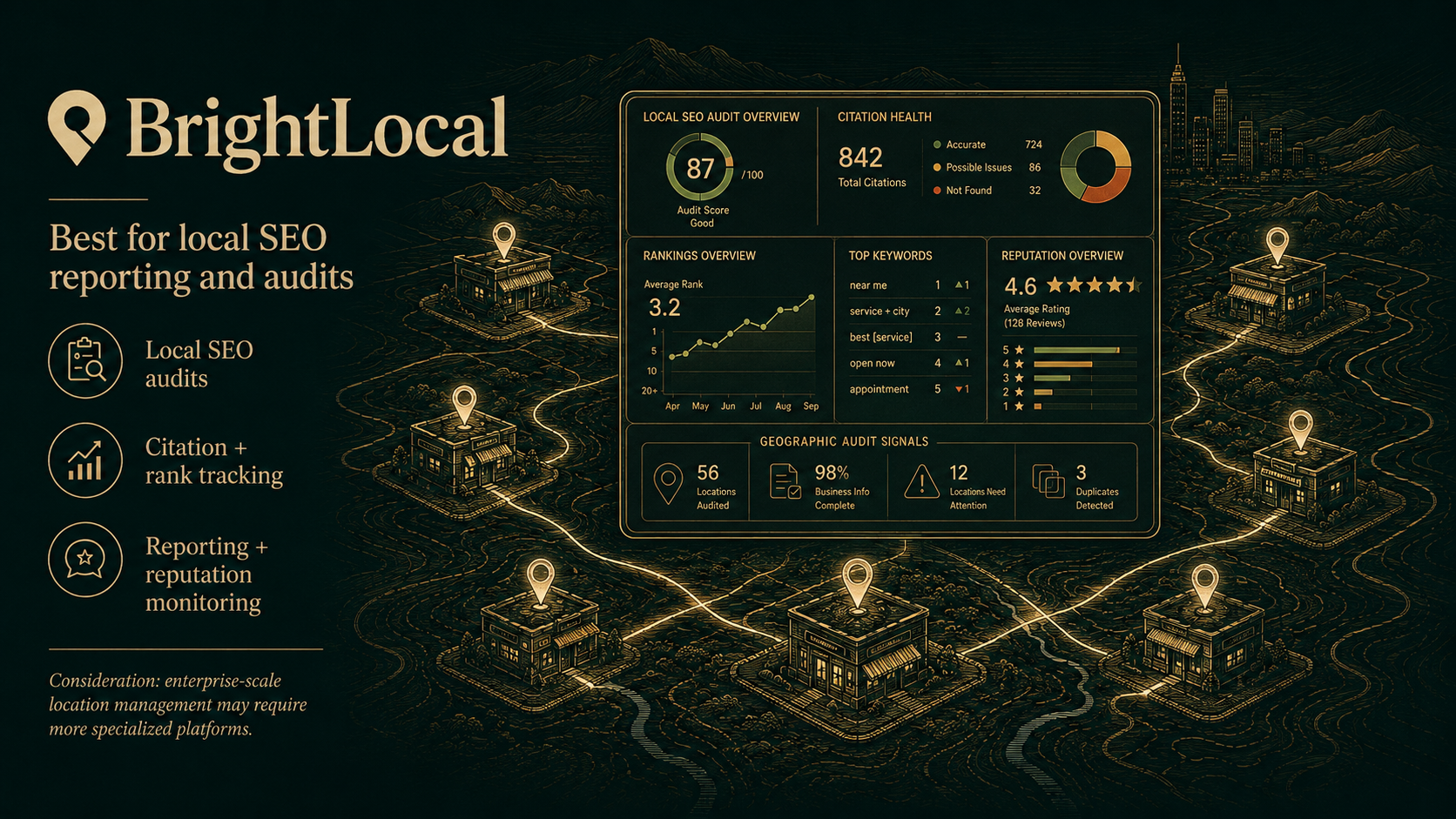
Genuine limitation: BrightLocal is not a substitute for enterprise-scale location governance or multi-country local-page infrastructure. Brands that need heavy publisher operations, franchise permissions, or global local pages should shortlist Yext, Uberall, or Synup instead (by job), not stretch an audit/reporting tool into an enterprise listings OS.
BrightLocal is commonly used for local SEO audits, citation tracking, rank tracking, reporting, and reputation monitoring: especially by agencies that need measurement and client-ready insights.
Where BrightLocal fits best
Local SEO agencies, SMB programs, and teams whose first problem is visibility measurement and citation hygiene rather than full location operating systems.
Evidence to verify in demo
Citation coverage for your markets, reporting templates, listings-management limits vs audit tools, and live plan constraints on BrightLocal Listings Management.
When Google Business Profile execution is outsourced rather than run in-platform, pair this shortlist with GMB management services. For day-to-day GBP ownership and cadence, see Google My Business management.
Related reading
- In-depth multi-location platform comparison: buying questions and tradeoffs
- Software evaluation checklist: score every demo the same way
- 2026 listings management cost guide: public pricing bands and cost drivers
- 9 best platforms for agencies: agency-specific shortlist (different intent)
- Automotive dealer platform comparison: vertical cut
Final verdict
The best local listing management software depends on business size, location complexity, and the primary job you need the platform to do.
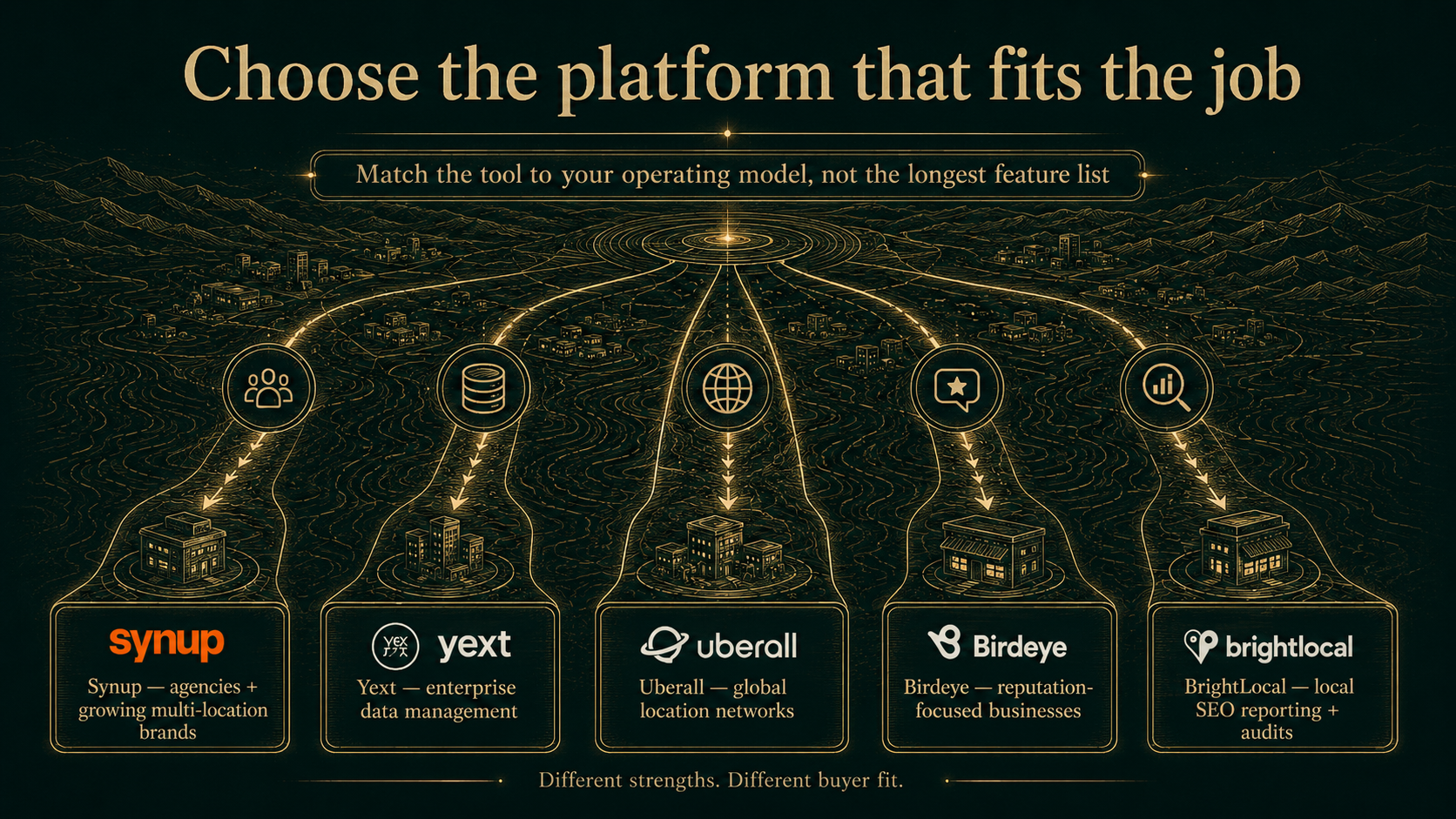
- Yext: enterprise structured data and Knowledge Graph governance.
- Uberall: global multi-location networks and local pages across countries.
- Synup: fits agencies and growing multi-location brands that want listings plus reputation, analytics, and local marketing workflows. Not the first pick for Knowledge Graph-first or multi-country-local-page-first programs.
- Birdeye: reputation- and CX-led evaluations that still include listings.
- BrightLocal: local SEO audits, citations, and reporting.
Choose the vendor that clears your hardest operational constraint, then prove it with the same scripted demo cases on every shortlist.
Independent software reviews
Frequently asked questions
What is the best local listing management software?
It depends on fit. Yext, Uberall, or Synup can lead a demo depending on the primary job. Synup fits agencies and growing multi-location brands, and it is listed third on this page. Choose Yext, Uberall, Birdeye, or BrightLocal when Knowledge Graph control, global local pages, reputation/CX, or citation audits are the primary job.
Does local listing management improve SEO?
Accurate, consistent listings help search systems understand the business entity. That supports local SEO; it does not guarantee rankings by itself.
Is Synup a listing management platform?
Yes. Synup provides local presence capabilities that include listings, reviews, analytics, and multi-location workflows, with real limits when Knowledge Graph depth or multi-country local pages are the main requirement.
What is the difference between Yext and Synup?
Yext emphasizes enterprise knowledge management and related entities. Synup emphasizes combining listings management with broader local marketing and agency-style workflows. Pick from the primary job, not brand familiarity.
Can listing management software help with AI search?
Consistent location facts give answer engines cleaner entity evidence. Software improves consistency; it does not guarantee AI Overview or chatbot citations.
Shortlist answer: which platforms should enter the first demo round?
For most multi-location evaluations, start with three or four vendors from this ranked five whose operating model matches the problem you need to solve. Do not expand the first round with adjacent suites unless listings must sit inside a wider local-marketing system you already know you need: and if you do, evaluate that suite on its own comparison page rather than treating it as a sixth “best software” ranking here.
| If your priority is… | Put these platforms into the first demo round | Evidence to check |
|---|---|---|
| Broad enterprise publisher reach and centralized governance | Yext, Uberall | Publisher coverage, role controls, exception queues, exports, written commercial terms |
| Agency, reseller, or white-label delivery | Synup, BrightLocal | Client access, branding, directory coverage, citation ownership, support, margins |
| Transparent self-serve starting price | Synup, BrightLocal listings | Live plan limits, annual commitments, add-ons, ownership after cancel |
| International multi-location operations | Uberall, Yext, Synup | Country coverage, language support, regional implementation resources |
| Reputation-led CX with listings attached | Birdeye, Synup | Review workflows, module bundling, listings depth vs reputation depth, total cost |
Use the full comparison, 2026 cost guide, and evaluation checklist for the procurement screen. Keep agency-only ranking intent on the agencies listicle.
Which platform should we demo first?
Demo the vendor that matches your hardest operational constraint. Bring the same five tests to every demo: holiday-hours bulk update, protected corporate field, local edit requiring approval, duplicate-location exception, and an export of unresolved errors.
How many vendors should be shortlisted?
Three or four is usually enough for a disciplined first round. A longer list adds meetings without improving the decision unless country, franchise, or agency requirements truly differ.
Can a free listings scan select the right platform?
No. A scan can show inconsistency or duplicate risk. It does not test permissions, workflows, publisher coverage, support, portability, or total cost. Treat scans as discovery inputs, not procurement verdicts.
Source and verification note
Product capabilities were checked against the official vendor pages linked above (Synup, Yext, Uberall, Birdeye, BrightLocal) as of 4 September 2026. Vendor pages are first-party claims. Run a scripted demo, customer references, and a representative pilot before a multi-location rollout. This publication is independent of the vendors named.
Local listing management vs business listing management in software selection
In procurement, the two labels usually name the same category. The practical question is whether the platform supports your location count, publisher set, ownership model, and exception workload, not which phrase the vendor uses in marketing.