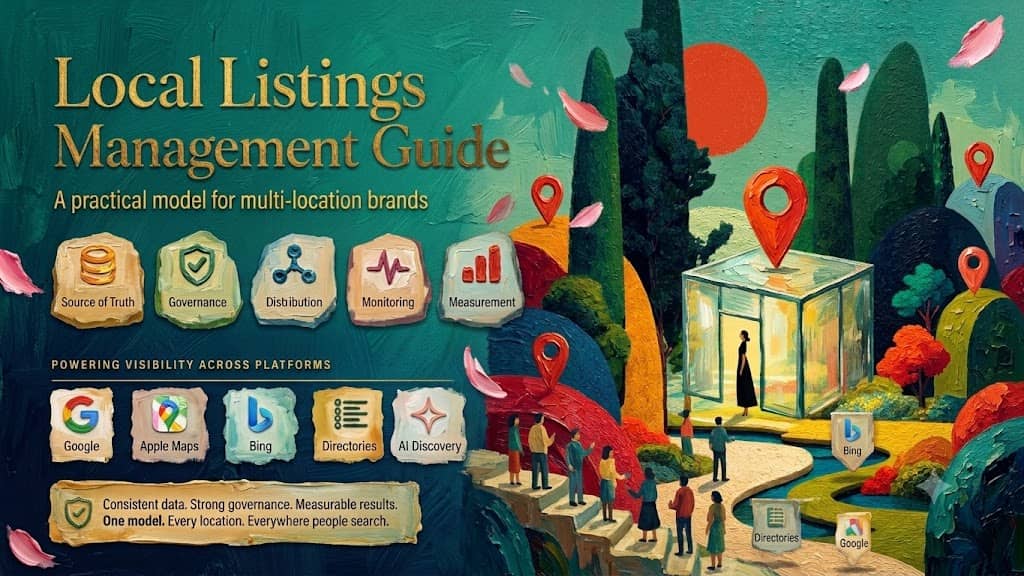
Local listings management is the ongoing process of creating, updating, and keeping location data accurate across search engines, directories, maps, and review platforms. It is the same discipline as business listing management for US multi-location brands.
Business listing management keeps NAP and profile data accurate across search, maps, and directories. It includes Google Business Profile management and connects to Google My Business management workflows and GMB management services when teams need ongoing GBP execution.
For a concise definition companion (the head-term hub), read What is business listing management?. For the local-search framing of the same work, see What is local listing management?.
Business listing management, local listings management, and local listing management name the same operating discipline. The labels differ; the work does not.
Why business listing management matters
- Local SEO: Consistent NAP and profile data help search engines trust each location and support map-pack and organic visibility.
- Customer trust: Accurate hours, phones, addresses, and status prevent failed visits, missed calls, and duplicate pins.
- AI search readiness: Reliable listings give AI Overviews and answer tools clearer entity evidence to cite about your locations.
How business listing management works
- Master record: One approved source of truth per location, with stable internal IDs.
- Distribution: Push updates to priority publishers, starting with Google Business Profile, then Apple, Bing, major directories, and vertical sites.
- Duplicate cleanup: Suppress or merge conflicting profiles that split reviews and confuse maps.
- Monitoring: Track live fields, failed updates, suspensions, and unauthorized edits, not only dashboard "synced" status.
- Governance and reporting: Field-level ownership, approval rules, and location-level accuracy metrics.
Google-specific execution often sits inside this program: see Google My Business management for day-to-day GBP workflows, and GMB management services when you need managed delivery. For related guides and comparisons, start from the listings management topic hub.
Key takeaways
- Treat location data as operational infrastructure. Names, addresses, phone numbers, hours, categories, URLs and status information affect discovery and customer experience.
- Use one approved source of truth. Every public field needs a defined owner, approver and effective date.
- Prioritize publishers by customer journey. Google, Apple, Bing, navigation services and relevant vertical directories usually matter more than raw directory count.
- Verify live outcomes, not submissions. A successful sync does not prove that a customer sees the correct value.
- Manage exceptions continuously. Moves, closures, duplicates, rebrands and unauthorized edits require dedicated playbooks.
What is business listing management?
Business listing management is the ongoing practice of keeping each location's public business data accurate across search engines, maps, directories, and review platforms. It is the same discipline as local listings management (and local listing management). Teams maintain NAP, hours, and categories, manage Google Business Profile (formerly GMB), then distribute, monitor, and verify the live result.
The public record normally includes the business name, address, phone number, opening hours, categories, services, website, local landing page, attributes, photos and operational status. Multi-location brands also need parent-child relationships, department profiles, store codes, location groups and historical states.
The work is broader than updating Google Business Profile. A customer may discover a branch in Apple Maps, Bing, a vertical directory, a vehicle navigation system or an AI-generated answer. Each destination applies its own policies, refresh schedules and evidence rules.
A 100-location brand managing 10 core fields across 5 major publishers is responsible for at least 5,000 field-and-publisher combinations. That scale makes spreadsheets and occasional manual checks unreliable unless the team uses stable identifiers and exception-based monitoring.
Local listings management (same as business listing management)
Are business listing management and local listing management the same?
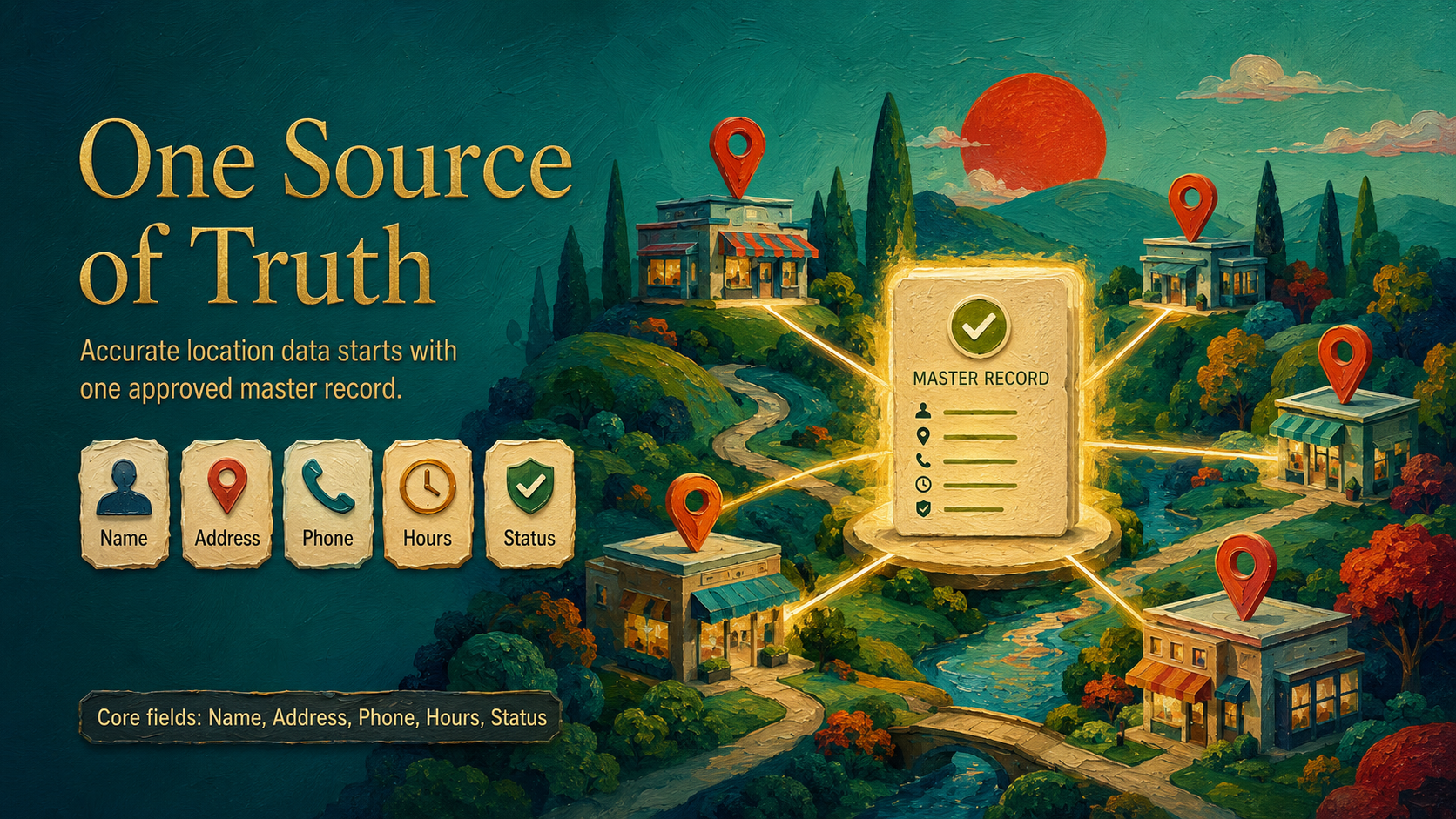
Usually, yes. Business listing management, local listing management, and local listings management all describe the work of keeping public business information accurate across discovery platforms.
The singular phrase often refers to the process or software category. The plural phrase emphasizes the profiles being managed. In practice, both require the same source-of-truth, ownership, distribution, monitoring, and correction controls.
The useful distinction is scope, not spelling. A single-location business may manage a few profiles directly. A multi-location organization needs stable IDs, bulk workflows, permissions, exception queues, and reporting across every location.
Which location fields need active management?
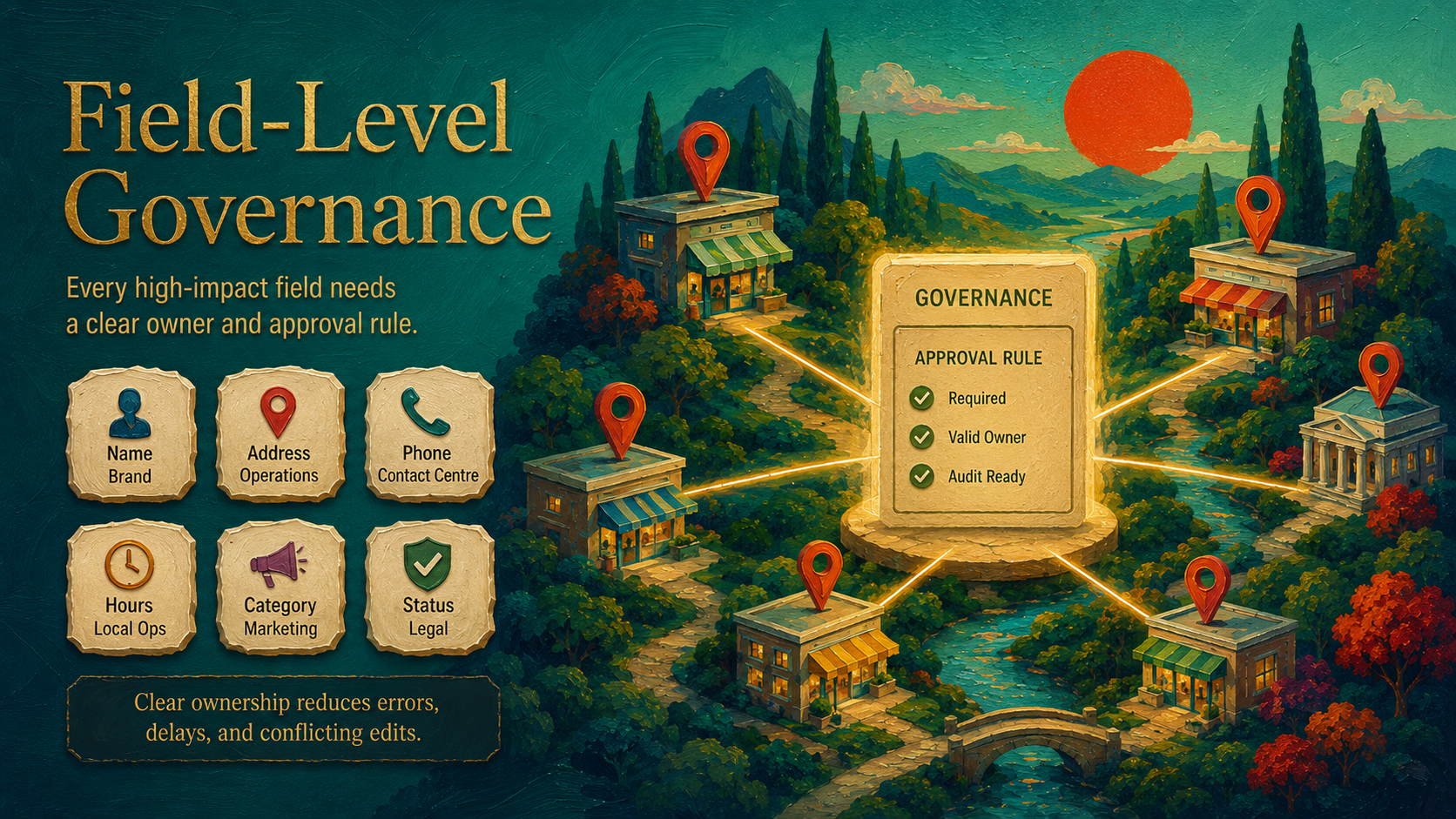
Every field that changes discovery, trust, contact or navigation needs a clear owner and verification rule.
| Field | Typical owner | Customer risk when wrong | Recommended control |
|---|---|---|---|
| Business name | Brand or legal | Confusion, duplicate creation | Approved naming standard |
| Address and map pin | Facilities or operations | Failed visits and navigation | Geocode and storefront verification |
| Phone number | Operations or contact center | Lost calls and poor attribution | Local-number registry and call testing |
| Regular and holiday hours | Local operations | Closed-door visits | Effective dates and expiry rules |
| Primary category | Local SEO or brand | Reduced relevance | Controlled taxonomy |
| Website and local page | Digital team | Wrong destination or tracking | URL validation and redirect checks |
| Operational status | Operations or legal | Closed locations appearing open | Closure and reopening playbook |
| Photos and attributes | Local and brand teams | Weak trust or policy conflicts | Approval and freshness standards |
Google's guidelines for representing a business require accurate real-world representation and include specific rules for chains, departments and practitioners. An internal naming preference cannot override how a business is actually represented offline.
What is NAP consistency in business listing management?
NAP consistency means customers and platforms see the same correct name, address, and phone number for each location across the sources they use. Treat it as factual agreement on identity, not identical commas or abbreviations. Wrong NAP breaks calls, navigation, and entity trust long before category copy matters.
Practical NAP controls:
- Keep one approved NAP per stable location ID
- Match Google Business Profile, Apple, and Bing to that record before secondary directories
- Retire old phones and addresses after moves or rebrands
- Confirm map pins against the customer entrance
- Queue duplicate profiles that advertise a second NAP for cleanup
Why is listings management harder for multi-location brands?
Complexity grows faster than location count because every branch has systems, people, publishers and exceptions attached to it.
Ten locations may be manageable manually. At 50 locations, bulk changes, permissions and duplicate detection become important. At 500 locations, stable IDs, APIs, approval rules and exception queues are essential. Franchise systems add another layer because corporate accuracy and local autonomy must coexist.
Common sources of complexity include:
- Multiple brands or departments at one address
- Separate corporate, franchisee and agency accounts
- Different categories, services and hours by market
- Openings, moves, temporary closures and rebrands
- Publisher-specific eligibility and formatting rules
- Old profiles retaining reviews, links or user activity
- Internal CRM, website and store databases disagreeing
Google provides bulk-management workflows for eligible multi-location organizations. Its bulk verification guidance is useful, but bulk access does not replace internal governance. It simply makes controlled operations possible at a larger scale.
What operating model keeps listings accurate?
A durable listings program connects inventory, governance, distribution, monitoring and measurement.
1. Maintain a complete location inventory
Create a record for every active, planned, moved, temporarily closed and permanently closed location. Use a permanent internal ID rather than the store name or address.
The record should preserve historical names, addresses, opening dates, closure dates and publisher IDs. History matters because a relocated branch may retain reviews and authority that should not be separated from the new record.
2. Define field-level governance
Assign an owner and approver to every high-impact field. Facilities may own addresses, operations may own hours, legal may approve closures and marketing may own categories and descriptions.
A practical change record should include:
- Location ID
- Field changed
- Old and approved values
- Requester and approver
- Effective date
- Reason for change
- Publishers affected
- Verification status
- Evidence and resolution notes
3. Distribute approved data
Use direct publisher tools, bulk spreadsheets, APIs, aggregators or a listings-management platform according to scale and complexity.
Google supports spreadsheet imports and bulk workflows for multiple profiles, while Apple provides official location-management guidance through the Apple Business Connect User Guide. Each destination still validates information independently.
4. Monitor the public result
Track what customers actually see. Monitor critical fields, duplicates, ownership changes, rejected updates, verification status and unexpected reversions.
A dashboard status such as "submitted" or "synced" may only confirm that data left the source system. It does not guarantee that the publisher accepted every field or that another source will not overwrite it later.
5. Measure operational performance
Measure whether the program keeps data accurate and resolves exceptions quickly. Do not rely only on impressions, clicks or calls, because those metrics are influenced by demand, competition, ranking and seasonality.
How should a local listings workflow operate?
The best workflow separates approval, distribution and verification so no team mistakes activity for completion.
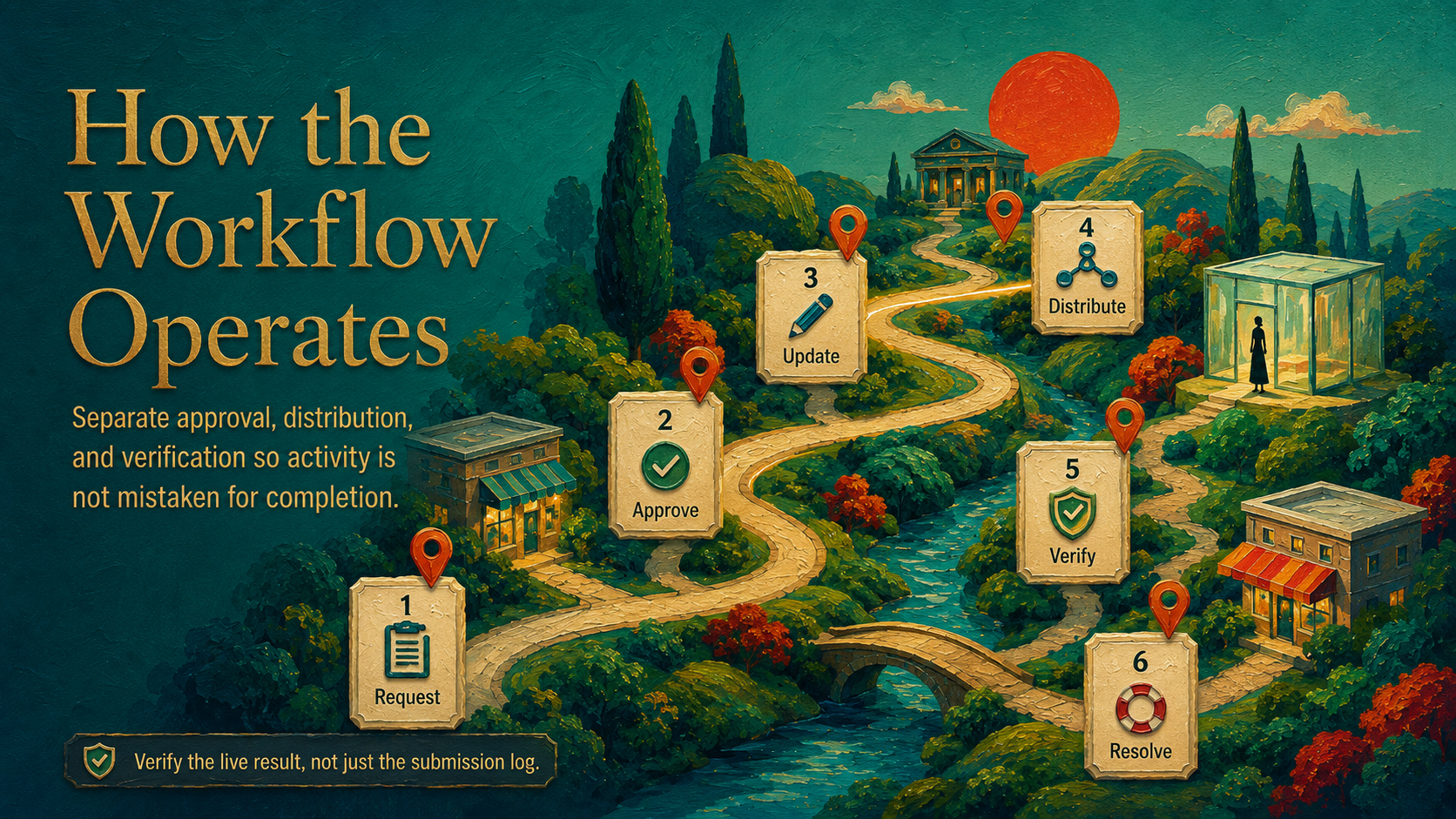
- Receive the change request. Capture the location, requested field, effective date and business reason.
- Validate the source. Confirm that the requester owns or is authorized to change the field.
- Check related records. Identify departments, parent entities, duplicates and downstream systems.
- Approve the final value. Record who approved it and when it should become public.
- Update the source of truth. Preserve the previous value and use the permanent location ID.
- Distribute the change. Send it to priority publishers through controlled channels.
- Verify the rendered result. Check the live profile, not only the submission log.
- Resolve exceptions. Investigate rejections, reversions, duplicates or policy conflicts.
- Document the outcome. Convert recurring problems into reusable playbooks.
For holiday hours, the workflow should start at least 2 to 4 weeks before the relevant date, depending on approval complexity and publisher lead time. Every temporary change should include an expiry or reversion rule.
Which publishers should a brand prioritize?
Prioritize platforms that influence discovery, navigation, trust or downstream data reuse in the markets you serve.
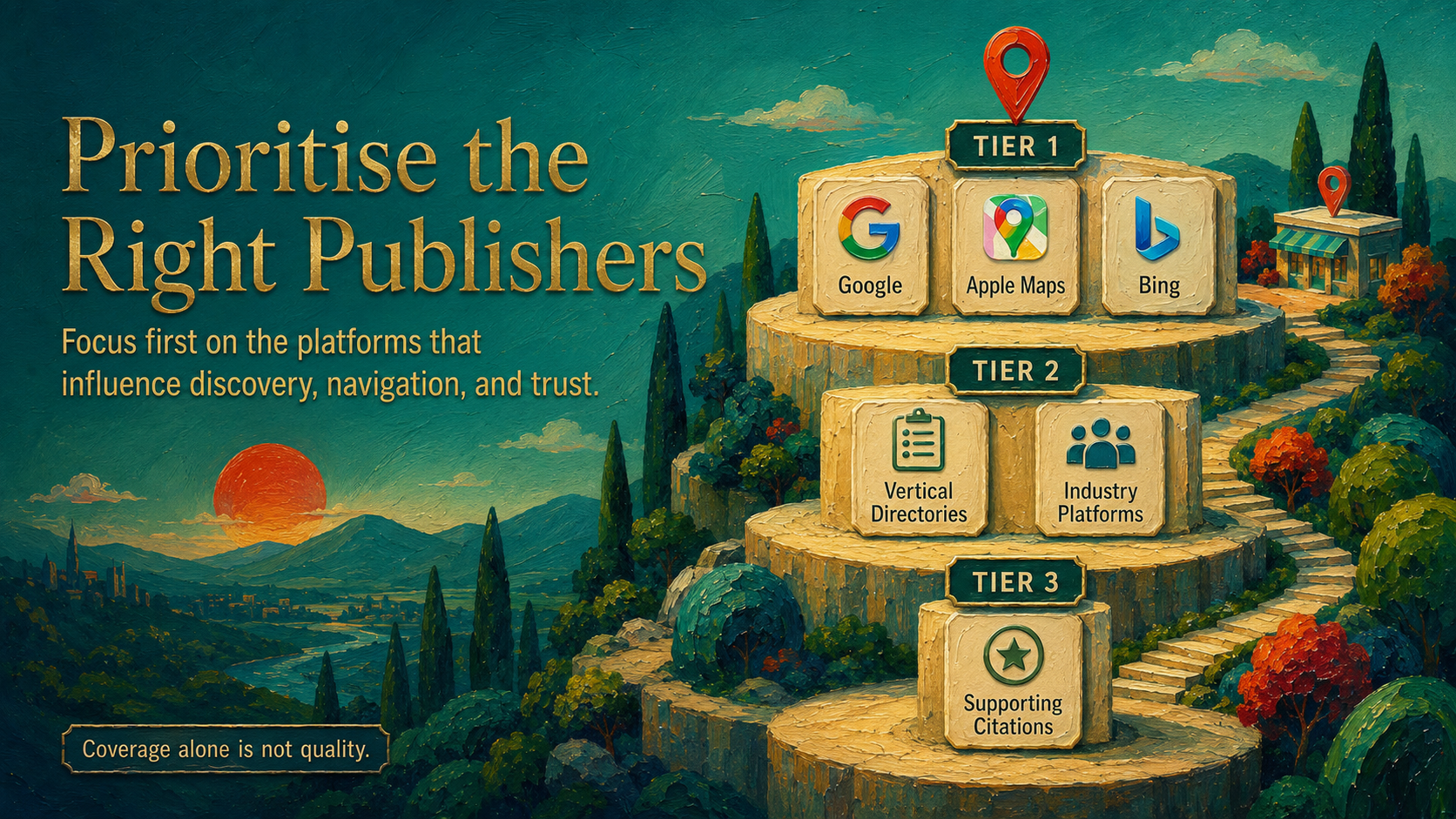
A practical publisher hierarchy is:
Tier 1: primary discovery and navigation
Google, Apple and Bing usually belong here, alongside any dominant navigation platform in the market. These platforms directly affect search results, directions, calls and visits.
Tier 2: industry and audience platforms
Healthcare networks, hotels, restaurants, automotive groups and home-services brands each have vertical directories that can matter more than a generic citation site.
Tier 3: supporting citation sources
Secondary directories may reinforce consistency and broaden coverage, but they should not consume the same operational attention as high-impact publishers.
Publisher count is not a quality metric by itself. A program covering 100 directories can still fail if Google shows the wrong hours, Apple routes customers to an old address or a closed branch remains active.
What should listings software or services provide?
The right solution should reduce operational risk, not simply promise a larger distribution network.
Evaluate:
- Bulk creation and editing
- Stable location IDs and publisher IDs
- Duplicate detection and suppression
- Approval rules and role-based permissions
- APIs, exports and audit logs
- Direct publisher relationships
- Department and hierarchy support
- Exception alerts and resolution workflows
- Local-page or structured-data integration
- Data ownership and offboarding terms
Smaller teams may manage a limited portfolio directly. Growing brands often use local listing management services for execution, while complex organizations may need dedicated local listing management software.
The deciding question is: Can the system show what changed, who approved it, where it was submitted, what the publisher displayed and what happens when the contract ends?
Which metrics show whether the program is working?
Operational metrics should come before marketing outcomes because accuracy is the part the listings team directly controls.
| Metric | What it measures | Useful target direction |
|---|---|---|
| Core-field accuracy | Correct high-impact values across priority publishers | Increase |
| Exception rate | Locations requiring investigation | Decrease |
| Resolution time | Time from detection to verified correction | Decrease |
| Duplicate rate | Unwanted profiles per active location | Decrease |
| Verification coverage | Eligible profiles under controlled ownership | Increase |
| Change success rate | Approved updates rendered correctly | Increase |
| Local-page parity | Agreement between website and publisher records | Increase |
For a portfolio of 200 locations, a 2% critical exception rate still means 4 branches may display a materially wrong status, address, phone number or opening schedule. Percentages should always be translated back into affected locations.
How do listings support AI discovery?
Listings provide structured entity evidence that can help search and AI systems identify a business, its locations and its current operating state.
Consistent location information reduces ambiguity between the corporate brand, individual branches, departments and similarly named businesses. It also supports website location pages, structured data, map records and publisher profiles that describe the same real-world entity.
Accurate listings do not guarantee inclusion in an AI answer. They make the underlying entity easier to resolve. Strong editorial content, clear authorship, primary sources, reputable mentions and useful location pages still matter.
Common local listings management mistakes
Chasing universal coverage
More directories do not automatically create more value. Prioritize platforms customers use and sources that redistribute data.
Letting names become identifiers
Names and addresses change. Use a stable internal ID to connect records across systems and publishers.
Confusing submission with success
An API response or dashboard status is not proof of a correct public listing. Verify the rendered profile.
Allowing unrestricted local edits
Local teams need useful access, but critical identity fields should require clear approval. Separate operational flexibility from brand and compliance risk.
Treating closures like ordinary edits
Closures, moves and mergers affect reviews, duplicates, redirects, location pages and historical records. Use dedicated event playbooks.
Business listing management checklist
Use this extractable checklist to run the program week to week:
- Identity: Approved business name, address or service area, phone, website, and internal location ID
- Hours: Regular hours plus holiday or temporary hours with clear effective dates
- GBP / Apple / Bing: Google Business Profile claimed and verified; Apple Business and Bing Places current
- Categories and services: Primary category and key services match real-world operations
- Duplicates: Competing or legacy profiles detected, owned, and pushed toward suppression or merge
- Monitoring: Live fields checked after updates; failed syncs and unauthorized edits assigned to owners
- Lifecycle: Opening, move, closure, and rebrand steps documented before the event
For the shorter definition hub, see What is business listing management?. Keep this guide for the multi-location operating playbook.
A 90-day implementation plan
A practical 90-day local listings rollout inventories locations and ownership in the first month, corrects and distributes priority publisher data in the second, and locks monitoring plus exception handling in the third so accuracy holds after the project ends.
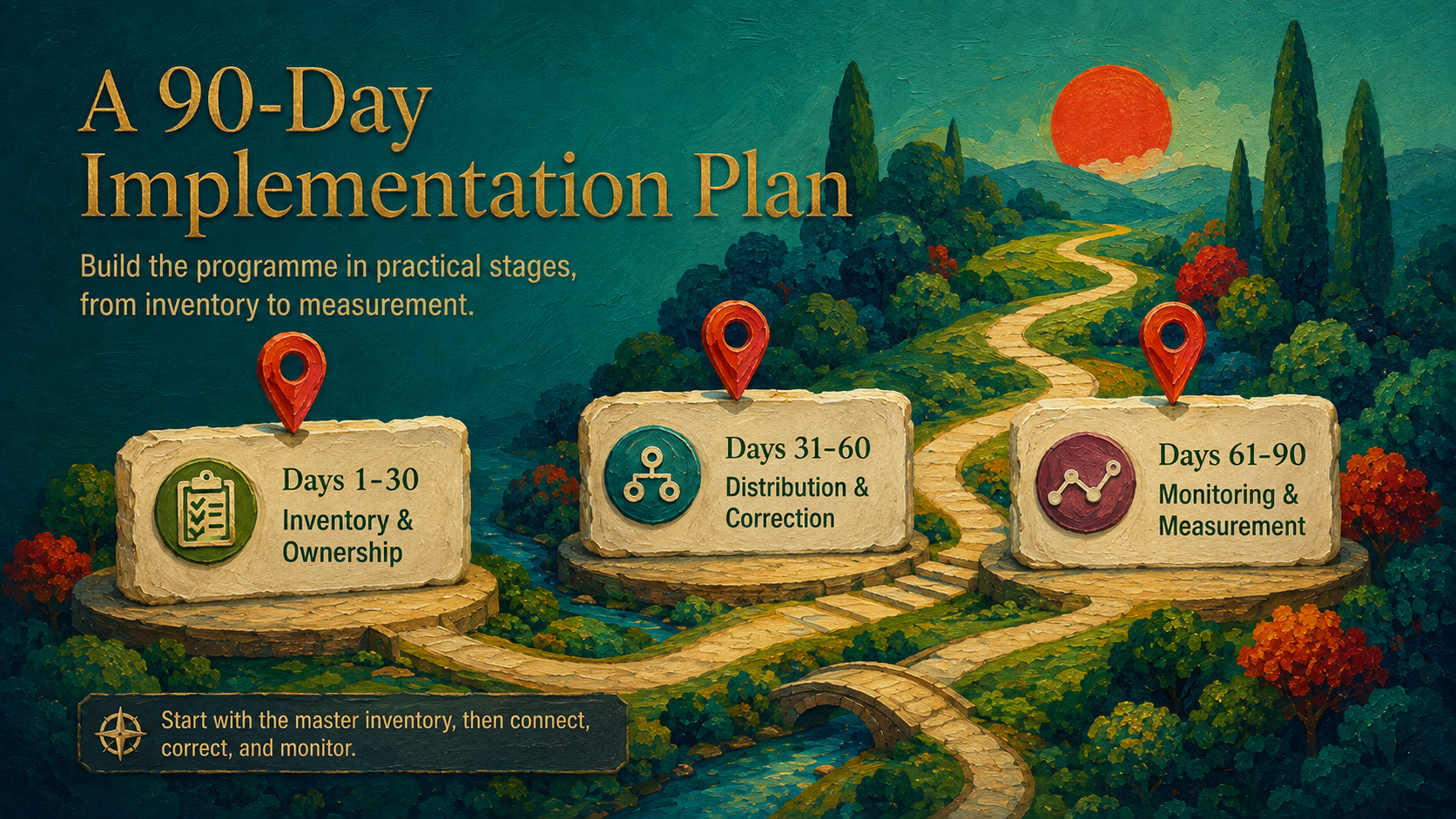
Days 1-30: inventory and ownership
Create the master location inventory, assign permanent IDs, document account access and define owners for core fields. Audit active, moved, closed and planned locations.
Days 31-60: distribution and correction
Connect priority publishers, clean duplicates, correct high-impact errors and document workflows for openings, moves, closures, rebrands and holiday hours.
Days 61-90: monitoring and measurement
Build an exception queue, define service levels, automate critical alerts and establish weekly operational reviews. Report accuracy, exceptions, resolution time and verification coverage.
Related reading
- What is business listing management?
- GMB management services
- Best local listing management software
- Why location data breaks across the local search ecosystem
- Run a complete business listings audit
- Build a multi-location listings governance model
- Compare local listing management software
- Google My Business management
- Review platforms for automotive dealer groups
- Explore franchise listing management platforms
Frequently asked questions
What is business listing management?
Business listing management is the ongoing process of creating, updating, and keeping your company's information accurate across search engines, online directories, maps, and review platforms, usually from one master NAP record per location. It covers NAP, hours, and categories, Google Business Profile (formerly GMB) ownership, distribution, duplicate control, monitoring, and verification of the live result.
Is business listing management the same as local listings management?
Yes. In US procurement and local SEO practice, business listing management, local listings management, and local listing management describe the same discipline. The practical question is publisher coverage and governance, not which label you use.
What is local listings management?
Local listings management is the practice of maintaining accurate business-location information across discovery platforms. Searchers and vendors also use local listing management and business listing management for the same work.
What is local listing management?
Local listing management is another name for local listings management and business listing management. It means keeping public business information accurate across search engines, maps, directories, and navigation services, with ownership, distribution, monitoring, and verified corrections.
Does business listing management help SEO?
Yes. Consistent NAP and profile data help search engines trust your locations and support local pack visibility. It does not replace useful Google Business Profile content, reviews, or a strong website.
What is the difference between local SEO and local listings management?
Local listings management maintains accurate business information across search engines, maps and directories. Local SEO is broader and can include location pages, content, reviews, links, technical optimization and on-page relevance.
How often should business listings be checked?
Critical changes should be monitored continuously, high-impact exceptions should be reviewed weekly and the complete portfolio should be audited at least quarterly. Openings, moves, closures and holiday periods require additional checks.
Can a business manage listings without software?
Yes. A small business with few locations can use publisher tools directly. Software becomes more valuable when location count, update frequency, permissions, duplicate risk or reporting complexity makes manual work unreliable.
What is the most important local listings management practice?
Maintain one approved source of truth with stable location IDs and field-level ownership. Distribution tools are useful, but they cannot compensate for conflicting internal records or unclear approval rules.
Does business listing management improve AI search visibility?
Honestly, it helps understanding more than it guarantees outcomes. Consistent NAP, hours, categories, and status give AI Overviews and answer tools clearer public evidence about your locations. That can improve how systems resolve your entity. It does not guarantee citations, rankings, or inclusion in any AI answer.
Can AI search use my business listings?
AI Overviews and answer tools use public business evidence. Accurate, consistent listings improve the facts those systems can cite; they do not guarantee a citation.
How much does local listings management cost?
Public list prices vary by location count, publisher coverage and whether you buy software, a managed service or both. Compare current published rates in How much does local listings management cost in 2026.