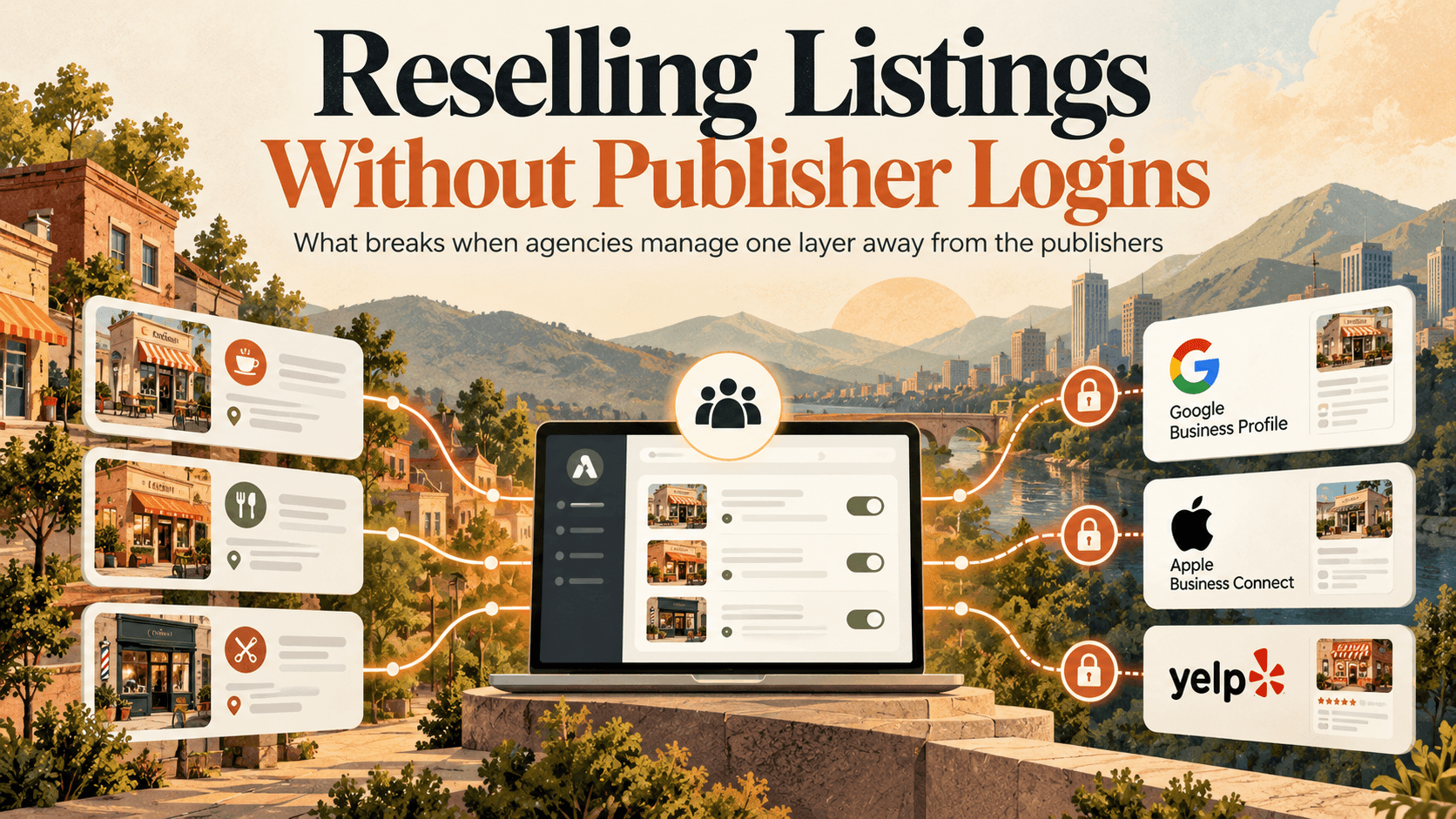
Publisher access is an authorized role inside a client’s Google, Apple, or Yelp account, such as Manager on a Google Business Profile, that lets an agency act on a listing without owning it. Without it, routine syncing may still work, but verification, recovery, and offboarding can break. The safer model is client-owned accounts and delegated agency roles, never shared passwords.
This distinction matters because white-label software can make the service look fully managed even when the agency is operating one layer away from Google, Apple, Yelp, Facebook, and other publishers. A reseller platform may distribute data or show listing status, but it does not automatically give the agency the same rights as an authorized user inside the publisher account. If the client or upstream provider controls those rights, the agency can become dependent on another party for the hardest cases.
Editorial approach: this guide treats “direct publisher login” as first-party or delegated publisher access, not password sharing. That can mean a Google agency organization, an Apple third-party partner delegation, or another publisher-supported user role. The article separates what a reseller dashboard can automate from the account-control work that still requires publisher authorization. No platform is presented as a universal solution.
What does “without direct publisher logins” actually mean?
It usually means the agency can manage client data through a reseller or white-label platform but does not hold its own authorized role inside the client’s priority publisher accounts. The agency may be able to push updates indirectly, yet it cannot independently sign in to confirm ownership, review account-level permissions, approve an OAuth connection, or take certain publisher-specific recovery actions.
That is different from a healthy delegated-access model. Agencies should not ask clients to hand over shared usernames and passwords. The better model is that the client retains ownership and the publisher grants the agency a supported manager, organization, partner, or user role.
Google explicitly supports this separation. Its Business Profile third-party policies require the client to retain ownership or co-ownership while the third party manages the profile through supported access. Google also says third parties must not share passwords with clients and, when a client requests it, must return exclusive control of the Business Profile within 7 business days of notice. For agencies, delegated access is the target, not credential ownership.
What can break when the agency only has a reseller dashboard?
Routine publishing may continue to work, which is why the risk can stay hidden for months. The gaps usually appear when something abnormal happens: a location needs re-verification, a connection expires, a profile is claimed by someone else, a duplicate must be resolved, an API authorization needs renewal, or a client wants to leave the agency. These are control problems, not simple data-entry problems.
| What breaks | Typical symptom | Why reseller access is not enough | Operational consequence |
|---|---|---|---|
| Ownership and recovery | Nobody at the agency can confirm who controls the profile | The dashboard may show a listing without exposing publisher-level owners and managers | Recovery depends on the client, former agency, or upstream vendor |
| Connection authorization | Google, Facebook, or another connection expires | OAuth or direct authorization often needs an authorized account holder | Publishing, reviews, or insights can stop until someone reconnects |
| Verification | A new or moved location needs verification | Verification may require publisher-specific evidence or an authorized account | Launches and relocations stall |
| Support escalation | A high-value profile is suspended, duplicated, or disputed | The reseller may need to escalate through another provider instead of acting directly | Resolution takes longer and evidence gets fragmented |
| Auditability | The agency cannot show who changed access or ownership | Reseller logs do not replace publisher account history | Security and offboarding become harder to prove |
| Offboarding | The client leaves and asks for direct control | The agency may not know which accounts, IDs, and connections must be transferred | The client inherits an unclear access stack |
Why does Google access matter so much for agency resellers?
Google Business Profile is usually the clearest example because Google has a formal agency structure. An agency can create an organization, manage business groups, and receive permission to client locations without becoming the owner of those businesses. That gives the agency a scalable way to manage access while keeping client ownership intact.
Google’s agency registration guidance tells agencies to create an organization, create business groups, obtain access to customer locations, and use user groups to control which agency staff can manage which business groups. This is a direct alternative to having every employee use client credentials.
If an agency skips that structure and relies only on an upstream reseller dashboard, several things become opaque. The agency may not know whether the client is the actual owner, whether a former vendor still has access, whether the connected Google account has the right location, or whether the authorization will survive a staff change. Those issues often appear during a migration or suspension rather than during ordinary publishing.
For multi-location clients, Google’s business-group documentation describes business groups as a safer way to manage and share access to sets of Business Profiles. This is the control layer an agency loses when it never receives publisher-level delegated access.
Does the same access problem exist outside Google?
Yes, but the mechanics differ by publisher. Apple and Yelp both provide supported ways for businesses to grant third parties access without surrendering the underlying account. The important pattern is consistent: the business should remain the owner, and the agency should receive explicit, revocable authority.
Apple Business supports delegated management through OAuth or a Partner Organization ID. Apple’s third-party partner guidance says a business can choose which brands and features to delegate to a verified third-party partner. That allows an agency or platform partner to manage approved content while the business retains the organization relationship.
Yelp allows a claimed business to invite up to 15 users and assign them to specific locations. Invited users receive the same permissions as the account holder, including updating business information, using payment details, and managing other users. Agencies should therefore use a company-controlled account and ensure clients revoke access during offboarding.
The exact permissions differ, but the procurement question is the same: can the agency and client prove who owns the publisher account, who is delegated, and how that delegation is removed or transferred? If not, the reseller stack has a governance gap even if routine syncing appears healthy.
What can a reseller platform still do without direct publisher access?
A reseller platform can still deliver meaningful value. It can centralize location data, distribute information to supported networks, monitor listing status, generate client reports, automate recurring updates, and give an agency one operating interface. The mistake is assuming that this operational convenience equals publisher ownership or unrestricted publisher access.
| Usually possible through a reseller platform | May require client or delegated publisher authorization | Why the distinction matters |
|---|---|---|
| Maintain a central location record | Connect or reconnect priority accounts | Connection rights belong to the publisher account holder |
| Push routine data to supported directories | Claim or verify some profiles | Verification can depend on first-party business evidence |
| Monitor listing health and sync status | Change account owners or managers | Account governance sits above the reseller dashboard |
| Generate white-label reports | Handle complex suspensions or ownership disputes | Publisher support may require direct account context |
| Bulk-update hours, phones, URLs, and status | Complete offboarding or access transfer | A dashboard export does not automatically transfer publisher authority |
What operational problems show up during onboarding?
A common onboarding risk is false confidence. A client says, “Our old agency handled Google,” but nobody knows which Google account owns the profiles. The reseller tool imports locations successfully, so the migration looks complete even though the agency has not confirmed ownership or delegated access.
- The agency imports locations before confirming which profiles already exist, creating duplicate risk.
- The client authorizes the wrong Google or Facebook account, so only some locations connect.
- A former agency remains an owner or manager, but the new agency cannot see that from the reseller dashboard.
- Store codes, publisher IDs, and internal location IDs are not reconciled before sync starts.
- The platform reports a listing as present, but nobody has verified whether the client can independently access it.
- White-label onboarding hides the underlying publisher connection step, so the client assumes the agency owns the relationship end to end.
A better onboarding rule is to treat publisher access as its own workstream. Location data can be imported in parallel, but the account-control checklist is not complete until priority publishers have a known owner, an authorized agency role, and a documented recovery path.
What breaks when a listing becomes an exception instead of a routine update?
High-risk exceptions expose the difference between “we can push data” and “we can manage the account.” Suspensions, duplicate merges, ownership conflicts, verification failures, and publisher support cases often need context that sits outside the white-label dashboard.
The agency may have to ask the reseller vendor to contact the publisher, ask the client to produce evidence, and ask a former account holder to approve a transfer. Each extra dependency can add resolution time and make it harder to maintain one case history. If the client is paying the agency as the accountable service provider, that dependency can become a client-experience problem even when the underlying software is functioning correctly.
This does not mean every agency must maintain a native login to every small directory. We recommend documenting an explicit access model for publisher accounts that materially affect business identity, discovery, reviews, or customer actions. Lower-value directories can often remain a syndication workflow, while priority publishers should have known ownership, delegated authority where supported, and a recovery path.
Which reseller platforms may fit this access model?
The right reseller platform is the one that helps the agency scale while still making client ownership and publisher connections explicit. White-labeling is useful, but the stronger buying question is whether the platform can separate agency branding from publisher authorization, document connection status, and support a clean client handoff.
| Platform | Typical operating model | What it helps centralize | Access caveat | Consideration | When to shortlist |
|---|---|---|---|---|---|
| BrightLocal | SEO agencies and consultants that want lighter client-facing reporting and listings workflows | White-label dashboards, listings/citations, review workflows, client access | Active Sync and other services use different publisher connection workflows, so agencies should verify authorization, connection ownership, and offboarding for the services they buy | Lighter agency workflow may offer fewer enterprise governance layers than larger multi-location suites. | When hands-on agencies want transparency and lighter infrastructure |
| SOCi | Enterprise agencies or service models tied to large franchise and multi-location programs | Central governance, listings, reviews, social, automation | Agencies should verify reseller, client-access, and publisher-authorization requirements for their intended service model | Broader enterprise suite can be heavier than an agency needs for a listings-only resale motion. | When the agency supports enterprise-scale distributed brands |
| Synup | Agencies that want a white-label listings and local marketing layer | Client dashboards, multi-client location management, listings, reviews, reporting, and client connection workflows | White-label presentation should not be confused with publisher ownership; client account authorization still matters for priority connections | Priority publisher connections still require the correct client authorization; white-labeling does not remove that dependency. | When the agency wants reseller branding plus practical multi-client operations |
| Uberall | Agencies and resellers that want API-led or embedded multi-location services | Partner provisioning, listings, integrations, white-label and reseller workflows | More integration flexibility can create more responsibility for defining connection and offboarding rules | Embedded and API-led implementations can require more technical planning and clearer ownership rules. | When local listings is part of a broader partner platform |
| Yext | Larger agencies, channel partners, and resellers serving multi-location clients | Structured location data, large-scale listings workflows, partner delivery, enterprise controls | A channel relationship does not remove the need to understand client publisher ownership and connection rights | Enterprise-oriented partner delivery may be more platform and governance than smaller agency programs need. | When clients need enterprise governance and broad distribution |
This is an operating-model comparison, not a universal ranking. Fit descriptions are editorial assessments based on publicly documented capabilities. Yext documents partner and enterprise-oriented delivery; Synup documents white-label client experiences, multi-client workflows, and publisher connection steps; Uberall supports integrated partner and multi-location workflows; BrightLocal supports agency-oriented listings and publisher connection workflows; and SOCi is positioned around distributed multi-location operations. In every case, the agency still needs an explicit publisher-access policy and should verify the exact reseller, authorization, and offboarding model for its use case.
What access model should agencies require?
Agencies should require a three-layer access model: client ownership, delegated agency access, and platform authorization. The client should retain control of core accounts and assets, while the agency receives role-based permissions needed to manage them. Platform-level authorization should support that access without replacing either client ownership or agency permissions.
Client ownership: The business controls the primary account or organization for priority publishers and can recover access without the agency.
Delegated agency access: The agency receives a supported organization, manager, partner, or user role using company-controlled agency accounts.
Platform authorization: The listings platform is connected through the approved account, OAuth flow, API, or partner mechanism needed to publish and retrieve data.
Location identity: Every location has a stable internal ID plus the corresponding publisher URLs or IDs for reconciliation.
Exit path: The contract and operating notes explain how agency users, platform connections, exports, and open cases will be transferred or removed.
What should the agency onboarding workflow look like?
Onboarding should separate data ingestion from access verification. The agency can build the location portfolio quickly, but it should not declare a client “fully onboarded” until priority publisher ownership and delegation are proven.
- Create the client’s canonical location inventory with stable IDs, legal/public names, addresses, phones, hours, websites, and lifecycle status.
- Inventory existing Google, Apple, Yelp, Facebook, Bing, and other priority profiles before creating anything new.
- Record the current account owner or administrator for each priority publisher.
- Have the client grant supported delegated access to the agency where the publisher allows it.
- Connect the reseller platform through the correct authorized account rather than an employee’s personal account.
- Match existing profiles to location IDs and resolve obvious duplicates before broad sync begins.
- Test one or two high-value locations for data publishing, review access, reporting, and exception handling.
- Document which cases the agency can resolve directly and which require the client or upstream vendor.
- Give the client a written offboarding map showing how access and data will be returned if the engagement ends.
When is it acceptable to resell listings without direct publisher access?
It can be acceptable when the agency’s scope is intentionally limited to data distribution and reporting, the client understands that limitation, and a separate party owns the publisher accounts and exception process. For example, a small agency may resell citation distribution while the client’s internal marketing team retains all Google and Apple control.
The model becomes risky when the agency promises full listings management but cannot independently perform the tasks implied by that promise. If the agency markets verification, review response, profile recovery, ownership cleanup, or rapid support escalation, it should know exactly which publisher roles and client authorizations are required to deliver those services.
What should the agency put in the contract or statement of work?
Operationally, the statement of work should describe access responsibilities as clearly as publishing responsibilities. This prevents the client from assuming that a white-label dashboard means the agency owns every publisher relationship.
- The client remains the owner of its publisher accounts and grants the agency delegated access where required.
- The client is responsible for providing business evidence or authorized representatives when verification or recovery requires it.
- The agency identifies which publishers are managed directly, through a platform connection, or through an upstream reseller.
- The service scope states whether suspensions, duplicate disputes, ownership recovery, and verification are included or separately scoped.
- The offboarding clause covers location exports, publisher IDs, connected accounts, open cases, agency-user removal, and platform disconnection.
- The agency will not require shared client passwords where a supported delegated-access method exists.
Why does offboarding expose weak reseller setups?
Offboarding forces every hidden dependency into the open. A client that could happily view white-label reports for two years may suddenly ask: Who owns our Google organization? Which Apple partner has access? Which email controls Yelp? Which accounts are connected through the platform? Which directory logins were created by the vendor?
If the agency cannot answer those questions, the client relationship ends with operational debt. A clean reseller program should be designed so the client can leave without losing the ability to manage its public business identity. For Google Business Profiles, Google’s third-party policy requires the agency to return exclusive control to the client within 7 business days after the client gives notice.
A clean handoff should include:
- Current canonical location export and stable location IDs.
- Priority publisher URLs and account ownership notes.
- List of agency users or organization IDs that must be removed.
- List of platform connections that will stop or need to be reauthorized.
- Open duplicate, suspension, verification, or support cases.
- Explanation of which citations or directory records persist after service ends.
- Final date on which the reseller platform will stop managing each location.
What should agencies audit every quarter?
For agencies with ongoing listings responsibility, we recommend a quarterly access audit alongside routine listing-health monitoring. The purpose is to confirm that the agency can still deliver the service it is selling and that the client can still recover control if the relationship changes.
- Every priority client has a known owner for Google, Apple, Yelp, Facebook, and other high-value publishers.
- Agency access uses company-controlled accounts and supported delegated roles.
- Former employees and former subcontractors have been removed.
- Platform connections are active and tied to the intended client accounts.
- Location IDs and publisher URLs still reconcile with the agency’s master inventory.
- High-risk cases have one case history and one accountable owner.
- The client could receive a usable export and access map within the agreed offboarding window.
Conclusion: what really breaks without direct publisher logins?
What breaks is not necessarily day-to-day syncing. What breaks is control when the normal workflow stops being normal. Agencies without direct or delegated publisher access can become dependent on clients, former vendors, or upstream platforms for verification, recovery, connection renewal, ownership cleanup, support escalation, and offboarding.
A strong reseller model therefore separates three things: the client owns the publisher relationship, the agency receives revocable delegated access, and the software automates the work that should be automated. That structure lets an agency white-label the service without white-labeling away the underlying account control.
Frequently asked questions
These questions focus on agency access, reseller software, and publisher control rather than general local SEO strategy.
Can an agency manage local listings without client publisher passwords?
Yes, and it should. Google tells third parties to request Manager access and never share passwords. Apple Business lets a verified business delegate selected brands and features to a verified partner. Yelp lets a claimed business invite users by location. In each case, the client keeps the account and the agency gets a removable role.
Is a white-label listings dashboard the same as direct publisher access?
No. A white-label listings dashboard can centralize location data, publishing, monitoring, reporting, and client-facing workflows, but it does not automatically transfer publisher ownership or account-level authority. Verification, permissions, OAuth authorization, recovery, support escalation, and user management may still depend on the underlying Google, Apple, Yelp, Facebook, or other publisher account.
What is the biggest risk of reselling listings without direct access?
The biggest risk is losing control when a routine listing becomes an exception. Normal syncing may continue for months, while verification failures, suspensions, ownership disputes, expired authorizations, duplicate cleanup, or client offboarding suddenly require account-level authority. Without delegated access, the agency may have to depend on the client, a former vendor, or an upstream platform to act.
Should agencies become owners of client Google Business Profiles?
Generally, no. Google’s third-party guidance says the business should retain ownership or co-ownership while the third party manages the Business Profile through supported access. Agencies can use organization, business-group, and Manager structures to operate at scale without unnecessarily taking ownership. This also makes access easier to audit, revoke, and hand back when the engagement ends.
Which reseller platforms should agencies evaluate?
Agencies can evaluate platforms such as Yext, Synup, Uberall, BrightLocal, and SOCi, all of which support different agency, partner, reseller, or multi-client workflows. The right fit depends on publisher authorization, white-label requirements, client ownership, integrations, exception handling, reporting, and offboarding. The software should make those dependencies visible rather than make a branded dashboard look like publisher-level control.
What should an agency hand back when a client leaves?
The agency should return the current location export, stable IDs, publisher URLs, ownership and access notes, open support cases, connection status, and a list of agency users or integrations to remove. It should also explain what will stop syncing or need reauthorization. For Google Business Profiles, Google requires third parties to return exclusive control within 7 business days after notice.