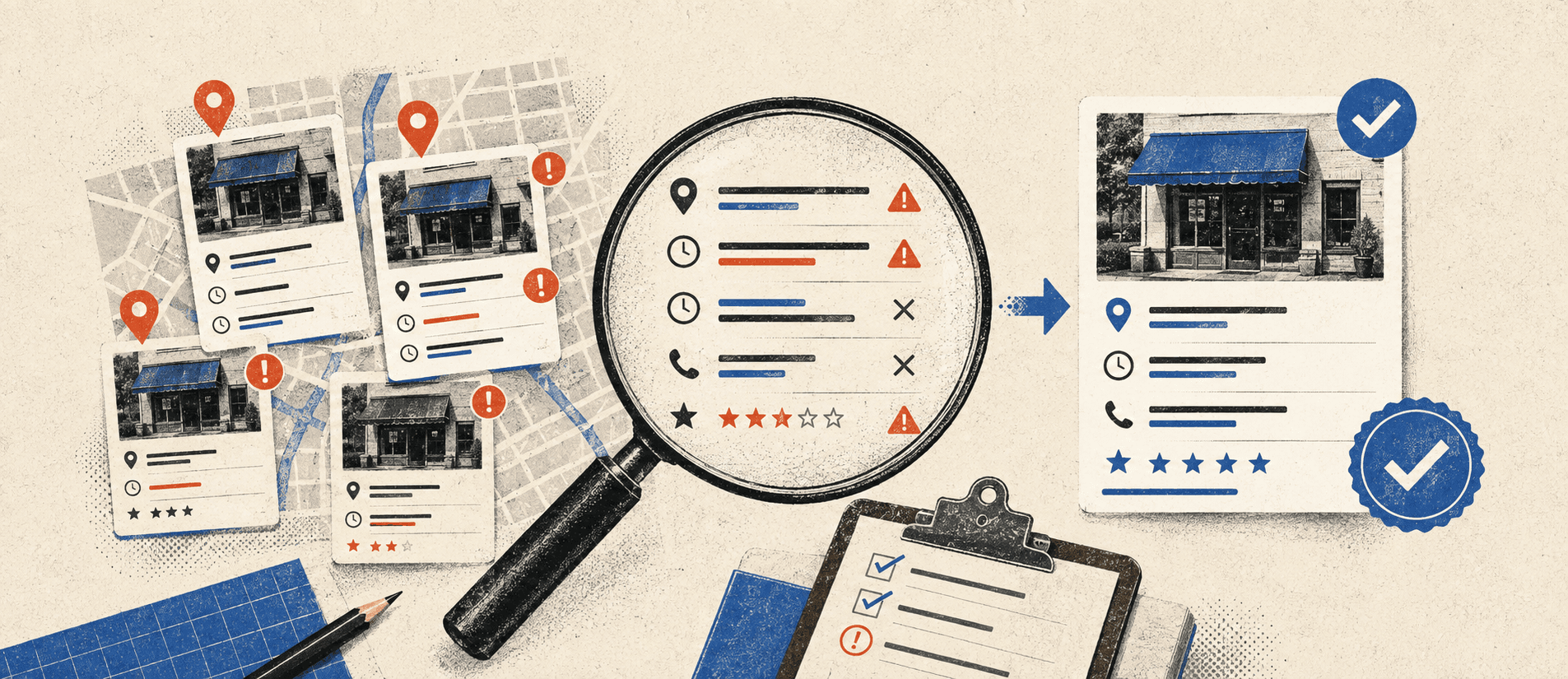
A business listing audit tool should show where name, address, phone, hours, categories and website disagree across publishers. BrightLocal is the strongest dedicated option for local SEO teams, Semrush pairs listings with broader SEO reporting, and Yext, Uberall and Synup fit brands that also need ongoing correction and governance.
A business listing audit tool should show where name, address, phone, hours, categories and website disagree across publishers. BrightLocal is the strongest dedicated option for local SEO teams, Semrush pairs listings with broader SEO reporting, and Yext, Uberall and Synup fit brands that also need ongoing correction and governance.
Verdict: BrightLocal is the best dedicated business listing audit tool for most agencies and local SEO teams in 2026. Semrush fits teams that want local diagnostics beside broader SEO work. Yext, Uberall and Synup make more sense when the audit must feed an ongoing multi-location management program. Whitespark is valuable for citation research, while Moz Local offers a lighter workflow.
Key takeaways
- BrightLocal is the best dedicated audit toolkit for agencies and hands-on local SEO teams.
- Semrush is useful when listing checks need to connect with keyword, competitor and site reporting.
- Yext, Uberall and Synup are stronger when the audit must lead directly into ongoing listings management.
- Whitespark is well suited to citation research and cleanup planning.
- Moz Local and Localo offer accessible workflows for smaller businesses.
- No tool finds every issue, so high-risk locations still need manual checks on Google, Apple Maps, Bing and the company website.
Teams often use business listing management to describe the same discipline as local listings management.
Which business listing audit tools are best in 2026?
The right tool depends on whether the job ends with a report or continues into remediation. An agency may need exportable citation findings, while a national brand may need permissions, bulk corrections and progress reporting across thousands of locations.
| Tool | Best fit | Strongest capability | Main limitation |
|---|---|---|---|
| BrightLocal | Agencies and local SEO teams | Citation auditing, tracking and reporting | Less enterprise governance |
| Semrush | Teams combining local and wider SEO | Listings data inside a broader SEO suite | Some features depend on plan or add-on |
| Yext | Large enterprises | Audit-to-correction workflow across a large network | Enterprise cost and complexity |
| Uberall | International multi-location brands | Listings visibility plus ongoing location marketing | Quote-based packaging |
| Synup | Agencies and growing location networks | Audits, listings and broader local marketing | Coverage should be tested by market |
| Whitespark | Citation research and cleanup projects | Citation discovery and competitive research | More specialist than all-in-one |
| Moz Local | Small and midsize businesses | Straightforward listing health workflow | Less complex enterprise control |
What should a listing audit tool check?
A useful audit should do more than count citations. It should identify the fields and publisher records that could confuse customers or search engines.
Look for:
- Name, address and phone conflicts.
- Incorrect regular, holiday and special hours.
- Duplicate, closed, practitioner or department profiles.
- Wrong primary and secondary categories.
- Broken landing-page URLs and tracking parameters.
- Missing attributes, services, descriptions and images.
- Ownership, verification and access problems.
- Differences between the source of truth and live publisher data.
- Location-level trends and a clear remediation queue.
Our business listings audit guide explains the manual process behind these checks. Use a tool to accelerate discovery, not to replace judgment.
1. BrightLocal: Best dedicated business listing audit tool
Best for: Agencies, consultants and internal local SEO teams.
Potential limitation: Large global organizations may need deeper permissions, integrations and change control than a specialist local SEO toolkit provides.
BrightLocal combines citation tracking, citation building, local search audits, rank tracking and review monitoring. Its audit-oriented workflow makes it practical for finding inconsistent records, comparing coverage and turning issues into client or stakeholder reports.
It is the strongest choice when the main deliverable is diagnosis and cleanup planning rather than enterprise-wide location governance.
Review BrightLocal's local SEO tools.
2. Semrush: Best for combining listing audits with broader SEO
Best for: Marketing teams already using one platform for keyword, competitor and technical SEO work.
Semrush’s local tools connect listing visibility with rank tracking and broader search reporting. That makes it useful when the same team needs to explain how profile accuracy, website health and local rankings interact.
Potential limitation: Confirm which local features, locations and distribution capabilities are included in the selected plan before buying.
3. Yext: Best enterprise audit-to-remediation workflow
Best for: Enterprises that want to identify issues and push controlled corrections from one source.
Yext combines listing monitoring with distribution and updates across its publisher network. Yext says Listings supports more than 200 integrations, which buyers should compare with the publishers that matter to their actual customers. It is relevant when an audit is the beginning of a permanent data-governance program rather than a one-time project.
Potential limitation: The platform may be more extensive than a small team needs. Buyers should test total cost, implementation and contract exit requirements.
Review Yext Listings or compare the best Yext alternatives.
4. Uberall: Best for international location networks
Best for: Multi-country brands that want audit visibility, listing updates and local marketing in one environment.
Uberall connects listings with reviews, local social, local pages and location performance. It is a strong shortlist candidate when a business needs to identify data problems across markets and then manage the affected locations continuously.
Potential limitation: Publisher coverage and capabilities should be validated country by country.
Review Uberall Listings.
5. Synup: Best for agencies and growing multi-location brands
Best for: Teams that want listing diagnosis, management, reviews, social and local SEO in a broader platform.
Potential limitation: A buyer with specialized markets or complex integrations should confirm publisher and workflow coverage in a live pilot.
Synup is useful when audit findings need to move into a managed workflow across clients or locations. Synup says its presence product supports more than 100 publishers in over 50 countries, so international buyers should validate coverage market by market. Its positioning spans listings, reputation, social and search visibility.
Synup Presence and our local listing software comparison.
6. Whitespark: Best for citation research and cleanup planning
Best for: Local SEO specialists investigating citation opportunities, incorrect records and competitor coverage.
Whitespark is especially useful for citation-focused research. It can help teams find where a business is listed, identify opportunities and plan cleanup or building work.
Potential limitation: It is a specialist workflow rather than a complete enterprise location-marketing system.
7. Moz Local: Best for a simpler listing-health workflow
Best for: Small and midsize businesses wanting an accessible way to monitor and improve listing data.
Moz Local focuses on profile completeness, listing distribution, duplicate handling and review workflows. It is easier to consider when the organization does not need advanced franchise permissions or custom data integrations.
Potential limitation: Large multi-location brands should compare reporting depth, country coverage and governance with enterprise platforms.
Which audit tool is best for each use case?
| Need | Recommended starting point |
|---|---|
| Dedicated local citation audit | BrightLocal |
| Local plus broader SEO reporting | Semrush |
| Enterprise audit and correction | Yext |
| International multi-location program | Uberall |
| Agency and broader local marketing workflow | Synup |
| Citation research and cleanup planning | Whitespark |
| Simple small-business listing health | Moz Local |
How to test a business listing audit tool
Do not evaluate a tool using only clean locations. Build a test set that includes one duplicate, one moved business, one location with complex hours, one practitioner or department listing and one location in another market.
For each test location, compare the report with live records on priority publishers. Record false positives, missed problems, update speed, export quality and whether the tool explains what action to take.
The strongest product is not the one showing the largest issue count. It is the one that reliably identifies material problems and helps the team resolve them without creating new conflicts.
Final verdict
BrightLocal is the best dedicated business listing audit tool for most agencies and local SEO teams. Semrush fits teams that want local diagnostics beside broader SEO work. Yext, Uberall and Synup make more sense when the audit must feed an ongoing multi-location management program. Whitespark is valuable for citation research, while Moz Local offers a lighter workflow.
Before committing, compare the tool’s output with a manual audit and confirm how it handles duplicates, ownership, special hours and the publishers that drive actual customer actions.
Independent software reviews
Frequently asked questions
What is a business listing audit?
A business listing audit compares a company’s key location data across its website, Google Business Profile, maps, directories and other publishers to identify incorrect, missing or duplicate information.
Are free listing scans accurate?
Free scans can reveal obvious issues, but they may use limited publisher sets or cached data. Important decisions should be checked against live profiles and business records.
How often should a multi-location brand audit listings?
Teams should monitor continuously where possible and run structured audits after openings, moves, rebrands, mergers, bulk hour changes or platform migrations.
Can an audit tool fix duplicate listings automatically?
Some platforms support duplicate suppression or guided remediation, but complicated ownership and publisher cases often require manual evidence and follow-up.