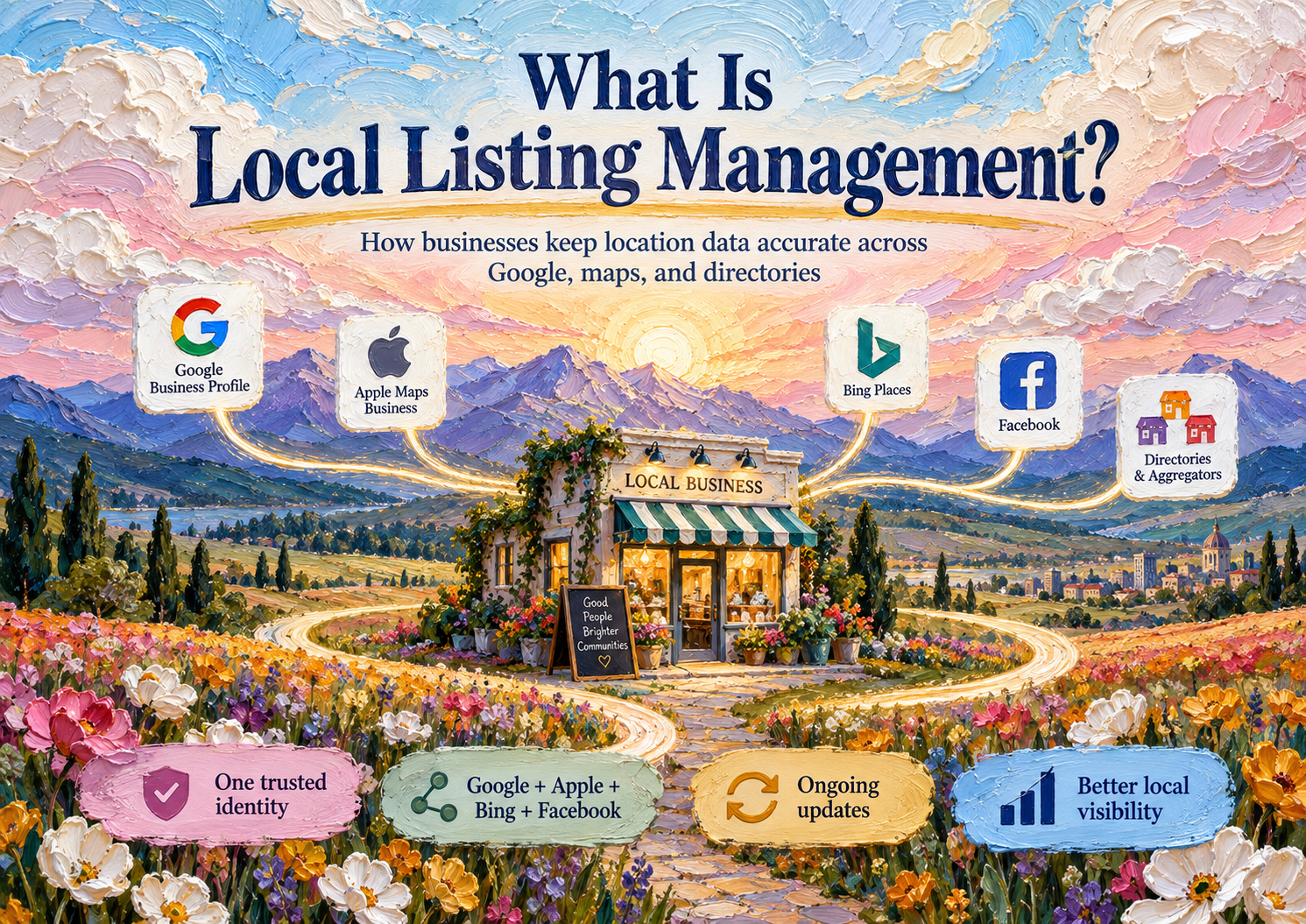
A local listing management RACI assigns who is Responsible, Accountable, Consulted, and Informed for creating, updating, and verifying local profiles across Google, Apple Maps, Bing Places, and other nearby-discovery surfaces. Use it when multi-location teams argue over who owns hours, NAP, categories, or duplicate cleanup. Definition hub: What is local listing management?.
This is an ownership operating model — not another definition page and not a software ranking.
Why local listing management needs a RACI
Local listings management fails when everyone can edit and nobody is accountable. Field teams change holiday hours in one system, marketing updates Google Business Profile elsewhere, and IT holds aggregator logins. Customers then see conflicting place cards. A written RACI stops that drift without inventing new tools.
Google's guidelines for representing your business expect real-world accuracy. Accuracy only sticks when named roles own the edit path and the verify loop.
Recommended RACI (multi-location default)
| Activity | Corporate local ops / listings lead | Marketing / SEO | Location / franchise manager | IT / vendor admin | Legal / brand |
|---|---|---|---|---|---|
| Canonical NAP, category, URL | A | C | C | I | C |
| Regular hours + special hours | A | I | R | I | I |
| Google Business Profile edits | A | C | R (when delegated) | C | I |
| Apple Maps / Bing Places | A | C | I | R (access) | I |
| Duplicate / spam disputes | A | C | C | C | C |
| Vendor / aggregator credentials | A | I | I | R | I |
| Public verify after material changes | A | C | R | I | I |
| Review response (if in scope) | C | A/R as policy | R | I | C |
R = does the work. A = one accountable owner. C = consulted before publish. I = informed after.
How to roll it out in 30 days
- Name one Accountable listings lead for the brand (not a shared inbox).
- Write which fields locations may change without approval (usually temporary hours, temporary closures) vs corporate-only (name, primary category, primary phone).
- Put ownership emails and recovery codes in a company vault — see also Multi-Location Listings Governance Model.
- Require a public place-card check after every material edit (edit hours help).
- Review the RACI quarterly when you add markets or change vendors.
Common failure modes
| Failure | Symptom | Fix |
|---|---|---|
| Two Accountables | Conflicting NAP published | One A per activity |
| Location edits name for SEO | Keyword-stuffed Google titles | Lock name to brand legal |
| Marketing owns GBP; ops owns POS hours | Holiday mismatch | Hours RACI with one A |
| Shared "listings@" login | Lockout / no audit trail | Named users + vault |
Related reading (local cluster)
- What is local listing management?
- Local listing management publisher priority checklist
- Seasonal hours change control for local profiles
- Multi-Location Listings Governance Model
- Sibling term: What is business listing management?
Frequently asked questions
Is a RACI the same as a governance model?
No. Governance covers policies, approvals, and audit history. A RACI is the people matrix for day-to-day local listing management tasks. Use both.
Should franchisees be Accountable for Google Business Profile?
Usually no. Franchisees are often Responsible for local hours under brand rules; corporate remains Accountable for identity fields and disputes.