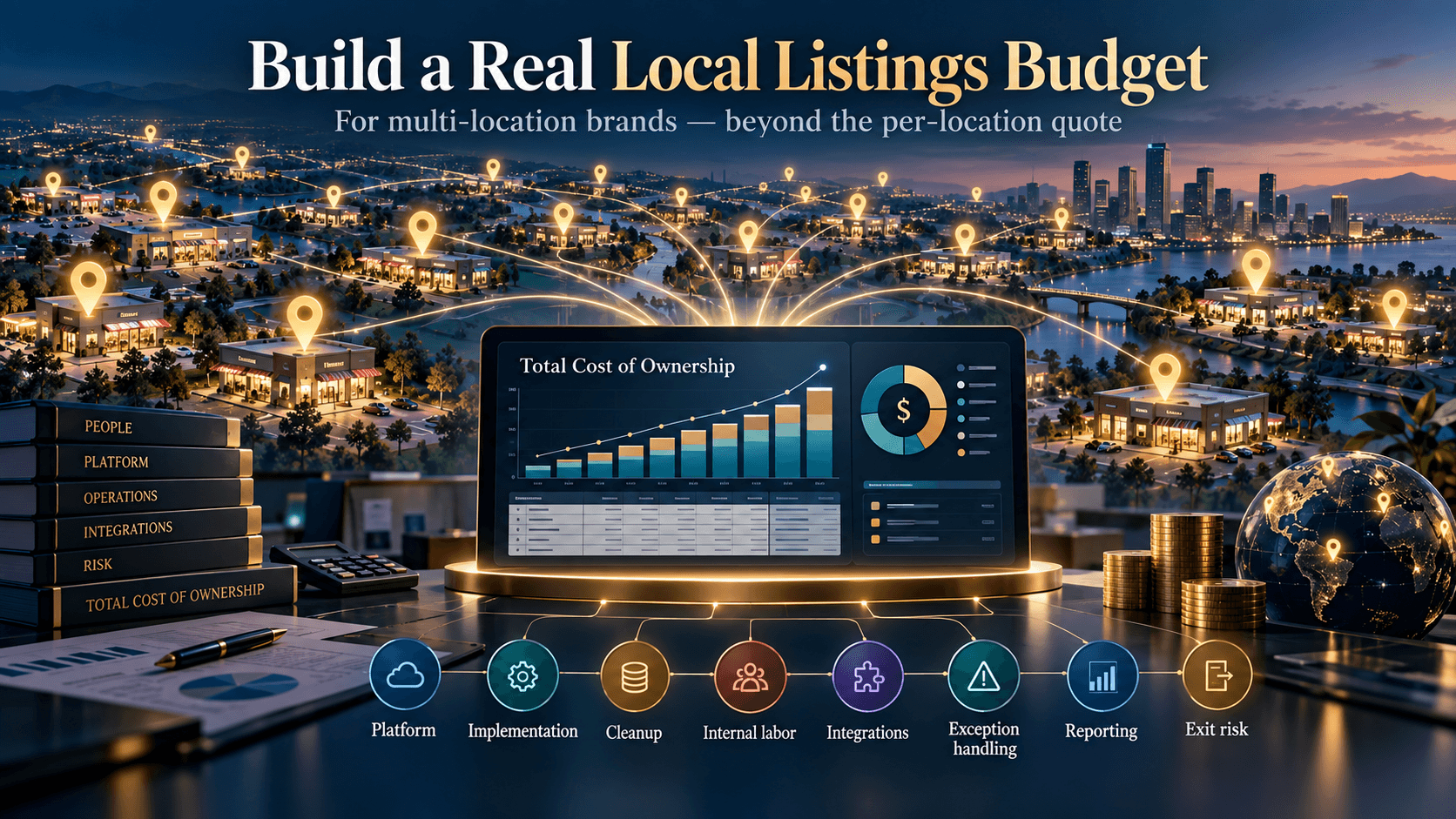
Multi-location brands should budget local listings management as a total operating program, not as locations multiplied by a vendor rate. The annual line should include the platform subscription, onboarding and migration, data cleanup, internal labor, integrations, exception handling, openings and closures, reporting, and exit costs. A per-location quote is only one input because the largest cost drivers are often operational.
That distinction matters most once a brand has dozens or hundreds of locations. A quote may look linear, but the real budget rarely is. Some platforms price in location bands, others use custom enterprise contracts, implementation effort rises with data complexity, and internal workload changes sharply when locations open, move, close, lose verification, or develop duplicate and ownership problems.
Editorial method: this guide separates documented vendor pricing from budgeting guidance. Public pricing and packaging were checked against official vendor pages on September 24, 2026. Where a vendor does not publish a numeric listings price, the article labels it quote-based rather than estimating one. No market-average implementation fee, ROI percentage, or labor benchmark is invented.
What should go into the budget line?
A local listings budget should include platform or software fees, directory and data-aggregator costs, implementation or migration expenses, staff or agency time, ongoing monitoring and correction work, reporting, and periodic audits. It should also account for one-time costs such as onboarding, integrations, cleanup, and large-scale location data updates.
- Recurring platform license or managed-service fee.
- One-time implementation, migration, configuration, and training.
- Initial cleanup for duplicates, ownership issues, bad source data, and legacy locations.
- Internal labor for approvals, data collection, QA, escalation, and reporting.
- API, middleware, CRM, BI, or data-warehouse integration work.
- Exception handling for suspensions, ownership disputes, publisher rejections, and support cases.
- Lifecycle work for openings, relocations, closures, rebrands, acquisitions, and divestitures.
- Measurement and reporting required to prove location health and business impact.
- Exit and migration work so the brand can change vendors without losing control of its data.
If finance sees only '150 locations × $X,' the budget hides the work that makes the software useful. It also creates a false comparison between vendors that bundle implementation, reporting, or support differently.
Why is a per-location quote not a complete budget?
A per-location quote measures one commercial unit, not total cost of ownership. It works only when the vendor fee is the dominant cost and every location requires roughly the same effort. Multi-location programs rarely behave that way because costs arrive as fixed fees, step changes, one-time projects, internal labor, and exception work.
The budget usually contains four different cost shapes:
| Cost shape | Examples | What triggers it | Why per-location math misses it |
|---|---|---|---|
| Fixed | Implementation, training, governance design, some integrations | Starting or redesigning the program | The cost exists even if the portfolio has few locations |
| Variable | Per-location licenses, managed location fees, some publisher products | Adding or removing locations | Useful, but only one part of the operating cost |
| Step-function | Tiered plans, volume bands, enterprise thresholds | Crossing a plan or portfolio boundary | The 51st location can change the bill differently from the 50th |
| Event-driven | Duplicate cleanup, ownership recovery, acquisitions, relocations, closures | Specific lifecycle or exception events | The workload is uneven and cannot be predicted from location count alone |
This is why an effective per-location cost can still be useful as a reporting metric, but it should be calculated after the budget is built, not used as the budget itself.
What formula should finance use for an annual listings budget?
Finance should calculate the annual listings budget as: annual software and license fees + internal labor + agency or service costs + directory or data fees + maintenance and monitoring + expected one-time costs. Keeping recurring and variable expenses separate makes forecasting easier and helps explain year-over-year budget changes.
Annual local listings budget = platform or service fees + implementation and migration + internal labor + integration and data costs + exception work + lifecycle-change work + measurement and reporting + exit or transition reserve.
Do not force every line into a per-location rate. Keep fixed costs fixed and event-driven costs visible. This makes year-over-year comparisons more honest because a brand that opens 40 locations or completes an acquisition can explain why spend changed without pretending the software suddenly became more expensive.
| Budget line | Recurring? | Owner | Forecast driver | Evidence to retain |
|---|---|---|---|---|
| Platform / service | Yes | Marketing / procurement | Active locations, plan, package, term | Quote, order form, renewal schedule |
| Implementation / migration | Usually one-time | Marketing + IT / ops | Systems, publishers, data condition, integrations | SOW, milestones, acceptance criteria |
| Internal operations | Yes | Marketing / local SEO / ops | Change volume and approval complexity | Role allocation, workflow volume |
| Integrations | Mixed | IT / RevOps / data | APIs, middleware, CRM, BI, security | Architecture, vendor fees, engineering estimate |
| Exception handling | Variable | Local SEO / support / agency | Duplicates, ownership, suspensions, publisher issues | Ticket counts and case logs |
| Lifecycle changes | Variable | Operations + marketing | Openings, moves, closures, acquisitions | Location plan and effective dates |
| Reporting / governance | Yes | Marketing + analytics | Stakeholder and compliance requirements | Dashboard and audit requirements |
| Exit / migration | Periodic | Procurement + IT + marketing | Contract end, vendor change, acquisition | Export rights, notice terms, transition plan |
How should brands forecast implementation, cleanup, and exception work?
Forecast these lines from portfolio condition and change volume, not from arbitrary percentages. A clean portfolio with stable ownership needs less remediation than an acquired network with duplicate profiles, former franchisees, conflicting addresses, and inconsistent store IDs. Finance should ask for workload evidence before accepting either a large setup fee or an unrealistically small one.
Implementation should have a scope, not just a fee
A useful implementation scope names the systems being connected, data fields being imported, account ownership being transferred, users being trained, locations being verified, and dashboards being configured. It should also define what counts as complete. 'Onboarding' without acceptance criteria is difficult to budget and difficult to challenge.
Cleanup should be separated from steady-state management
Initial duplicate suppression, ownership recovery, store-code normalization, and legacy-location cleanup are not the same work as keeping an already-clean portfolio current. Put them in a separate project line so the recurring run rate is not distorted by one-time remediation.
Exception work needs a queue
Suspensions, rejected edits, verification failures, duplicates, and publisher-specific issues are unpredictable at the individual-location level but measurable as a portfolio workload. Track the number of open cases, age, owner, and resolution state. That evidence is stronger than budgeting an undefined 'support' buffer.
How should internal labor appear in the budget?
Internal labor should be visible even when no incremental headcount is requested. Local listings requires someone to collect changes, approve data, coordinate openings and closures, review exceptions, manage access, check reporting, and work with vendors. Treating that time as free makes a cheaper platform look artificially economical.
You do not need to turn the budget into a time-sheet exercise. Assign the major roles, estimate the recurring workload they own, and revisit the assumption when the portfolio changes. For example, a centralized brand may need one approval owner, while a franchise system may spend more time chasing local changes and resolving conflicts between corporate and franchisee data.
The important comparison is not software price versus software price. It is software plus internal operating model versus the alternative software plus its operating model.
How do Yext, Synup, Uberall, SOCi, and BrightLocal change the budget shape?
These platforms should not be compared only on headline price because they create different budget structures. Yext is enterprise and quote-led. Synup publishes location-based tiers for smaller portfolios and moves larger estates toward enterprise pricing. Uberall and SOCi are primarily sales-led. BrightLocal publishes clear location bands. The right financial model depends on what the platform replaces and what work remains internal.
| Platform | Budget shape | What to include beyond license | Pricing visibility | Main budgeting risk | Best financial fit |
|---|---|---|---|---|---|
| Yext | Custom enterprise subscription with governance and integration value | Implementation, integrations, role design, data migration, ongoing administration | Listings pricing is sales-led rather than a simple public per-location card | Comparing the quote to lighter tools without valuing governance and integration work | Large enterprises with complex location data and systems |
| Synup | Published location tiers at smaller scales, with enterprise treatment for larger portfolios | Any add-on usage, integration work, migration, agency or managed-service labor, and contract-specific exit terms | More transparent at lower location bands than most enterprise-first vendors | Assuming the included-location tier is the full operating cost or ignoring step changes between plans | Growing multi-location teams and agencies that want a broader local marketing stack |
| Uberall | Package-led, quote-based multi-location pricing | Add-ons, integrations, implementation, analytics, collaboration, and internal governance | Official pricing page presents packages and request-pricing paths rather than numeric listings rates | Budget creep when add-ons are evaluated after the base package | International or enterprise teams buying a connected local presence stack |
| SOCi | Enterprise / franchise sales-led platform | Onboarding, governance, local-user rollout, integrations, automation oversight, reporting | Listings page is demo-led rather than a public numeric price card | Buying enterprise automation for a workflow that does not need franchise-scale governance | Franchise and decentralized enterprise networks |
| BrightLocal | Published location bands with separate local SEO and citation components | Citation Builder, any extra services, internal operator time, migration, and >100-location custom requirements | High: Manage pricing is published through 100 active locations | Treating the low effective location rate as proof that internal operations or other products are unnecessary | Smaller chains, agencies, and hands-on teams that value predictable bands |
Yext: Yext's official Listings page documents 200+ direct publisher integrations, bulk workflows, role-based access, audit trails, and enterprise-scale location management. Those capabilities explain why the budget should include governance and implementation, not only the license quote.
Synup: the site's September 2026 pricing review records published Synup bands from Solo through Scale, with Enterprise for larger portfolios. Use the local listings management cost in 2026 page for the current card-level numbers rather than duplicating them here. Budget the step between tiers as a threshold, not as a perfectly linear per-location curve.
Uberall: Uberall's official pricing page presents package-led plans and add-ons such as analytics and collaboration, with request-pricing paths for parts of the offering. That means procurement should price the configured package, not treat 'Listings' as the entire annual cost.
SOCi: SOCi's official Business Listings Management page positions listings inside an automated multi-location platform and directs buyers to a demo rather than publishing a numeric listings rate. Budgeting should therefore start with scope, location governance, and integration requirements before the sales quote arrives.
BrightLocal: BrightLocal's official pricing help page publishes Manage bands from $54 per month for one active location through $769 per month for 91-100 locations, with custom packages available above standard ranges. This is a useful example of why portfolio pricing can behave as a banded step function rather than a single per-location rate.
The comparison is not a ranking. Yext can justify a larger budget when enterprise governance is the requirement; Synup can be easier to model at lower published tiers; Uberall and SOCi need configured quotes; BrightLocal is easier to forecast from public bands. For buyer-fit differences beyond budgeting, see best local listings management platforms in 2026.
What should procurement ask before approving the budget?
Procurement should force the quote to reveal what creates cost now, what creates cost later, and what remains the brand's responsibility. This makes proposals comparable even when one vendor uses a per-location card and another uses a custom enterprise contract.
- What is the exact recurring price at our current location count, and what changes at the next two location thresholds?
- Which implementation, migration, training, or setup work is included versus separately billed?
- Are duplicate cleanup, ownership cases, verification problems, and publisher escalations included?
- Which analytics, APIs, integrations, white-label features, collaboration tools, or AI features require a higher plan or add-on?
- What internal work will our team still perform every week or month?
- How are new openings, closures, relocations, acquisitions, and divestitures priced?
- Is there a minimum term, auto-renewal window, early termination charge, or notice period?
- What data can we export, and what happens to publisher connections or enhanced content after cancellation?
- What support level and response process are included in the quoted package?
- Which assumptions in the quote would cause the annual spend to change?
A good proposal should let finance trace each answer to a budget line. If the answer to a cost question is 'included' without a defined scope, ask what volume, response level, or usage limit is actually included.
How should brands present the budget to finance?
Present the budget in three layers: run, change, and risk. This is easier to defend than a single software line because it explains what the company is paying to keep the portfolio stable, what it expects to change during the year, and what it must be able to recover from.
| Layer | What belongs here | Forecast source | Finance interpretation |
|---|---|---|---|
| Run | Recurring platform, internal operations, standard reporting, routine support | Current portfolio and contract | Baseline cost to keep listings operating |
| Change | Openings, moves, closures, acquisitions, integrations, migrations, cleanup projects | Annual business plan and known projects | Planned variable investment |
| Risk | Unexpected exception work, ownership recovery, emergency migration, contract exit | Historical cases and procurement risk review | Contingency that protects continuity |
Then calculate effective cost per active location as a secondary management metric. That figure can help compare years or business units, but it should include the full program cost and be accompanied by the reason it moved. A lower effective cost is not automatically better if it comes from cutting cleanup, governance, or support.
What should not be hidden inside the software line?
Do not hide internal labor, one-time remediation, managed services, integration engineering, or exit work inside a generic 'listings software' number. Those costs behave differently and have different owners. Keeping them separate makes the program easier to audit, renegotiate, and improve.
It also prevents a common procurement mistake: selecting the lowest software quote and discovering later that the organization still needs an agency, an internal coordinator, engineering time, and a separate reporting tool. Conversely, a higher platform quote may be defensible if it demonstrably replaces several of those lines. The budget should make that tradeoff visible rather than assuming it.
Conclusion: what is the right local listings management budget line?
The right local listings management budget is a total-cost-of-ownership model, not a per-location multiplication. Start with the recurring platform or service, then add implementation, cleanup, internal labor, integrations, exception handling, location lifecycle work, reporting, and exit risk. Keep fixed, variable, step-function, and event-driven costs separate so finance can see what actually drives spend.
Use per-location cost after the model is built as a normalization metric, not as the model itself. The best budget is the one that survives a new store opening, an acquisition, a vendor renewal, and a migration without forcing the team to discover previously invisible work.
Frequently asked questions
These questions focus on building a finance-ready listings budget rather than choosing the cheapest vendor.
How much should a multi-location brand budget for local listings management?
There is no defensible universal amount because vendor models and operating complexity differ. Build the budget from the actual subscription or quote plus implementation, labor, integrations, exception work, lifecycle changes, reporting, and transition costs. Use public vendor pricing only where it exists.
Should local listings management be budgeted per location?
Per-location pricing can be one recurring input, but it should not be the whole budget. Fixed implementation, internal labor, integrations, tier thresholds, acquisitions, closures, and support cases do not scale in a perfectly linear way.
What is the biggest hidden cost in listings management?
The most commonly hidden categories are internal operations and exception handling. Someone still has to approve data, coordinate location changes, resolve ownership and duplicate issues, review reports, and work with publishers or vendors when automation fails.
How should a brand compare Yext and Synup for budgeting?
Yext is usually modeled as a custom enterprise platform with governance and integration costs around the subscription. Synup is easier to model from published location tiers at smaller scales, but brands should still include integration, labor, usage, and contract-specific costs. Compare total operating model, not only the quote.
Why can BrightLocal look cheaper per location at larger bands?
BrightLocal publishes location bands rather than charging the one-location price repeatedly. That can lower the effective software cost per active location within a band. It does not eliminate internal labor, citation services, migration, or other program costs.
What should be included in a listings budget contingency?
Use the contingency for genuinely uncertain operating events such as verification failures, ownership recovery, unusual duplicate cleanup, emergency migrations, or unplanned acquisitions and closures. Do not use contingency to hide known recurring costs.