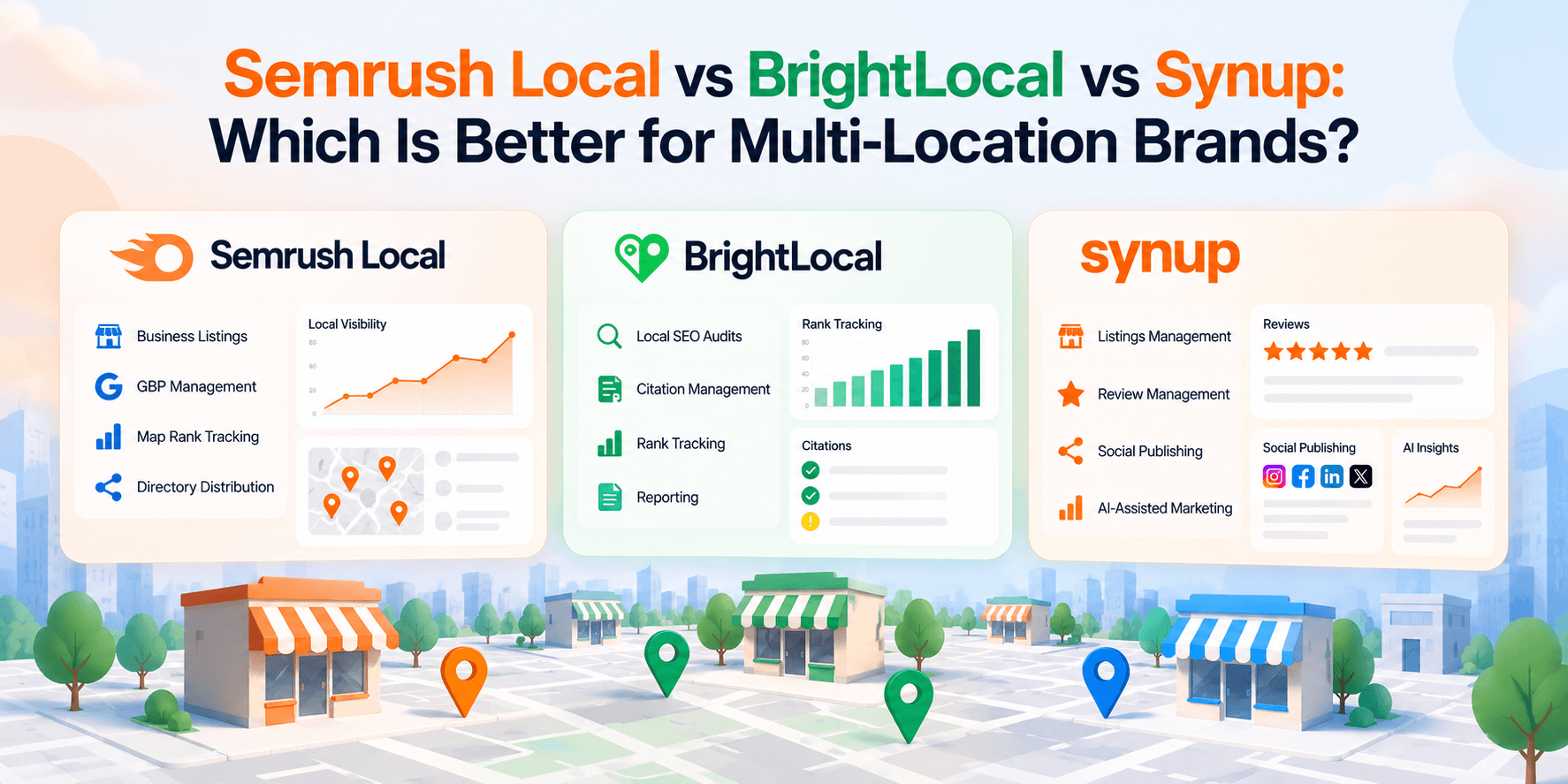
Semrush Local, BrightLocal, and Synup help multi-location businesses manage local search visibility, business listings, and customer reviews. However, each platform takes a different approach.
Synup is worth considering for integrated listings, reputation management, social publishing, and AI-assisted local marketing. Semrush Local focuses on Google Business Profile (GBP) automation, directory distribution, and geographic rank tracking. BrightLocal offers specialized local SEO auditing, citation management, and reporting tools.
For franchises, retail chains, healthcare networks, and agencies, the right choice depends on how many locations you manage, which marketing tasks need automation, and the level of reporting and administrative control your team requires.
This comparison examines their documented capabilities, published pricing, limitations, and suitability for multi-location operations.
Semrush Local vs BrightLocal vs Synup: Quick Comparison
| Platform | Best suited for | Main advantage | Key consideration |
|---|---|---|---|
| Synup | Brands and agencies managing multiple local marketing functions | Integrated listings, reviews, social publishing, and local visibility tools | Credit allowances and location tiers |
| Semrush Local | Teams prioritizing GBP automation and local search visibility | Automated profile workflows, listings distribution, and map rank tracking | Full listings management requires Pro or Business |
| BrightLocal | Agencies and brands needing detailed local SEO analysis | Ranking grids, citation auditing, and modular services | Listings and reputation tools depend on subscription tier |
All three platforms can support local search operations, but they differ in how they manage business information, automate tasks, and measure performance.
For integrated local marketing, evaluate Synup. For Google Business Profile automation and directory synchronization, consider Semrush Local. For specialized audits, citation management, and SEO reporting, BrightLocal deserves attention.
These recommendations reflect different use cases, not independent performance testing.
How We Evaluated These Platforms
This comparison focuses on the needs of US-based businesses managing multiple physical locations.
Seven criteria were used:
- Business listings management: Distributing and maintaining accurate location information.
- Google Business Profile management: Updating business details, publishing posts, monitoring changes, and managing connected profiles.
- Local rank tracking: Measuring visibility across relevant geographic areas.
- Review management: Monitoring reviews, requesting feedback, and coordinating responses.
- Multi-location administration: Managing corporate access, location groups, and distributed responsibilities.
- Pricing and limitations: Understanding subscriptions, add-ons, usage allowances, and billing models.
- Operational suitability: Supporting agencies, franchises, regional businesses, and enterprise teams.
Product information and published prices were checked against official vendor documentation available in October 2026.
The article does not represent hands-on testing or independently measured software performance. Recommendations are editorial assessments based on documented capabilities and practical buying requirements.
For a broader purchasing framework, see this local listing management software evaluation checklist.
Semrush Local vs BrightLocal vs Synup: Feature Comparison
| Feature | Synup | Semrush Local | BrightLocal |
|---|---|---|---|
| Business listings management | Included | Pro and Business | Manage and Grow |
| Google Business Profile management | Supported | Base, Pro, and Business | Plan-dependent |
| Local rank tracking | Geographic rank grids | Map Rank Tracker | Local Rank Tracker and Local Search Grid |
| Citation auditing | Listing accuracy and health monitoring | Listing monitoring and accuracy tools | Dedicated Citation Tracker |
| Listings distribution | Publisher network | Pro and Business | Active Sync on Manage and Grow |
| Manual citation building | Confirm available services | Not a primary offering | Separate Citation Builder |
| Review monitoring | Included | Expanded management in Pro | Grow |
| Review generation | Included | Pro and Business | Grow |
| Social publishing | Connected social channels | Primarily GBP publishing in Local toolkit | GBP posting on Manage and Grow |
| AI-assisted capabilities | Sydekick workflows | GBP AI Agent | AI visibility and insights tools |
| Multi-location administration | Location-based tiers | Per-location plans and Business offering | Location-based tiers and custom plans |
| Published pricing | Yes | Yes | Yes |
Feature availability can depend on the selected plan, connected publishers, permissions, and usage limits.
For example, Semrush Local Base includes automated GBP review replies, but the broader Review Management product is part of Pro.
Similarly, BrightLocal provides citation auditing on Track, while ongoing Active Sync is available on Manage and Grow.
The differences become clearer when examining each platform individually.
1\. Synup: Best for Integrated Multi-Location Marketing
Best for: Multi-location brands, franchise networks, and agencies seeking centralized listings, reputation management, local visibility reporting, and social publishing.
Synup is a local marketing platform that combines business listings management, review workflows, local SEO monitoring, social publishing, and AI-assisted automation.
Its platform is designed to help organizations coordinate marketing activities across numerous physical locations.
For a retail or service chain operating several dozen branches, Synup can provide a centralized environment for maintaining business information, monitoring customer feedback, and identifying local search issues.
Synup also offers Sydekick, an AI agent that supports activities such as identifying listing discrepancies, preparing review responses, generating content, and monitoring local visibility.
According to Synup's product documentation, the agent supports approval-based workflows and can perform selected tasks within configured rules.
Key Features
Business listings management
Synup supports distributing and synchronizing business information across its connected publishing network.
Businesses can maintain names, addresses, telephone numbers, operating hours, categories, and other supported attributes.
Synup's listings synchronization documentation explains that location information must be verified before synchronization begins.
Certain publishers, including Google, Facebook, and Yelp, require businesses to connect their accounts before synchronization can occur.
Review management
Synup provides tools for monitoring customer reviews, preparing responses, and managing review-request campaigns.
These features can help corporate marketing teams identify which locations have unanswered reviews or recurring reputation concerns.
Local rank tracking
The platform offers geographic rank tracking, allowing businesses to examine search visibility across different areas rather than relying only on one citywide ranking position.
Social publishing
Synup supports scheduling and publishing social content through connected accounts.
Businesses should verify the supported networks and workflow permissions required for their particular campaigns.
AI-assisted marketing
Sydekick can assist with listings, reviews, social content, local SEO, and AI search visibility monitoring.
The platform's capabilities documentation outlines its supported activities.
Multi-Location Strengths
Synup's principal advantage is its integration of several local marketing functions.
Consider a home services franchise operating 40 branches.
Corporate marketing may need to maintain approved business categories, monitor listing accuracy, and coordinate promotional content.
Individual branch managers may be responsible for reporting changes to opening hours or handling local customer feedback.
A platform combining these functions can reduce the need to work across several disconnected tools.
Synup is also relevant to agencies managing multiple client locations because it provides centralized reporting and white-label capabilities on eligible plans.
However, the value of consolidation depends on whether the platform supports the organization's actual integrations, permissions, and reporting requirements.
Limitations
Synup uses monthly credits for certain automated activities.
Businesses should confirm which actions consume credits, how much usage their typical workflows require, and whether additional purchases will be necessary.
According to Synup's pricing documentation, agent work pauses when available credits are exhausted, while other non-credit-metered platform functions continue operating.
The Solo plan does not include white labeling, which is available from Premium onward.
Organizations primarily needing occasional citation audits or basic rank reports may also find that a narrower SEO-focused product is sufficient.
Synup Pricing
Synup publishes the following monthly subscription plans:
| Plan | Included locations | Monthly price |
|---|---|---|
| Solo | 1 | $49 |
| Premium | Up to 10 | $299 |
| Pro | Up to 25 | $499 |
| Scale | Up to 50 | $899 |
| Enterprise | More than 50 | Custom |
Its published pricing includes core features across plans, with differences in location capacity, monthly credits, concurrent agent activity, and infrastructure.
Annual billing discounts are available.
Before purchasing, confirm how the platform counts locations, particularly when multiple brands or business profiles operate from the same physical address.
Choose Synup if: Your organization wants to coordinate listings, reviews, local SEO, social content, and automation across multiple locations within a shared platform.
2\. Semrush Local: Best for Google Business Profile Automation and Local Visibility
Best for: Businesses and marketing teams prioritizing Google Business Profile automation, listings synchronization, and geographic search visibility.
Semrush Local provides tools for managing local search presence, Google Business Profiles, online listings, customer reviews, and geographic rank tracking.
Its Local toolkit is available as a standalone product or alongside other Semrush subscriptions.
The platform is particularly relevant to marketing teams that want to automate selected GBP activities while measuring visibility across Google Maps.
For organizations already using Semrush for wider SEO research and reporting, the Local toolkit may fit into an existing software environment.
However, buyers should confirm whether their intended workflows require other Semrush subscriptions or reporting add-ons.
Key Features
Google Business Profile automation
Semrush Local Base includes GBP AI Agent capabilities.
These support tasks such as generating and publishing GBP posts, responding automatically to reviews, publishing supplied photographs, and suggesting profile improvements.
Automated actions should still be configured carefully, especially when responding to sensitive customer feedback.
Listings management
Semrush Local Pro includes Listing Management, which distributes business information to supported directories.
The platform also offers tools for detecting duplicates, monitoring listing information, and handling certain publisher suggestions.
Review management
Local Base includes automated responses to Google reviews.
Local Pro adds broader review monitoring, review generation campaigns, alerts, and additional analytics.
Map Rank Tracker
Semrush provides geographic ranking analysis through Map Rank Tracker.
Its published Local plans include different credit allowances:
- Local Base: 375 Map Rank Tracker credits
- Local Pro: 1,225 Map Rank Tracker credits
Multi-location administration
Semrush Local Pro supports bulk GBP connections, location grouping, and team collaboration.
Larger organizations can also request customized arrangements through Local Business.
Multi-Location Strengths
Semrush Local is particularly relevant when Google Maps visibility is a significant marketing KPI.
For example, a retailer may want to compare search visibility around individual stores and identify geographic areas where competitors appear more prominently.
Map Rank Tracker can help marketing teams investigate those differences.
The platform also offers automated GBP workflows that may reduce manual publishing and maintenance work.
For larger businesses, Local Business provides a route to customizable limits and support arrangements.
Semrush states that this offering is available for organizations managing 20 or more locations.
Limitations
Local Base does not include the full listings distribution and centralized review management capabilities provided by Pro.
Businesses requiring those functions should evaluate Local Pro or request a Business quotation.
Publisher behavior is another consideration.
Semrush distinguishes between directories that support ongoing synchronization and submission-based publishers that independently control publication and later edits.
According to Semrush's Listing Management documentation, the platform cannot guarantee that submission-based publishers will accept every update or preserve information against future changes.
Organizations should therefore monitor public listing accuracy rather than treating successful submissions as confirmed corrections.
Semrush Local Pricing
Semrush publishes the following prices with annual billing:
| Plan | Price | Main capabilities |
|---|---|---|
| Local Base | $30/month per location | GBP automation and Map Rank Tracker |
| Local Pro | $60/month per location | Base features plus listings, expanded review management, and advanced GBP tools |
| Local Business | Custom | Customized limits, pricing, and support |
The monthly amounts shown for Base and Pro require annual billing.
Additional users, reporting products, or other services may create separate charges depending on the account configuration.
Choose Semrush Local if: Your organization prioritizes Google Business Profile automation, directory synchronization, and map-based search visibility reporting.
3\. BrightLocal: Best for Local SEO Auditing and Citation Management
Best for: Agencies, local SEO specialists, and multi-location brands requiring detailed audits, rank tracking, citation analysis, and flexible reporting.
BrightLocal is a local SEO platform focused on measuring and managing local search performance.
Its products include geographic rank tracking, Google Business Profile audits, citation analysis, listings management, and review-related capabilities.
Rather than requiring every customer to adopt a broad marketing suite, BrightLocal offers subscription tiers and separately priced citation services.
This can be useful for agencies and in-house SEO teams that already use other tools for social publishing or customer communication.
For example, an agency managing 30 healthcare locations may need detailed search audits and citation reports without replacing its existing customer engagement systems.
Key Features
Local Rank Tracker
Tracks local keyword visibility across supported search environments and reporting configurations.
Local Search Grid
Displays geographic ranking performance, helping businesses examine variations in visibility across neighborhoods and service areas.
Citation Tracker
Identifies existing business citations and reports inconsistencies or citation opportunities.
Google Business Profile Audit
Helps businesses review GBP information and relevant local search signals.
Active Sync
Supports ongoing business information synchronization on eligible plans.
Citation Builder
Provides separately purchased manual citation submissions, corrections, and selected additional services.
Reputation management
BrightLocal Grow includes review monitoring, review generation, and related reputation features.
Its subscription documentation explains which products are included in each plan.
Multi-Location Strengths
BrightLocal is particularly useful when teams need to diagnose specific local SEO problems.
Consider an agency managing 30 clinics.
The agency may discover that several locations have incomplete business information, inconsistent citations, or weaker visibility in specific neighborhoods.
BrightLocal's auditing and ranking tools can help identify where attention is needed.
Its modular structure can also be useful when the business prefers to purchase manual citation services separately rather than subscribing to a more extensive enterprise marketing platform.
White-label reporting is another consideration for agencies presenting local SEO results to clients.
Limitations
BrightLocal is not primarily a comprehensive social media publishing platform.
Organizations needing extensive social collaboration, automated customer communication, or enterprise-wide campaign management may need additional software.
Its citation products also serve different purposes.
Citation Tracker audits citations, Active Sync provides ongoing synchronization through supported connections, and Citation Builder performs separately purchased manual work.
Businesses should not assume that identifying an error in Citation Tracker automatically corrects the public directory listing.
BrightLocal's standard location tiers extend to 100 locations, with custom arrangements available for larger portfolios.
BrightLocal Pricing
BrightLocal offers three principal subscription tiers: Track, Manage, and Grow.
For businesses managing 21–30 locations, its published monthly-billing rates are:
| Plan | Monthly price | Primary focus |
|---|---|---|
| Track | $156 | Audits, rank tracking, and citation analysis |
| Manage | $230 | Track features plus ongoing listings management |
| Grow | $296 | Manage features plus reputation management |
Annual billing discounts are available.
Citation Builder is charged separately.
According to BrightLocal's pricing documentation, standard manual submissions or updates cost $3.20 per site when paying by card.
The company also advertises citation pricing starting at $2 per citation through qualifying purchase options.
Additional services, such as duplicate removal, can carry extra charges.
Choose BrightLocal if: Your team places greater value on local SEO auditing, geographic ranking analysis, citation correction, and modular purchasing than on broad social marketing functionality.
Semrush Listing Management vs BrightLocal: What's the Main Difference?
The main distinction is how the products combine business listings distribution, citation auditing, and correction workflows.
Semrush Local Pro emphasizes ongoing directory distribution through supported publisher connections.
BrightLocal offers citation auditing across its subscription tiers, ongoing listings synchronization through Active Sync on eligible plans, and a separately purchased Citation Builder service.
Synup also supports ongoing listings distribution but combines it with broader reputation and social marketing functionality.
Listings Distribution vs Citation Building
| Requirement | Synup | Semrush Local | BrightLocal |
|---|---|---|---|
| Maintain location records | Yes | Yes | Supported through relevant tools |
| Distribute business updates | Publisher network | Pro and Business | Active Sync on Manage and Grow |
| Audit existing citations | Listings health monitoring | Listings accuracy monitoring | Dedicated Citation Tracker |
| Purchase manual citation work | Confirm service requirements | Not a primary offering | Citation Builder |
| Monitor synchronization issues | Supported | Supported | Supported through applicable tools |
| Manage publisher exceptions | Requires verification | Publisher-dependent | Service and publisher-dependent |
Citation building, continuous listings synchronization, and live-data verification are related but different activities.
For example, submitting a corrected address to a directory does not necessarily mean the directory has published it.
Even after an update appears publicly, later changes from users, publishers, or other data sources may require additional monitoring.
A reliable process should therefore include one approved source of business information, controlled distribution, and verification of public results.
This local listings management guide explains how organizations can structure those responsibilities.
BrightLocal's Citation Builder documentation also provides further details about its manual submission service.
Which Platform Offers Better Local Rank Tracking?
All three platforms provide geographic local visibility measurement, but the tracking tools and available reporting limits differ.
Semrush Local includes Map Rank Tracker.
BrightLocal offers Local Rank Tracker and Local Search Grid.
Synup provides local rank grid tracking and location visibility reporting.
The appropriate choice depends on what the organization needs to measure.
Why Geographic Rankings Matter
Consider two dental clinics located several miles apart.
A customer searching near the first clinic may see a different set of Google Maps results from someone performing the same search near the second clinic.
Reporting a single ranking position for the entire city can hide those differences.
A useful local rank tracking workflow should examine:
- Search visibility around individual locations
- Differences across neighborhoods or service areas
- Relevant competitors in each geographic market
- Changes across comparable reporting periods
- Keyword and tracking capacity for the full location portfolio
Google explains that local ranking is primarily influenced by relevance, distance, and prominence.
As a result, visibility can differ according to the searcher's location even when two businesses have similar profiles.
See Google's official local ranking guidance.
For a broader explanation of location-specific optimization, see this guide to local SEO for multiple locations.
What to Compare Before Buying
A marketing team should compare rank tracking based on geographic coverage, keyword limits, grid resolution, refresh frequency, historical reporting, and export capabilities.
Also consider how much tracking capacity is included in the subscription.
For example, Semrush Local uses Map Rank Tracker credits, while BrightLocal provides tool allowances and report limits through its subscription structure.
The platform with the most appealing ranking visualization is not necessarily the one that provides sufficient capacity for every branch and keyword.
Pricing Comparison: What Do 25 Locations Cost?
A hypothetical business with 25 locations provides a useful way to compare the published pricing models.
However, the subscriptions below cover different functionality and should not be treated as equivalent packages.
Illustrative Monthly Costs for 25 Locations
| Platform and plan | Monthly subscription equivalent | Billing basis |
|---|---|---|
| Synup Pro | $499 | Published monthly price covering up to 25 locations |
| Semrush Local Base | $750 | 25 × $30, billed annually |
| Semrush Local Pro | $1,500 | 25 × $60, billed annually |
| BrightLocal Track | $156 | Published monthly price for 21–30 locations |
| BrightLocal Manage | $230 | Published monthly price for 21–30 locations |
| BrightLocal Grow | $296 | Published monthly price for 21–30 locations |
Prices reflect publicly listed US-dollar rates reviewed on October 28, 2026.
Semrush Local's amounts are monthly equivalents under annual billing. BrightLocal and Synup figures use their published monthly-billing rates.
<text>For the three broader options in this example, the advertised monthly subscription equivalents are:</text>
| Plan | Monthly equivalent |
|---|---|
| BrightLocal Grow | $296 |
| Synup Pro | $499 |
| Semrush Local Pro | $1,500 |
The difference does not automatically mean one platform provides better value.
BrightLocal Grow includes specialized local SEO and reputation tools.
Synup Pro combines listings, reviews, social publishing, local search visibility, and AI-assisted workflows within its stated capacity and credit allowances.
Semrush Local Pro uses per-location pricing and includes advanced GBP workflows, listings management, review tools, and Map Rank Tracker credits.
Why the Cheapest Subscription May Not Be the Best Value
Subscription prices are only one part of the total cost.
For a fair comparison, organizations should account for the following:
- Required product modules and features
- Additional locations or business profiles
- Rank tracking and automation usage limits
- Customer review and messaging requirements
- Additional users and reporting products
- Integrations and onboarding services
- Manual citation work
- Internal administration and support requirements
A lower-priced platform may require complementary software.
A more expensive product may also provide capabilities that the organization rarely uses.
For portfolios beyond standard published tiers, request enterprise quotations based on identical requirements.
How Should Franchise and Enterprise Teams Evaluate These Tools?
Software suited to an independent business may not automatically meet the requirements of a large franchise or enterprise network.
The purchasing process should examine how headquarters, regional marketers, franchise owners, and agencies share responsibilities.
Centralized Control and Location Ownership
Corporate marketing should have clearly defined authority over brand-critical information.
Individual locations may need permission to manage operating hours, photographs, or approved customer responses.
For example, a franchise manager may need to update holiday hours but should not be able to change the official business name across the entire network.
During vendor demonstrations, ask to see how permissions work for different organizational levels.
Also verify who retains ownership of the underlying business profiles if the software contract ends.
This multi-location listing ownership guide provides a useful framework for separating account ownership from day-to-day management access.
Opening, Relocating, and Closing Locations
Managing a changing location portfolio requires clear procedures.
Opening a new location involves verifying eligibility, creating accurate business information, connecting the correct accounts, and confirming public details.
A relocation requires carefully updating the relevant address and customer-facing information.
Permanent closures need equal attention.
A closed business should not remain marked as open because outdated directory information was left unchanged.
This location closure checklist outlines the coordination required across public profiles, directories, and website information.
Google's Business Profile guidelines should guide decisions about business names, locations, categories, and profile eligibility.
Monthly Operational Accountability
A multi-location marketing platform should make it easier to identify unresolved issues and assign responsibility.
For example, a branch manager may report incorrect Sunday operating hours while the corporate marketing team controls publishing access.
A useful workflow should record the issue, assign ownership, submit the correction, and verify whether the public listing was updated.
The platform should also make unresolved problems visible to the appropriate managers.
For recurring location-level tasks, this franchisee local SEO checklist provides a practical framework.
A 30-Day Software Evaluation Plan
Instead of migrating an entire location portfolio immediately, test the shortlisted platforms using approximately five representative branches.
The objective is to compare how each product handles the same real-world tasks.
| Period | Activity | Evidence to collect |
|---|---|---|
| Week 1 | Import approved business information and configure access | Data completeness, account connections, and setup effort |
| Week 2 | Update operating hours and correct known listings errors | Submission results, publisher acceptance, and public accuracy |
| Week 3 | Test review workflows, geographic rankings, and user permissions | Workflow performance, reporting quality, and unresolved issues |
| Week 4 | Evaluate support, usage limits, costs, and employee feedback | Operational effort and purchasing decision |
Choose locations with different characteristics.
A useful pilot could include a high-performing branch, a branch with inaccurate listings, a location in a competitive market, a franchise-operated branch, and a location with unusual operating hours.
Questions to Ask During the Pilot
Ask every vendor to demonstrate the same activities.
Can the system detect an incorrect telephone number? Can it submit and verify a correction? Can a regional manager identify unanswered reviews across multiple locations? Can headquarters approve business information changes before publication?
Also test what happens when a publisher rejects an update or an automation reaches a usage limit.
A platform that clearly reports unresolved issues may be more valuable operationally than one that displays a successful submission without confirming the public result.
At the end of the pilot, compare workflow completion, administrative effort, reporting quality, and full commercial costs.
The goal is to select software that supports the organization's actual operating model rather than relying entirely on feature lists.
Frequently Asked Questions
Is Semrush Local Better Than BrightLocal for Multi-Location SEO?
Neither platform is universally better.
Semrush Local is particularly relevant when GBP automation, listings synchronization, and geographic visibility tracking are priorities.
BrightLocal is more focused on specialized local SEO audits, citation management, and reporting.
The better choice depends on whether your organization values ongoing publishing workflows, diagnostic SEO tools, or a combination of both.
Does Synup Offer the Same Features as Semrush Local and BrightLocal?
The three platforms overlap in business listings, reviews, and local visibility measurement.
However, their capabilities, interfaces, permissions, and usage allowances differ.
Synup also offers social publishing and AI-assisted workflows through Sydekick.
Its official capabilities documentation provides information about these functions.
Buyers should test their required workflows rather than assuming feature names indicate identical functionality.
Can Semrush Local Manage Multiple Google Business Profiles?
Yes.
Semrush Local supports multi-location management, including bulk GBP connections and editing through relevant plans.
Its Business offering is available for larger organizations requiring customized arrangements.
The Semrush Local plan documentation explains the available features and location-based requirements.
Does BrightLocal Charge Separately for Citation Building?
Yes.
BrightLocal's Citation Builder is a separately priced service.
Standard manual submissions or updates cost $3.20 per site when paying by card, with other purchase options and additional services available.
Its subscription plans provide citation auditing through Citation Tracker, while Active Sync is included in eligible tiers.
See BrightLocal's official Citation Builder pricing.
Which Software Is Most Appropriate for More Than 100 Locations?
All three can be evaluated for larger organizations, but standard subscription tiers may not cover every enterprise requirement.
Synup offers an Enterprise tier for portfolios exceeding its Scale plan.
Semrush Local provides a customizable Business offering.
BrightLocal offers custom arrangements for organizations managing more than 100 locations.
Ask each vendor for proposals covering locations, permissions, integrations, publisher coverage, reporting, usage limits, and support.
Will Listings Management Software Automatically Improve Google Maps Rankings?
No.
Listings management software can help businesses maintain accurate information, identify problems, and monitor local visibility.
However, Google does not guarantee ranking improvements from using a particular software platform.
Relevance, distance, and prominence remain central factors in local rankings.
Businesses should measure improvements in information accuracy, reporting quality, customer engagement, and operational efficiency without assuming a direct ranking increase.
Final Buying Recommendation
For multi-location brands comparing Semrush Local, BrightLocal, and Synup, the right choice depends on the organization's operating priorities.
Synup is worth considering when listings, reviews, social publishing, local SEO, and AI-assisted workflows need to operate within one environment.
Semrush Local is relevant when Google Business Profile automation, directory distribution, and geographic search visibility are central requirements.
BrightLocal is particularly useful for organizations emphasizing local SEO auditing, citation management, geographic ranking analysis, and modular services.
Before choosing, compare current product documentation, request equivalent pricing proposals, and test each platform with representative locations.
For additional purchasing options, see this local listing management software comparison.
The strongest buying decision comes from verified workflow performance, transparent costs, and clear operational requirements not simply the number of features advertised.