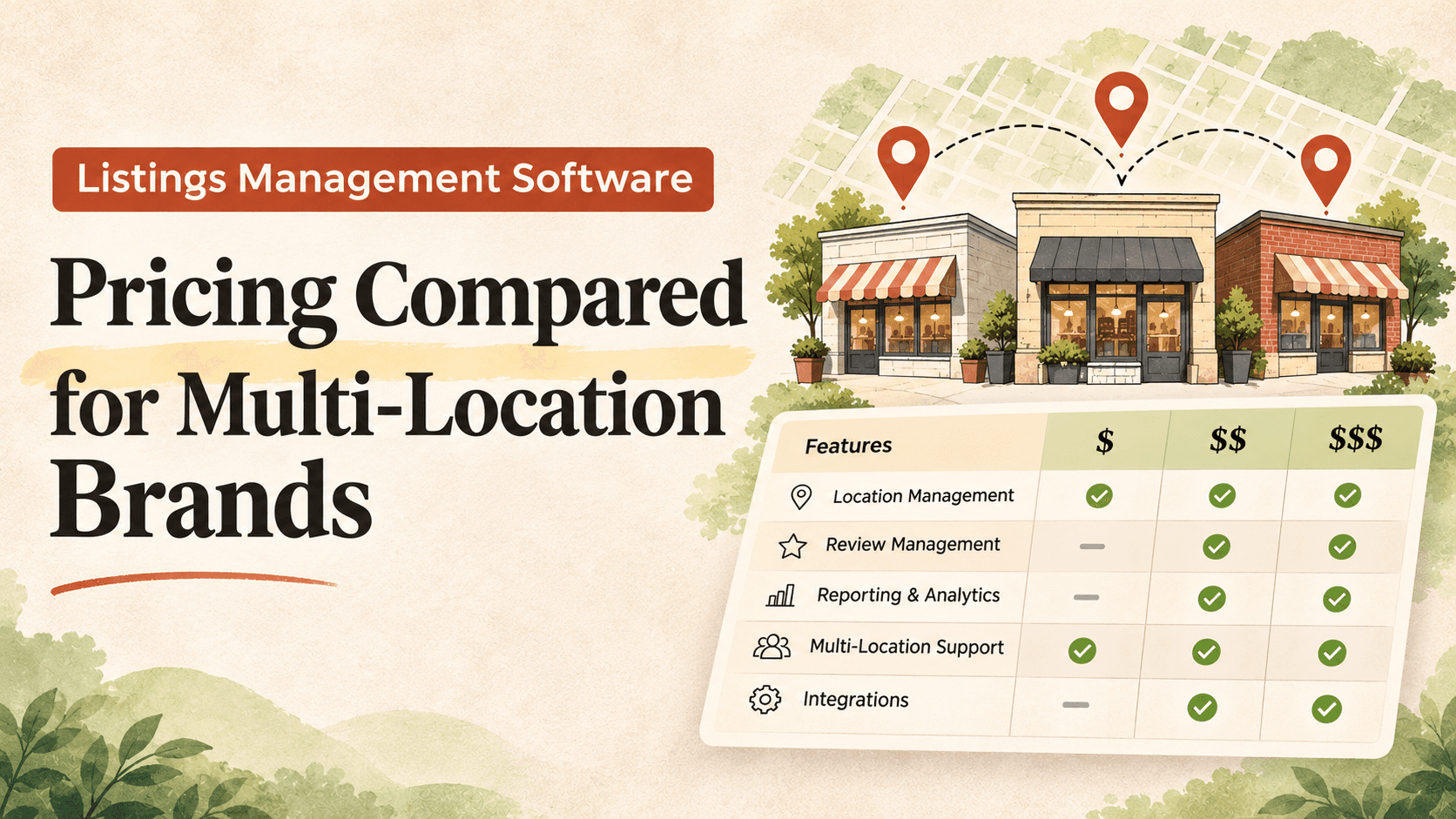
For multi-location brands, the lowest advertised subscription is not necessarily the most economical choice. A platform that reduces manual updates, improves operational control, and replaces several existing tools may offer better overall value, even with a higher subscription fee.
Six platforms worth comparing are BrightLocal, Synup, Yext, Moz Local, Uberall, and SOCi.
BrightLocal offers published pricing for local SEO and listings tools. Synup combines location management with broader marketing capabilities and capacity-based plans. Yext focuses on structured location data and publisher distribution, while Moz Local emphasizes ongoing listing maintenance. Uberall and SOCi are relevant to brands with more complex multi-location operations.
This guide compares their pricing models, explains what affects the total cost, identifies potential additional charges, and shows how to evaluate software for 10, 50, 100, or more business locations.
Listings Management Software Pricing at a Glance
The most suitable pricing model depends on your location count, required capabilities, and how your team manages listing updates.
| Software | Best suited for | Pricing approach | Main cost consideration |
|---|---|---|---|
| BrightLocal | Smaller chains, agencies, and local SEO teams | Published plans based on location-count bands | Features vary by plan; citation services cost extra |
| Synup | Growing multi-location brands | Published location-capacity plans | Credit allowances, capacity thresholds, and additional usage |
| Yext | Enterprise location data management | Product packages and contract-based enterprise pricing | Selected products, licenses, and implementation scope |
| Moz Local | Focused listings management | Location-based subscriptions | Confirm current pricing, geographical eligibility, and features |
| Uberall | International and distributed businesses | Feature-based packages with quote-led pricing | Included modules, add-ons, geography, and integrations |
| SOCi | Franchise and enterprise marketing operations | Custom pricing based on locations and selected agents | Agent selection, usage limits, and deployment scope |
Key takeaway: Compare the total annual cost of managing your active locations, not simply the advertised starting subscription.
A platform charging more for software may still be more economical if it reduces repetitive work or eliminates the need for additional services.
For background on the operational requirements, see this local listings management guide.
How We Evaluated Listings Management Software Pricing
This comparison covers six established providers that offer business listing management capabilities for organizations with multiple locations.
The analysis uses six criteria:
- Pricing transparency: Whether subscription prices are publicly available or require a custom quotation.
- Billing structure: Whether charges are based on locations, capacity bands, features, usage, or enterprise contracts.
- Listing capabilities: Support for location updates, publisher synchronization, duplicate management, and ongoing monitoring.
- Multi-location scalability: Bulk changes, location grouping, access controls, and centralized governance.
- Additional functionality: Review management, local search reporting, social publishing, and other marketing tools.
- Total cost of ownership: Subscriptions, onboarding, integrations, additional services, and internal labor.
Published prices were checked against available official vendor information in November 2026.
Where current first-party prices could not be confirmed, the comparison explains the pricing approach without assigning an unsupported amount.
The recommendations are based on documented product capabilities and purchasing considerations. They are not the results of independent hands-on testing, negotiated enterprise purchasing, or controlled software performance benchmarks.
Prices are quoted in US dollars where applicable. Taxes, currencies, discounts, and contract-specific charges may differ.
Detailed Pricing Comparison: 6 Listings Management Platforms
1. BrightLocal — Best for Published Pricing and Flexible Citation Services
Best for: Small and midsize multi-location brands, agencies, and businesses that want transparent subscription pricing alongside local SEO reporting.
BrightLocal provides local SEO tools covering rankings, citation analysis, listing management, Google Business Profile audits, and review-related activities.
Its pricing structure is especially relevant to businesses that want to select a plan based on the number of locations they manage.
BrightLocal distinguishes between three subscription tiers:
- Track: Local ranking analysis, citation tracking, and auditing.
- Manage: Track capabilities plus listing synchronization and Google Business Profile posting.
- Grow: Manage capabilities plus review monitoring, review generation, and additional reputation features.
Citation Builder is a separate pay-as-you-go service.
BrightLocal pricing
The following are published US-dollar prices for monthly billing.
| Location allowance | Manage | Grow |
|---|---|---|
| 1 location | $54/month | $65/month |
| 6–10 locations | $109/month | $131/month |
| 21–30 locations | $230/month | $296/month |
| 41–50 locations | $384/month | $494/month |
BrightLocal also offers annual billing at discounted rates.
For example, its published annual price for Manage at one location is $485, equivalent to approximately $40.42 per month when spread across the year.
Monthly and annual billing should not be confused when comparing providers.
BrightLocal's Citation Builder starts at $3.20 per citation, with lower rates available through qualifying bulk credits. Citation work is not included automatically in the subscription price.
Strengths
BrightLocal's published pricing makes initial budgeting relatively straightforward.
The separation between subscriptions and one-time citation services also allows organizations to purchase specific citation work without committing to every available marketing feature.
Its local rank tracking and auditing capabilities are useful when teams need reporting alongside listing maintenance.
Limitations
Not every subscription includes listing synchronization or review management.
Buyers should also check report allowances, citation charges, synchronization capabilities, and publisher coverage.
BrightLocal identifies the United States, United Kingdom, Canada, and Australia as its principal platform markets, with citation services available in additional countries. Organizations operating internationally should confirm the coverage applicable to each market.
For enterprise networks or brands requiring complex approval processes, evaluate governance capabilities before purchasing.
Choose BrightLocal if: Your organization wants published subscription prices, local SEO reporting, and flexibility between ongoing software and separately purchased citation work.
2. Synup — Best for Combining Listings and Local Marketing Workflows
Best for: Growing multi-location brands and agencies that want listings, reviews, local search monitoring, content publishing, and automation within one environment.
Synup provides centralized location management alongside broader local marketing functionality.
Its published offerings describe business listing synchronization, review management, local visibility reporting, social publishing, and AI-assisted workflows.
For a company operating dozens of franchise outlets, this approach may reduce the need to use separate applications for routine listing maintenance and related marketing activities.
For example, a retail brand could coordinate approved opening-hour updates across its locations while monitoring review activity and identifying listing discrepancies.
Synup pricing
Synup publishes capacity-based plans with monthly and annual billing options.
The following are the advertised monthly prices.
| Plan | Monthly price | Included locations | Effective cost at full capacity |
|---|---|---|---|
| Solo | $49 | 1 | $49.00/location |
| Premium | $299 | Up to 10 | $29.90/location |
| Pro | $499 | Up to 25 | $19.96/location |
| Scale | $899 | Up to 50 | $17.98/location |
| Enterprise | Custom quote | More than 50 | Contract-dependent |
The effective rates above assume that every available location slot is being used.
For example, a business using 25 locations on Pro would pay an effective $19.96 per location per month.
A business using only 15 locations on the same $499 plan would pay approximately $33.27 per active location.
This distinction matters when comparing capacity-based subscriptions against direct per-location billing.
Synup advertises an annual billing discount and includes different monthly agent-credit allowances by tier.
Its published plan structure provides core capabilities across location plans, while white labeling starts at Premium.
The plans also differ in concurrent agent capacity and infrastructure arrangements.
How Synup's usage credits affect costs
Synup uses credits for selected agent activities and infrastructure-intensive operations.
Its published documentation describes credit usage for activities such as listing updates, review responses, content publishing, and reporting.
If the included credit allowance is exhausted, metered agent work can pause until additional credits are purchased or capacity becomes available. Unmetered functionality is treated separately.
Businesses should therefore estimate both their number of locations and their likely automation volume.
A company making frequent bulk changes and generating substantial reporting activity may have different usage requirements from another business with the same number of locations.
Strengths
Synup can help consolidate several local marketing functions into one platform.
Its published capacity tiers are useful for organizations planning growth, particularly when they expect to move from a smaller portfolio to dozens of locations.
Centralized workflows may also reduce the time spent switching between separate listing, review, and reporting systems.
Limitations
Capacity-based pricing creates thresholds where adding a location may require moving to a higher tier.
Buyers also need to evaluate agent credits, additional usage charges, publisher coverage, and how automation is governed.
The value of the broader platform depends on whether the organization actually uses its additional marketing capabilities.
Choose Synup if: You want to combine listing management with reputation and local marketing workflows, and you can forecast both location growth and expected automation usage.
3. Yext — Best for Enterprise Location Data Distribution
Best for: Large organizations requiring centralized control over business information across numerous digital publishers.
Yext provides software for managing structured business data and distributing it across supported digital platforms.
Its Listings product works with Yext's centralized Knowledge Graph to store and maintain information about business locations.
For a retailer managing hundreds of stores, this architecture can help coordinate approved updates to addresses, opening hours, services, and other business information.
The platform is particularly relevant when multiple internal teams contribute to location data and require consistent publishing processes.
Yext pricing
Yext offers different product packages, including Listings, Pages, Reviews, and other digital presence capabilities.
Its enterprise pricing depends on the selected products, licensed entities or locations, and commercial agreement.
Yext also distinguishes its enterprise packages from single-location small-business offerings.
For a multi-location procurement process, buyers should request a written quote showing:
- Listings licenses and location allowances.
- Required products and additional modules.
- Publisher coverage and supported business fields.
- Data integration and API requirements.
- Onboarding and implementation services.
- User access, support, and contract terms.
Strengths
Yext's centralized structured-data model is useful for complex business location portfolios.
Its integration framework helps organizations manage approved information from a single environment.
It also provides publisher status and synchronization capabilities, although reporting and update support can vary by integration.
Limitations
Publisher integrations do not all offer identical functionality.
Some support two-way synchronization, while others primarily accept submissions. Update speed and available reporting also vary.
Organizations should verify the publishers, fields, licenses, and workflows included in their proposed agreement.
Businesses with relatively simple requirements should also assess whether enterprise implementation complexity is justified.
Choose Yext if: Centralized data governance, structured location information, and enterprise publisher distribution are your main priorities.
4. Moz Local — Best for Focused Listings Management
Best for: Small and midsize businesses that primarily need ongoing listing distribution, synchronization, and location monitoring.
Moz Local focuses on maintaining business information across supported online directories and location discovery services.
Its product offering includes listing distribution, monitoring, and additional local marketing capabilities.
For a regional business operating 15 stores, this type of software can help maintain accurate addresses, contact information, and operating hours without requiring a broader enterprise marketing system.
Moz Local pricing
Moz Local has offered location-based subscription plans, including Lite, Preferred, and higher-level options.
However, current official prices for those subscriptions could not be established reliably during this review.
For that reason, this comparison does not repeat the unverified $14 and $20 monthly rates found in the original article.
Before making a purchasing decision, obtain current pricing directly from Moz and confirm:
- The subscription price per business location.
- Available plans and included features.
- Whether monthly and annual billing are offered.
- Additional review, social, and reporting functionality.
- Geographic availability.
- Any multi-location or volume discounts.
Moz Local and Moz Pro are separate product offerings. Buyers should not assume a Moz Local subscription includes every feature of the broader Moz SEO research platform.
Strengths
Moz Local provides a focused option for businesses that want repeatable listing maintenance rather than extensive enterprise marketing operations.
Its location-oriented approach can simplify budgeting once the current subscription price and plan requirements are confirmed.
Limitations
Availability varies by geography and package.
Organizations operating in multiple countries should confirm that Moz Local supports the relevant markets and required publishers.
Buyers requiring customized franchise approvals, specialized integrations, or extensive citation development may need additional software or services.
Choose Moz Local if: Your primary requirement is straightforward listing synchronization and monitoring, and the current quoted package supports your business locations.
5. Uberall — Best for International Multi-Location Operations
Best for: Retailers, restaurants, service businesses, and enterprises coordinating location marketing across multiple regions.
Uberall provides location marketing software covering business listings, customer reviews, local social publishing, and related operational activities.
Its offering is relevant to brands that need central oversight while allowing regional teams to participate in local marketing.
A company operating in several countries may need to maintain consistent business information while accommodating different publisher networks, languages, and local operating requirements.
Uberall pricing
Uberall currently advertises three primary packages:
| Package | Main included capabilities |
|---|---|
| Show Up | Core location marketing functionality and listings |
| Stand Out | Core functionality, listings, and reviews |
| Connect | Core functionality, listings, reviews, and local social capabilities |
The company also advertises optional enhancements, including analytics, collaboration workflows, and additional publishing or review functionality.
Publicly comparable subscription prices were not available for these packages during this review.
Organizations should request a quote that separates the main package from optional modules and services.
The purchasing process should also establish the cost of implementation, geographical coverage, and integrations.
Strengths
Uberall is relevant to organizations whose location networks span multiple markets.
Its product structure can support listing management alongside reviews and broader local marketing activities.
This may reduce the need for separate products when a business requires those additional functions.
Limitations
Custom pricing makes it harder to estimate costs without a tailored proposal.
Not every publisher or feature is necessarily available in every country.
Buyers should request a country-by-country coverage schedule and confirm what the selected plan includes.
Approval workflows and additional collaboration capabilities may also require specific add-ons.
Choose Uberall if: Your organization operates across several markets and needs location management integrated with broader local marketing activities.
6. SOCi — Best for Franchise Marketing and Distributed Brand Governance
Best for: Franchise networks and enterprises that need centralized control while coordinating local search, reviews, and marketing execution.
SOCi provides a multi-location marketing platform that combines local search management, reputation workflows, social media, and AI-assisted operations.
Its product structure is designed for businesses where corporate marketing teams, franchisees, and local operators participate in different parts of marketing execution.
A national franchise, for example, may want to manage location information centrally while permitting approved local review responses and marketing content.
SOCi pricing
SOCi publishes a custom pricing approach based primarily on location count and selected Genius Agents and skills.
Its published model states that it does not charge additional per-user or per-listing fees.
Instead, the commercial scope depends on the number of locations and which capabilities the organization deploys.
SOCi identifies three main agent categories:
| Agent category | Relevant capabilities |
|---|---|
| Local Search | Listings management, optimization, and related search visibility work |
| Social | Social content creation, publishing, and engagement |
| Reputation | Review management, feedback, and reputation workflows |
Some skills have usage allowances that depend on the selected package.
Enterprise buyers should request a quote showing the cost of each required agent or bundle, location commitments, usage limits, and implementation services.
Strengths
SOCi is relevant when listing management forms part of a larger distributed marketing operation.
Its location- and agent-based structure may suit organizations that need to coordinate marketing activities across many local teams.
Its published lack of separate seat fees may also be useful when many employees and franchise operators require access.
Limitations
Organizations seeking only basic listing synchronization may not need the platform's broader functionality.
Buyers should carefully review which agents and skills are included, how usage limits operate, and what automation requires approval.
Enterprise deployment can also involve significant governance and integration planning.
Choose SOCi if: You manage a large franchise or distributed organization and need listings management alongside coordinated reputation and local marketing operations.
Comparing Published Prices at 10, 25, and 50 Locations
BrightLocal and Synup provide public pricing structures that allow a useful comparison of location-count effects.
The table below uses monthly billing and selected plans. It is not a feature-for-feature comparison.
| Active locations | BrightLocal Manage | Synup applicable plan | Synup monthly price |
|---|---|---|---|
| 10 | $109/month | Premium | $299/month |
| 25 | $230/month | Pro | $499/month |
| 50 | $384/month | Scale | $899/month |
These prices come from the vendors' published monthly schedules.
The important distinction is that the products do not provide identical feature bundles.
BrightLocal Manage includes local SEO reporting and supported listing synchronization, while Citation Builder remains separately billed and advanced reputation functions require Grow.
Synup includes a broader marketing feature set under its published plans, with different automation allowances and capacity limits.
Consequently, a company should not interpret the difference between the subscription prices as proof that one vendor is more cost-effective.
For example, a business using several separate services for reviews, social publishing, and location management may find value in consolidating functions.
Another business that needs only listing synchronization and local ranking reports may have little reason to pay for additional marketing capabilities.
The correct comparison is the cost of delivering the same required work.
What Determines Listings Management Software Pricing?
The most important pricing factors are location count, directory coverage, included features, usage allowances, and contract terms.
1. Number of business locations
Many providers charge based on managed locations, but the billing calculation differs.
Some use direct per-location prices. Others offer bands that include a maximum number of locations.
Enterprise providers may negotiate prices based on location volume and selected capabilities.
For example, a hypothetical subscription charging $20 per location per month would cost:
| Locations | Monthly subscription | Annual subscription |
|---|---|---|
| 10 | $200 | $2,400 |
| 50 | $1,000 | $12,000 |
| 100 | $2,000 | $24,000 |
| 500 | $10,000 | $120,000 |
These calculations are illustrative, not vendor quotations.
Capacity-based pricing requires additional care.
A plan allowing 50 locations may offer an attractive effective rate when fully used but a much higher rate when the business operates only 30 locations.
Organizations planning expansion should calculate costs for both current and forecast location counts.
2. Directory coverage and synchronization
Not every platform supports the same publishing destinations.
Coverage can vary across Google Business Profile, Apple Maps, Bing Places, Facebook, navigation services, and industry-specific directories.
A contract should specify which publishers are available in each country and which business fields can be updated.
Also distinguish between:
- Initial listing creation or submission.
- Ongoing synchronization.
- Duplicate identification and suppression.
- Manual citation-building services.
- Verification and correction of rejected changes.
A published network containing hundreds of destinations is not necessarily more valuable than reliable coverage of the platforms customers actually use.
3. Additional local marketing features
Some listings platforms also include review management, social publishing, local ranking reports, customer feedback tools, and AI-assisted workflows.
These can be valuable when they replace existing software subscriptions.
However, bundled features have little economic value if the organization does not use them.
Buyers should separate mandatory capabilities from optional functionality and compare costs accordingly.
4. Usage limits and automation credits
Not every software feature is necessarily available without usage restrictions.
Platforms may impose limits on report generation, API requests, automated agent operations, ranking checks, or other activities.
A business should estimate how much activity it generates each month.
For example, a company updating hundreds of location records frequently may need a different allowance from a company that rarely changes its operating information.
A contract should explain what happens when usage limits are reached and whether additional charges or task pauses apply.
5. Onboarding, integrations, and support
Large organizations often need more than a software subscription.
Implementation may include location-data cleanup, account verification, employee training, integrations, and migration from existing systems.
Some vendors include portions of this work. Others may charge separately.
Buyers should ask for clear descriptions of onboarding deliverables, support arrangements, and any integration fees.
How to Calculate the True Cost of Listings Management Software
The most useful financial comparison includes both the cost of software and the resources required to operate it.
Annual total cost of ownership = Subscription fees + Onboarding + Add-ons + Integration costs + Internal labor + Other applicable charges
For comparison across different network sizes:
Effective monthly cost per active location = Annual total cost of ownership ÷ (12 × Average active locations)
Using average active locations is particularly useful when a business opens or closes outlets during the year.
Example: Comparing two software scenarios
Consider a hypothetical retail chain operating 100 locations.
It evaluates two software arrangements.
| Cost component | Scenario A | Scenario B |
|---|---|---|
| Annual software subscription | $18,000 | $24,000 |
| Onboarding | $3,000 | $1,500 |
| Additional modules | $6,000 | $0 |
| Internal labor | $12,000 | $6,000 |
| Total annual cost | $39,000 | $31,500 |
| Effective monthly cost per location | $32.50 | $26.25 |
_Illustrative budgeting example only. These amounts do not represent prices or measured savings from any vendor._
Scenario B has a higher software subscription but a lower total ownership cost because it requires fewer additional modules and less internal labor.
The difference is $7,500 annually.
However, real purchasing decisions should use defensible labor estimates rather than assuming that automation will deliver a particular savings percentage.
A company could establish a baseline by measuring how much time employees currently spend making updates, reviewing errors, and preparing reports.
It could then evaluate whether the proposed software actually reduces those activities during a demonstration or controlled pilot.
Include first-year and ongoing costs separately
The first year may include implementation expenses that do not recur every year.
A useful financial model therefore calculates:
First-year cost: Subscription, implementation, onboarding, integrations, labor, and additional services.
Ongoing annual cost: Recurring subscriptions, usage charges, maintenance, support, and labor.
This helps avoid comparing a provider's recurring subscription against another provider's complete first-year proposal.
How to Choose Software Based on Business Size
Business size influences requirements, but location count alone should not determine the purchasing decision.
Small chains: 5–20 locations
Smaller organizations generally benefit from clear pricing, straightforward listing maintenance, and manageable onboarding requirements.
BrightLocal and Moz Local are worth evaluating for focused local SEO and listing operations.
Synup may also be relevant when the business wants to combine listings, reviews, and other marketing tools.
The main purchasing question is whether a broader platform will eliminate enough manual work to justify its cost.
Growing brands: 20–100 locations
Growing networks should prioritize bulk updates, reliable account permissions, reporting, and predictable expansion costs.
Synup, BrightLocal, and Yext are relevant for different reasons: integrated marketing workflows, published subscription tiers, and structured location data management.
Buyers should test how the platforms handle simultaneous changes across many locations and how they report failed or delayed updates.
Capacity thresholds and additional usage charges become increasingly important as the network grows.
Enterprise networks: More than 100 locations
Large enterprises and franchise systems may need advanced governance, integrations, regional access controls, and contractual support.
Yext, Uberall, and SOCi are relevant enterprise candidates, alongside custom or enterprise offerings from other providers.
For these organizations, a procurement decision should include IT, marketing, operations, and the teams responsible for location data.
International businesses should also evaluate local publisher coverage, language requirements, and data management obligations.
Hidden Costs to Check Before Signing a Contract
Advertised subscription prices do not always represent the complete cost of a listings management program.
Before approving a contract, review the following expenses and operational risks.
Onboarding and migration
Ask whether the vendor will import existing location information, validate records, and assist with account connections.
Clarify who is responsible for correcting inaccurate data before migration.
Additional locations
Determine when location-count changes affect billing.
For tiered plans, confirm what happens when the business crosses a capacity threshold.
For enterprise contracts, establish whether newly opened locations can be added immediately and how they are charged.
Premium modules and usage
Check whether reviews, analytics, social publishing, additional reports, APIs, or AI-assisted activities involve separate charges.
Ask for documented usage limits and overage terms.
Publisher and citation services
Establish whether directory submissions, citation cleanup, data-aggregator services, or specialized publisher connections cost extra.
Do not assume that a listing synchronization subscription includes every form of citation-building work.
Contract renewal and cancellation
Review minimum commitments, automatic renewal terms, annual increases, cancellation notice periods, and any termination fees.
Request a written explanation of what happens to listing information and integrations when the contract ends.
Data ownership and portability
Confirm that the organization retains appropriate ownership and control of its business information and publisher accounts.
Ask how location data, reports, historical activity, and integrations can be exported or transferred.
Google Business Profile ownership and manager permissions should remain consistent with Google's applicable policies.
A listings platform should help the business manage its presence, not unnecessarily restrict access to its underlying business information.
What Should You Ask Vendors Before Purchasing?
A structured vendor demonstration can reveal costs that are not obvious from a pricing page.
Use the following checklist when comparing proposals.
| Question | Why it matters |
|---|---|
| How many active locations are included? | Establishes the actual subscription capacity |
| What happens when we add more locations? | Reveals tier changes and expansion costs |
| Which publishers are supported in each country? | Identifies geographical coverage gaps |
| Are updates continuously synchronized? | Distinguishes ongoing maintenance from one-time submissions |
| Which features require additional modules? | Exposes incomplete subscription comparisons |
| Are there report, API, or automation limits? | Helps forecast usage charges |
| How are failed updates and duplicates handled? | Measures operational usefulness |
| Who can approve location changes? | Supports governance and accountability |
| What does implementation include? | Prevents unexpected onboarding expenses |
| What happens if we cancel? | Clarifies data access and listing continuity |
Ask vendors to demonstrate real workflows rather than relying only on feature presentations.
For example, provide a hypothetical scenario in which 40 outlets need holiday-hour updates while two locations have conflicting addresses.
A useful demonstration should show how the platform approves those changes, distributes them, identifies failures, and verifies the public results.
Does Listings Management Software Improve Local SEO?
Listings management software helps businesses maintain accurate information across relevant digital platforms. It does not guarantee better Google Maps rankings.
Google's official local ranking guidance identifies relevance, distance, and prominence as the main factors influencing local results.
Google also explains that complete and accurate business information can help a company appear for relevant searches.
However, purchasing software does not guarantee improved rankings, search visibility, or revenue.
For multi-location brands, listings software is valuable because it can improve operational consistency.
Examples include coordinating holiday-hour changes, correcting outdated phone numbers, identifying duplicate listings, and maintaining accurate addresses.
Organizations should measure these operational outcomes directly.
Useful indicators include the percentage of accurate priority listings, unresolved update errors, average correction time, and the number of locations with outdated information.
Can Google Business Profile be managed without paid software?
Yes.
Google provides bulk Business Profile import and update functionality that enables eligible organizations to create or update multiple locations using spreadsheets.
This means businesses should evaluate what additional value paid software provides beyond native publisher tools.
That value may include cross-publisher synchronization, centralized approvals, monitoring, reporting, and integrations.
What about location landing pages?
Listing accuracy and website optimization are complementary activities.
Multi-location businesses should maintain useful, accurate location pages that describe real business locations and their relevant services.
Google's LocalBusiness structured data guidance explains how websites can provide structured details about locations.
Structured data can help search engines interpret information, but it does not guarantee higher rankings or special search presentation.
Frequently Asked Questions
How much does listings management software cost per location?
Pricing varies by provider and contract structure.
Some platforms publish prices per location, others charge by location-capacity tier, and enterprise products may require custom quotations.
The most useful comparison is the total annual cost divided by the average number of active locations.
Which listings management software is best for multi-location brands?
There is no single platform that fits every organization.
BrightLocal is worth considering for published pricing and local SEO reporting. Synup provides integrated listings and marketing workflows. Yext focuses on structured location data, Moz Local on listing maintenance, Uberall on distributed location marketing, and SOCi on franchise and enterprise coordination.
The appropriate choice depends on the organization's actual requirements.
Is free business listing management sufficient?
Free publisher tools can be sufficient for businesses with relatively few locations and straightforward requirements.
Google Business Profile provides free management and bulk-update functionality for eligible users.
However, maintaining information across multiple publishers and coordinating approvals may become time-consuming as location counts increase.
What is the difference between local SEO software and listings management software?
Listings management software primarily maintains business information across directories, maps, and other supported publishers.
Local SEO software may also include ranking analysis, citation auditing, keyword research, competitor monitoring, and reporting.
Some platforms combine these functions, but their feature depth differs.
Is listings management software worth the investment?
It can be worthwhile when the platform reduces operational costs, improves listing accuracy, or helps coordinate complex location networks.
Organizations should compare subscription fees with measurable labor requirements, additional services, and the consequences of inaccurate public information.
Should franchises choose per-location or enterprise pricing?
Smaller franchises may benefit from straightforward location-based plans.
Larger networks with complex approvals, multiple markets, and integration requirements may find enterprise arrangements more suitable.
The decision should also account for franchise expansion, ownership arrangements, and whether costs are paid centrally or allocated to franchisees.
Final Verdict: Which Listings Management Software Offers the Best Value?
The best listings management software is the platform that meets the organization's operational requirements at a sustainable total cost.
BrightLocal is a practical starting point for businesses prioritizing published pricing, local SEO reporting, and flexible citation services.
Synup is worth evaluating when combining listings management with reviews, publishing, and automation could reduce the number of separate tools required.
Moz Local offers a focused approach to listings management, although buyers should verify its current pricing and market availability directly.
Yext is relevant to organizations requiring structured location data and enterprise publisher distribution.
Uberall deserves consideration for distributed and international location marketing, while SOCi is suited to franchise and enterprise networks coordinating multiple marketing functions.
Before making a final choice, obtain comparable quotations, verify feature coverage, evaluate usage restrictions, and calculate total annual ownership costs.
Most importantly, test the software against the work your team performs regularly.
A platform that maintains accurate business information, reduces manual corrections, and provides reliable operational reporting may deliver more practical value than one with a lower headline price but significant additional costs.