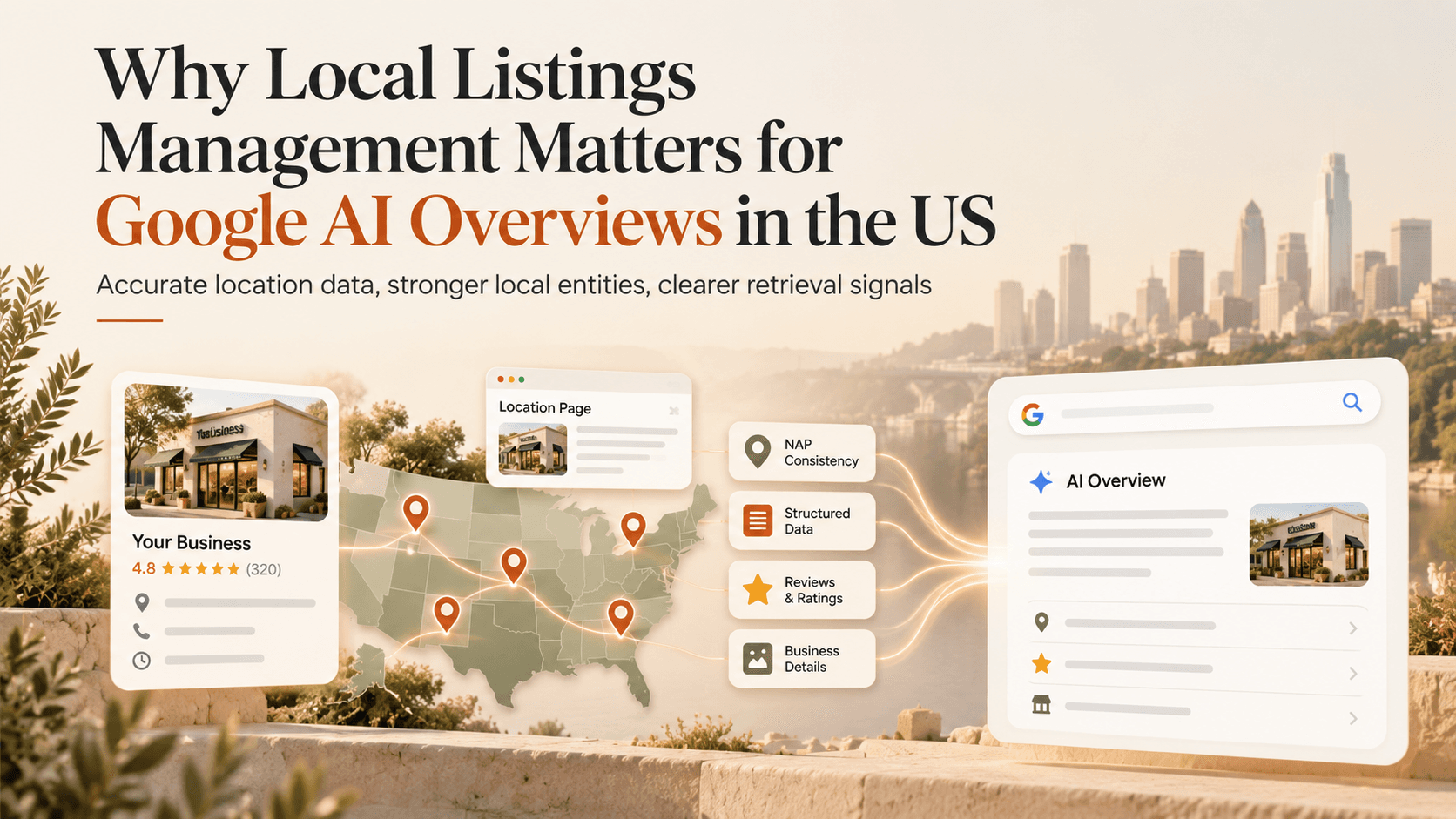
Local listings management matters for Google AI Overviews because Google's generative search features are built on core Search systems and can include information about local businesses. Accurate Business Profile data, consistent location facts, crawlable location pages, and clear local entity information give Google stronger material to retrieve and reconcile. But Google has not published a separate 'local listings ranking factor' for AI Overviews, and listings accuracy does not guarantee inclusion.
For US multi-location brands, the practical goal is therefore not to 'optimize a listing for AI Overviews' as a standalone tactic. It is to make every location easy for Google to understand across Business Profile, Search, Maps, the website, structured data, reviews, and other local sources. When those facts conflict, generative search has a harder evidence problem before content quality even enters the picture.
Key takeaways
Local listings management supports Google AI readiness by keeping each location accurate, retrievable, and consistent across Business Profile, Search, Maps, location pages, structured data, and other local sources. Google's current guidance treats generative AI visibility as an extension of core Search: no special AI markup is required, but Search eligibility, current Business Profile data, and site inclusion in Search generative AI features matter.
- Google says AI Overviews and AI Mode use core Search systems and may use query fan-out; there is no special schema or llms.txt requirement.
- Google says Business Profiles can help local products and services appear in AI responses and other Search results.
- Pages must be indexed and snippet-eligible to appear as supporting links, and the site must be included in Search generative AI features.
- Search Console's Generative AI performance report, rolled out to all websites as of August 31, 2026, shows impressions from AI Overviews and AI Mode, so teams can measure visibility instead of inventing an 'AI listings score.'
Editorial approach: this guide separates documented Google guidance from operational inference. Listings accuracy is treated here as foundational evidence, not a guaranteed ranking factor.
What does Google actually say about AI Overviews and local businesses?
Google's current guidance says generative AI features still depend on core Search systems and normal SEO fundamentals. For local businesses, Google specifically recommends keeping Business Profile information current and says Business Profiles can help products and services appear in AI responses. It also says no special AI-only markup is required, but Search eligibility still matters.
Google Search Central's AI Features and Your Website guidance says AI Overviews and AI Mode rely on the same foundational SEO practices as Search, may use query fan-out across related searches and data sources, require no special AI schema, and specifically recommend keeping Business Profile information up to date.
Google's guide to optimizing for generative AI features, published in May 2026, goes further: it says generative AI responses can include local-business information, Business Profiles can help products and services become visible in AI responses, and sites must be included in Search generative AI features in Search Console to be eligible for display.
That does not create a new local-AI ranking formula. It tells us something more useful: local business data remains part of the information environment Google's generative features can retrieve from.
Why does local listings management matter before AI Overview optimization?
Local listings management is the ongoing work of keeping each location's business facts accurate and consistent across Google Business Profile, other publishers, and the business website. It controls the basic facts Google needs to associate a query with a real business location: name, address, phone, hours, category, website, services, status, and other location attributes. If those facts are stale or contradictory, the business creates ambiguity across the same systems that generative Search depends on.
| Listings-management job | Why it matters to Search | AI-search relevance | What it does not guarantee |
|---|---|---|---|
| Keep Business Profile data current | Gives Google direct, claimed business information | Provides structured local facts that generative systems can use | AI Overview inclusion |
| Maintain accurate categories and services | Improves relevance to local intent | Helps Google connect a location to specific needs or queries | A top ranking for every query |
| Control openings, moves, and closures | Prevents stale or contradictory entity states | Reduces the chance that old locations conflict with current ones | Immediate recrawling or refresh |
| Match location pages to profile data | Supports consistency between web and local surfaces | Creates crawlable explanatory context beyond the profile itself | That the website will be cited |
| Manage reviews and profile completeness | Contributes to local prominence and user context | Can give Google additional factual and experiential material | That review sentiment becomes an AI ranking factor |
| Monitor duplicates and connection errors | Reduces competing versions of the same business | Makes entity resolution cleaner across sources | That duplicates are the only cause of weak AI visibility |
How does Google decide what local information to trust?
Google does not rely on one database for local business facts. It combines information from business owners, websites, users, third parties, and its own interactions with places. That is why listings management should be treated as entity consistency rather than one-dashboard maintenance.
Google's local listings information-source documentation says local listing information can come from publicly available web content, licensed third-party data, contributions from users and business owners, and information derived from Google's interactions with a place or business. The same page notes that local listings themselves may include AI-generated summaries.
For a US multi-location brand, this means an inaccurate profile is not isolated. It can conflict with the location page, user edits, third-party directory data, and other business-information sources. The operational job is to reduce those conflicts so Google's systems have a coherent current entity to work with.
Why do relevance, distance, and prominence still matter?
Relevance, distance, and prominence still matter because Google continues to use them for local results while generative AI features remain rooted in core Search systems. Listings management cannot change a searcher's distance, but it can improve relevance and reduce factual ambiguity by keeping categories, hours, services, status, and other Business Profile fields complete and accurate.
Google's local ranking guidance says complete and accurate Business Profile information helps businesses show for relevant searches and explains that local results are mainly based on relevance, distance, and prominence, which Google describes as how well-known a business is. Businesses cannot change a searcher's distance, but they can improve how accurately Google understands what the business is, where it is, whether it is open, and what it offers.
For AI-search workflows, the safest inference is not that those three factors are copied directly into an AI Overview score. It is that local relevance and business-entity understanding continue to matter because generative features are grounded in Google's Search systems rather than operating as a separate local index.
Why does location-page quality matter even with a strong Business Profile?
Location-page quality matters because Business Profile data covers core facts while the website supplies richer service and location context. Google says a page must be indexed and eligible to appear in Search with a snippet to support AI Overviews or AI Mode, and the site must remain included in Search generative AI features.
That separates website eligibility from listing accuracy. A Business Profile can be correct while its linked location page is noindexed, canonicalized elsewhere, or excluded from Search generative AI features; likewise, an indexed page does not correct stale profile data. Multi-location teams need both the local entity record and the supporting web page to be healthy.
A strong local listings program should therefore connect every important profile to a stable, indexable location page rather than a generic homepage whenever the business has meaningful location-level information.
How should structured data support local listings management?
Structured data should reinforce visible location facts, not become a second database with different values. Use it to make the page's business identity explicit while keeping the markup aligned with what users see on the page and what the Business Profile says.
Google's Local Business structured data documentation supports properties such as business name, address, geo coordinates, telephone, URL, departments, and opening hours. Google's structured data guidelines also say markup should describe content that is visible to readers, and Google does not guarantee that structured data will produce any particular Search feature.
For multi-location US brands, a practical location-page data stack should align:
- Business Profile business name, address, phone, categories, and hours.
- Visible location-page name, address, phone, hours, services, and status.
- LocalBusiness structured data for the same physical location.
- Canonical URL and internal links that consistently point to the intended location page.
- Store or location ID in internal systems so future updates map to the same entity.
How does query fan-out raise the value of consistent location entities?
Google says AI Overviews and AI Mode may use query fan-out across related searches and data sources. For local queries, that creates multiple retrieval paths to the same entity: Business Profile, location pages, service pages, reviews, directories, and other sources. Consistent location facts reduce the reconciliation burden when those paths describe the same real-world business.
Google does not say that every local AI Overview follows the same fan-out pattern, and it does not publish the exact sources used for a given response. The operational implication is still important: a multi-location brand should avoid forcing Google's systems to reconcile several conflicting versions of the same location while answering related questions. Typical contradictions look like this:
- A restaurant profile says the location closes at 10 p.m., while the location page says 11 p.m.
- A healthcare location changed address, but older citations still describe the former site as active.
- A retailer's Business Profile links to the correct store page, while structured data on that page still contains the previous phone number.
- A service business uses one primary category in its profile but its location page never explains that service at all.
- A closed location still has reviews, directory records, and an indexable page competing with the replacement location.
None of those contradictions proves that an AI Overview will be wrong or omit the business. They do show why listings management is broader than directory hygiene: it is the process of keeping the entity coherent across the sources Google's search and generative systems can retrieve. Our guide to local pack and AI answer accuracy covers how to keep those priority surfaces aligned.
Why does multi-location governance matter more than one-time cleanup?
For a single location, a one-time cleanup may remain accurate for months. For a US brand with dozens or hundreds of locations, the data changes continuously: holiday hours, remodels, temporary closures, new phone systems, acquisitions, franchise transfers, category changes, relocations, new stores, and permanent closures. AI-search readiness therefore depends on governance, not a one-off optimization project.
The brand should define who can approve each field, which system is authoritative, which changes are urgent, how publisher failures are escalated, and how the website is updated at the same time as the listing network. Without that operating model, a portfolio can be clean on audit day and inconsistent again two weeks later. A typical ownership split looks like this:
- Operations owns factual store status, hours, addresses, and lifecycle dates.
- Marketing or local SEO owns category strategy, profile content, local-page quality, and search-performance interpretation.
- IT or security owns company accounts, authentication, APIs, and vendor offboarding.
- A central data owner maintains the canonical location record and stable location IDs.
- High-risk exceptions such as suspensions, duplicates, ownership disputes, and major rebrands use a separate escalation path.
Which tools can support AI-search-ready local listings at scale?
Listings software can support AI-search readiness by keeping location data accurate, distributing changes, surfacing duplicates or connection failures, and giving multi-location teams a governed workflow. No platform can guarantee Google AI Overview inclusion, and Google notes that no third-party tool has access to its internal ranking or AI systems. The table below is alphabetical, not a ranking; compare how each tool maintains reliable location facts while website indexing and content remain separately managed. For a wider field of vendors, see our local listing management software comparison
_Vendor capabilities checked against official product pages on September 30, 2026._
| Platform | Typical fit | Useful capability | AI-readiness relevance | Trade-off to test |
|---|---|---|---|---|
| BrightLocal | Local SEO teams combining priority-publisher sync with citation cleanup | Active Sync for Google, Apple, Bing, Facebook and Yelp plus Citation Builder for broader coverage | Helps keep core listings current while supporting wider citation consistency | Citation Builder listings are one-off submissions, so later edits outside Active Sync need paid manual updates |
| SOCi | Large franchise and distributed multi-location organizations | Centralized listings automation, multi-location monitoring, and correction workflows | Keeps location facts synchronized across major discovery platforms at scale | Broader platform scope may require more setup for smaller teams |
| Synup | Growing multi-location brands and agencies managing many locations | One-source listings sync, duplicate and connection alerts, AI visibility tooling | Pairs listing sync with AI visibility tracking for ChatGPT, Gemini, Perplexity and Copilot | Its AI visibility tracking does not list Google AI Overviews, so AI Overview tracking still runs through Search Console |
| Uberall | Global or enterprise brands managing listings across many markets | 150+ platforms, real-time sync, duplicate suppression, and AI-search coverage | Extends consistent location data across maps, directories, voice, and AI search | Broader suite scope can add rollout complexity |
| Yext | Large enterprises with structured entity-data and governance needs | 200+ direct integrations, structured data, and role-based workflows | Distributes governed location data across publishers and AI discovery surfaces | Enterprise implementation may be heavier than smaller portfolios need |
What local listings problems are most likely to weaken AI-search readiness?
The highest-risk problems are the ones that create conflicting business identities or prevent Google's systems from retrieving the current location accurately. These are not proven 'AI Overview penalties'; they are information-quality failures that can weaken ordinary Search and therefore the foundation generative Search uses.
- Duplicate Google Business Profiles for the same operating location.
- Former locations still marked open after a move or closure.
- Business Profile hours that disagree with the official location page.
- A profile linking to a generic homepage while the actual location page is orphaned or noindexed.
- Different phone numbers across Google, the website, and major directories without an intentional tracking strategy.
- Categories that no longer represent what the location actually offers.
- Location pages with copied or nearly identical text and little location-specific value.
- Structured data containing old addresses, names, URLs, or hours.
- Profiles controlled by former agencies or employees, delaying corrections and verification.
Does citation consistency across third-party directories matter for AI Overviews?
Third-party citation consistency can matter indirectly because Google says it uses licensed third-party data and public web content as local information sources. But there is no published rule stating that a specific citation count, NAP-consistency percentage, or directory network directly determines AI Overview inclusion.
The practical priority should be accuracy on high-value sources and the removal of material contradictions. A business does not need every obscure directory on the web to display byte-for-byte identical data before it can appear in an AI feature.
Focus first on Google Business Profile, the official website, major navigation and discovery platforms, important industry directories, and any data providers that materially influence the brand's footprint. Treat long-tail citation work as support for entity consistency, not a guaranteed AI-visibility tactic.
How should multi-location brands operationalize this for the US?
For US multi-location brands, operationalize AI readiness by making one approved location record feed both listings and the website. Use stable IDs, company-controlled publisher access, synchronized change workflows, recurring live checks, and a separate exception queue for duplicates or verification failures. The objective is a coherent, retrievable location entity, not an AI-only optimization layer.
- Maintain one stable internal ID for each location.
- Keep an approved master record for name, address, phone, hours, category, status, and location URL.
- Use company-controlled ownership for priority publisher profiles.
- Route changes through one approval workflow instead of accepting competing spreadsheets.
- Push urgent hours, phone, opening, move, and closure updates through the listings system and website together.
- Audit location-page canonicals, indexability, structured data, and profile URLs after CMS or migration changes.
- Review duplicate, verification, and ownership exceptions separately from routine sync health.
- Reconcile live publisher data against the internal master on a recurring cadence.
What should teams measure instead of an 'AI Overview listings score'?
Teams should measure documented inputs and Google's actual AI visibility data, not invent an 'AI Overview listings score.' Track profile accuracy, ownership coverage, page indexation, structured-data consistency, duplicate backlog, and Search Console's Generative AI performance report, which includes impressions from AI Overviews and AI Mode. None of these metrics proves that one listing field caused inclusion.
| Metric | What it measures | Why it matters | What it cannot prove |
|---|---|---|---|
| Profile accuracy rate | Locations matching the approved master | Reduces factual drift | AI Overview inclusion |
| Ownership/access coverage | Locations under company-controlled access | Speeds corrections and recovery | Search prominence |
| Location-page indexation | Important pages indexed under intended canonicals | Makes web context retrievable | That Google will cite the page |
| Structured-data consistency | Markup matching visible and profile facts | Reinforces machine-readable entity detail | A ranking boost |
| Duplicate/exception backlog | Unresolved identity problems | Shows where Google may encounter competing records | Direct AI impact |
| Generative AI impressions | AI Overviews and AI Mode impressions in Search Console | Shows pages, countries, devices, and visibility trends | Causation from listings or any one field |
What should you not do just because AI Overviews exist?
Do not build an AI-only local listings program or invent special markup. Google says no AI-specific schema, llms.txt file, or content 'chunking' is required for generative search. Do, however, confirm the site's Search generative AI control is set to include the site if you want eligibility for AI Overviews and AI Mode. Include is the default, but a property can inherit an exclude setting from its parent property.
- Do not invent separate 'AI categories' or change real business information to chase generative visibility.
- Do not add unsupported schema fields that are absent from the visible page.
- Do not build thin location pages solely to create more AI-search entry points. Google says creating content for fan-out query variations mainly to manipulate generative AI responses violates its scaled content abuse policy.
- Do not measure success only by whether one prompt triggers an AI Overview.
- Do not assume a Business Profile update instantly changes generative results.
- Do not claim that a listings-management vendor can guarantee AI Overview citations.
What should a 30-day local listings and AI-search readiness plan include?
The first 30 days should make each location accurate, indexable, and measurable before the team experiments with AI-specific content. Start with ownership and the canonical location record, align Business Profile and web facts, fix technical and indexing problems, resolve high-impact contradictions, then establish recurring QA and a baseline in Search Console's Generative AI performance report.
- Week 1: inventory all US locations, Business Profile ownership, current status, location URLs, duplicates, and verification issues.
- Week 1: reconcile name, address, phone, hours, categories, and lifecycle status against the approved master location record.
- Week 2: audit location-page indexability, canonicals, internal links, and visible location facts.
- Week 2: align LocalBusiness structured data with the same location record.
- Week 3: fix duplicate profiles, stale closures, disconnected accounts, incorrect URLs, and high-value directory contradictions.
- Week 3: confirm each priority location has useful location-specific web content beyond basic NAP data.
- Week 4: sample high-intent US local queries and record whether the brand appears in traditional local results, AI Overviews, or other AI features without assuming one caused the other.
- Week 4: establish a recurring listings QA cadence so data stays current after the initial cleanup.
When should content become the bigger priority than listings?
Content becomes the bigger priority after the location identity is accurate, the important pages are indexed, the profiles are accessible, and obvious conflicts are resolved. At that point, weak AI-search visibility may be a content, authority, relevance, or competitive problem rather than a listings problem.
A location page that says little beyond an address and phone number gives Google less useful context than a page that clearly explains services, local availability, customer policies, expertise, and other decision-relevant information. Listings establish the entity; useful web content explains it.
Conclusion: why local listings management matters for Google AI Overviews
Local listings management matters for Google AI Overviews because generative Search still depends on Google's broader Search systems and local business information. Accurate Business Profile data, consistent entity facts, indexed location pages, and aligned structured data improve the quality of the information Google can retrieve about a location.
But the strongest conclusion is also the most restrained one: local listings management is a foundation, not an AI Overview guarantee. Google has not published a separate local-listings formula for AI Overviews. The defensible strategy is to keep the business entity accurate and retrievable across Search, Maps, Business Profile, the website, and important third-party sources, then improve the usefulness and authority of the content that explains each location.
Frequently asked questions
Do Google Business Profiles directly rank in AI Overviews?
Google has not published a separate AI Overview ranking factor for Business Profiles. It does say that generative AI responses can include local business information and that Business Profiles can help products and services become visible in AI responses and other Search results.
Does local listings management guarantee AI Overview visibility?
No. Accurate listings improve the quality and retrievability of local business information, but Google does not guarantee inclusion in AI Overviews, AI Mode, local results, or supporting links. Treat listings management as infrastructure: it reduces conflicting entity facts while content quality, relevance, eligibility, and Google's systems still determine what appears.
Does NAP consistency matter for AI Overviews?
Yes, as an entity-quality practice, not as a published AI ranking factor. Google says local information can come from business owners, public web content, users, third parties, and Google's own interactions. Consistent name, address, phone, hours, and status reduce contradictions, but Google has not published a NAP threshold for AI Overview inclusion.
Should every location have its own indexable page?
Usually, yes, when each location has meaningful facts or services worth indexing. A stable location page gives Google crawlable context beyond the Business Profile and can be eligible as a supporting link in AI features if indexed and snippet-eligible. The page should provide real location-specific value, not just duplicated address data.
Is special schema needed for AI Overviews?
No. Google says there is no special AI schema, llms.txt requirement, or machine-readable AI file needed for AI Overviews or AI Mode. Use standard structured data that matches visible content, including LocalBusiness markup where appropriate, and separately confirm the site's Search generative AI inclusion setting in Search Console.
How should US multi-location brands track AI Overview visibility?
Use Search Console's Generative AI performance report for impressions from AI Overviews and AI Mode, then compare that trend with operational listings KPIs such as profile accuracy, ownership, indexation, and duplicate backlog. Google says the report can break generative AI impressions down by page, country, date, and device, but it does not prove causation.