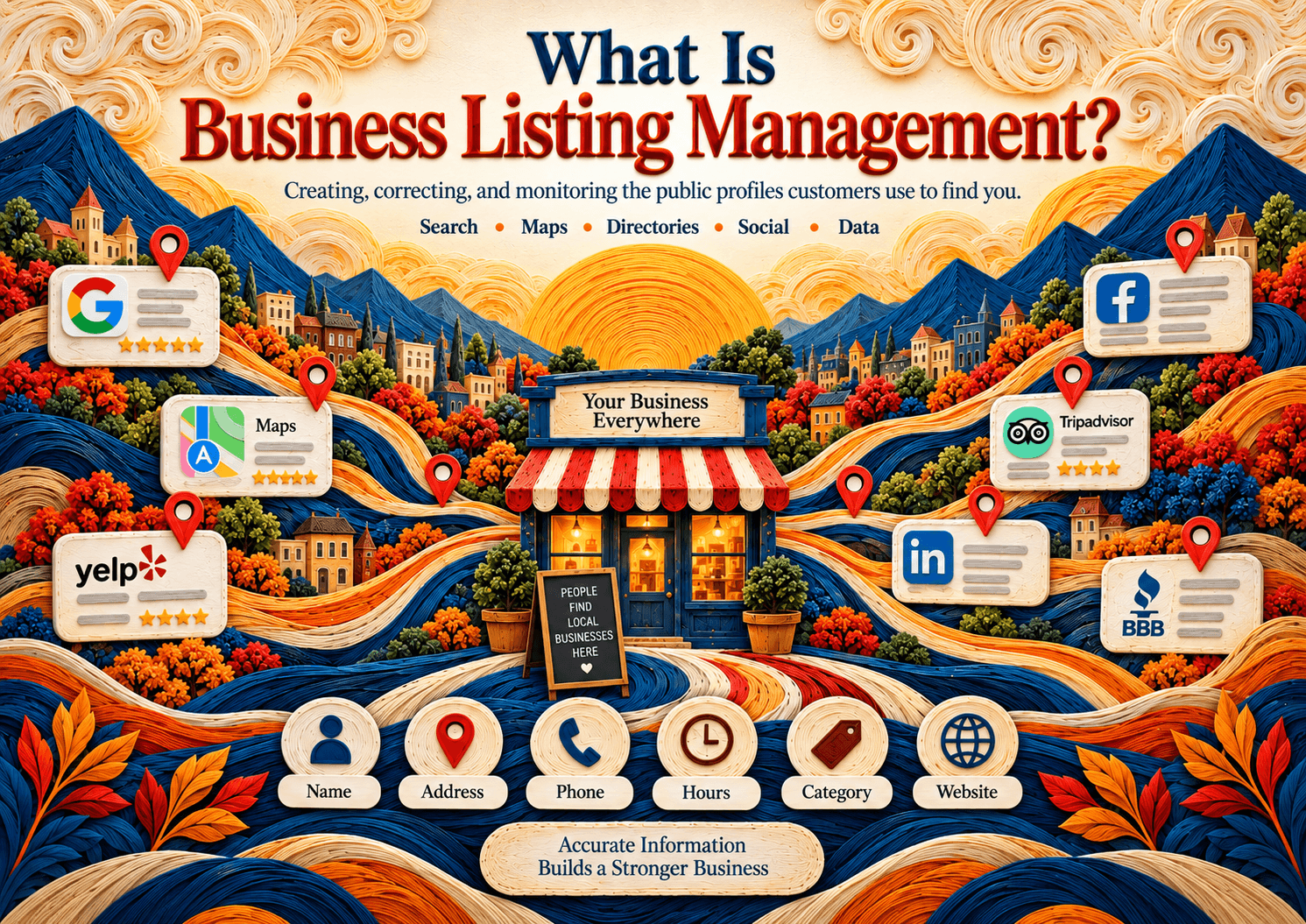
NAP consistency in business listing management means keeping the business Name, Address, and Phone aligned to one approved real-world record across the profiles customers use — while allowing platform-specific formatting differences that do not change the underlying facts. NAP is the foundation of listing accuracy; it is not the entire discipline (hours, categories, status, and attributes still matter).
Definition hub: What is business listing management?. Ops steps: Business listing management checklist.
Why NAP still matters
Customers and platforms use name, address, and phone as identity anchors. When those fields disagree in material ways, you get:
- Duplicate place cards and split reviews
- Calls to retired numbers
- Navigation to old suites or closed storefronts
- Failed matching when data providers try to merge records
NAP work is identity work. Cosmetic sameness (identical punctuation everywhere) is secondary to factual sameness.
What "consistent" should mean
| Field | Consistent means | Usually OK variation |
|---|---|---|
| Name | Same real-world business name; no keyword spam | Minor legal suffix display differences if platforms truncate |
| Address | Same deliverable location / suite truth | USPS vs platform abbreviations (St vs Street) when the place is unambiguous |
| Phone | Same customer-facing primary number | Tracking numbers only if you knowingly accept match risk and keep operations aligned |
Google's representation guidelines emphasize accurate real-world names and putting information in the correct fields rather than stuffing address or phone into the title.
Name rules that prevent self-inflicted duplicates
- Use the name customers see on the door / brand standard — not a list of services.
- Do not append city names, "best," or keyword strings to game search.
- Document allowed DBA vs legal name usage per platform.
- For departments (Pharmacy vs Main Store), follow platform department rules instead of creating confusing parallel brands.
Address rules that survive multi-platform reality
- Include suite/unit when it affects where a human should arrive.
- For service-area businesses without a customer-facing storefront, follow each platform's SAB rules rather than inventing a fake storefront address.
- After a move, treat old-address cleanup as part of the project — not an afterthought.
- Store latitude/longitude in the source file when pins are chronically wrong.
Phone rules for modern call routing
- Pick one primary public phone per location unless departments truly need separate public lines.
- If marketing wants call tracking, decide explicitly whether tracking numbers will appear on listings (they can create NAP mismatch across the web).
- When replacing a PBX, update the source file and priority publishers in one change window.
- Hunt social profiles and old directories for the retired number.
NAP audit method (practical)
- Export or write the canonical NAP from first-party systems (not from Yelp).
- Sample Google, Apple, Bing, and your top directories.
- Mark each field: match / formatting-only / material mismatch / missing.
- Fix material mismatches first.
- File duplicates separately when two profiles both look "right" but compete.
- Re-verify public pages after edits.
Evidence table: classifying mismatches
| Example | Class | Action |
|---|---|---|
| "Street" vs "St." | Formatting-only | Usually ignore |
| Suite 200 vs Suite 100 | Material | Fix to canonical |
| Old downtown address on Apple | Material | Relocation workflow |
| Keyword-stuffed Google title | Material / policy risk | Restore real-world name |
| Tracking number on GBP, main number on website | Material (unless intentional) | Align strategy |
NAP vs the rest of the listing
Even perfect NAP fails customers when:
- Hours are wrong (edit hours help)
- The business is temporarily closed but still shows open
- The primary category misrepresents the business (categories help)
- Attributes and services are outdated
Treat NAP as necessary, not sufficient.
Multi-location NAP governance
| Control | Purpose |
|---|---|
| Location IDs | Prevent row mix-ups in spreadsheets and platforms |
| Name template | Stop local keyword inventions |
| Address validation step | Catch suite and ZIP errors before publish |
| Phone change ticket type | Force cascade to publishers |
| Exception queue | Track publishers that reject address updates |
Franchise networks should decide which fields franchisees may suggest versus which fields only corporate may publish.
Hypothetical NAP workbook (one location)
| Field | Canonical value | Apple | Bing | Notes | |
|---|---|---|---|---|---|
| Name | Lakeside Dental Group | match | match | match | |
| Address | 410 Westlake Ave, Austin, TX 78701 | match | St. abbreviation | match | formatting-only on Apple |
| Phone | (512) 555-0148 | match | old number | match | material mismatch — fix Apple |
Use a sheet like this during audits. Color only material mismatches so teams do not waste a week on punctuation.
Chain and franchise NAP edge cases
- DBA vs legal entity: customers need the public brand name; legal entity names belong in contracts, not necessarily on the map title.
- Mall and airport units: unit identifiers and pin placement matter as much as street number.
- Healthcare credentials in the name: follow platform rules; do not invent credential spam.
- Acquisitions: old brand names on lingering profiles create identity forks — schedule rename waves with ownership checks.
Connecting NAP work to hours and status
After NAP is stable, the next identity-adjacent failures are usually hours and open/closed status. Keep them on the same source row as NAP so a relocation project cannot update the address while leaving "open" on the empty building. The parent definition page covers the full field set under what business listing management includes.
Related reading
- What is business listing management?
- Business listing management checklist
- Business listing management vs local SEO
- Why location data breaks
- Business listings audit guide
Frequently asked questions
Does NAP consistency require identical punctuation on every site?
No. Aim for identical facts. Harmless abbreviation differences are normal across publishers.
Is NAP the same as business listing management?
NAP is a core part of it, not the whole discipline. Hours, categories, status, duplicates, and verification matter too.
Should I use a unique tracking phone on every listing?
Only with a deliberate matching and operations plan. Random tracking numbers are a common cause of self-inflicted NAP drift.