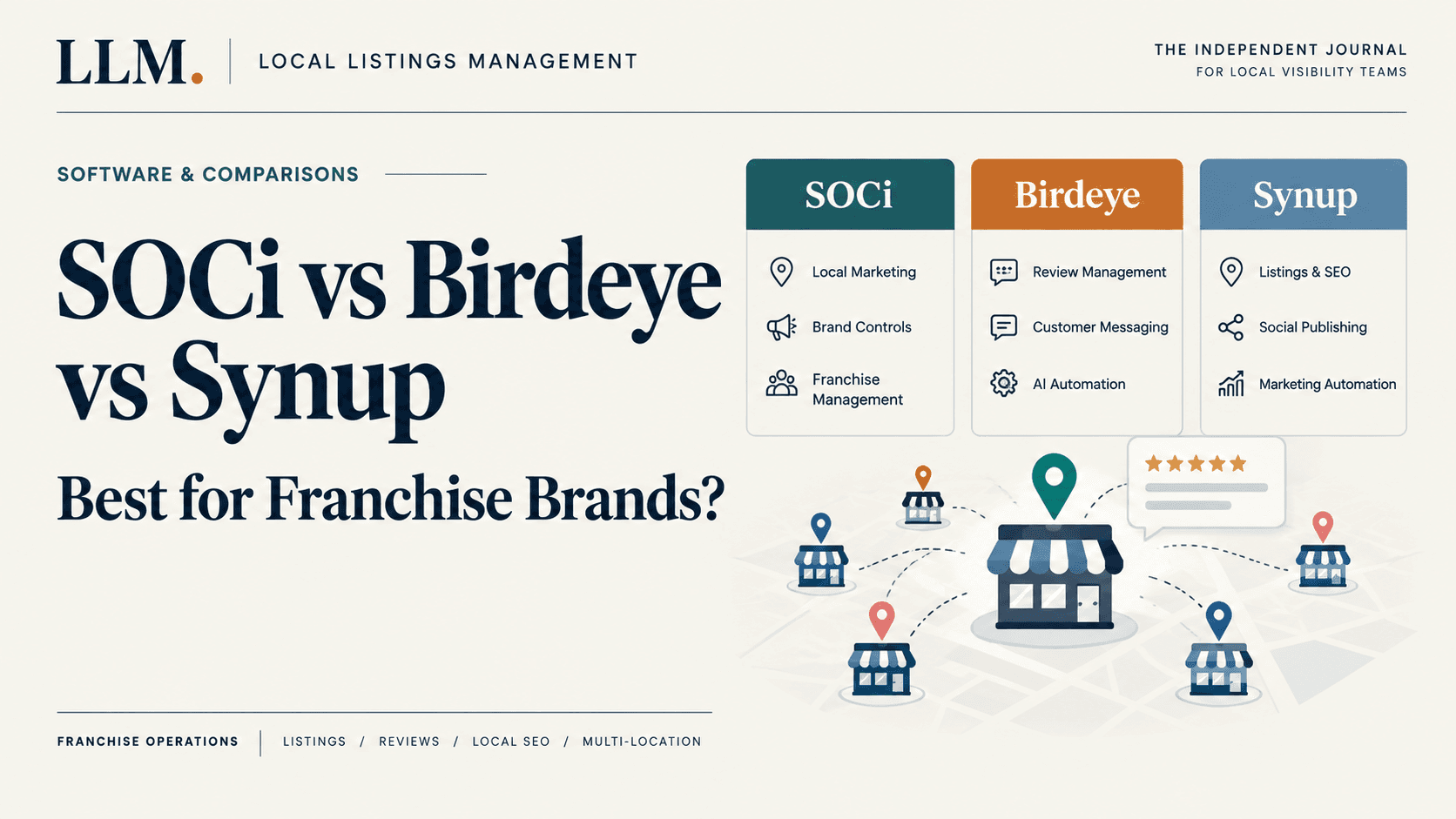
Birdeye combines reputation management, review generation, customer communication, and AI-powered customer experience workflows.
The right choice depends on whether your franchise prioritizes customer reviews, local search visibility, marketing automation, or corporate oversight across independently operated locations.
For growing franchise systems, pricing transparency and manageable day-to-day workflows may be important. Larger networks may need more sophisticated permissions, approval processes, integrations, and reporting.
This guide compares all three platforms using consistent criteria, including their capabilities, strengths, limitations, pricing models, and suitability for different franchise operating structures.
SOCi vs Birdeye vs Synup: Quick Comparison
| Platform | Best suited to | Main strengths | Key consideration |
|---|---|---|---|
| Synup | Growing franchises, multi-location brands, and agencies | Listings, reviews, social publishing, and local marketing automation | Confirm franchise permissions, AI usage allowances, and integrations |
| SOCi | Distributed franchise networks requiring coordinated local marketing | Corporate brand controls, Genius Agents, local search, and automated marketing execution | Enterprise implementation and custom pricing |
| Birdeye | Franchises emphasizing reputation and customer experience | Review generation, responses, messaging, listings, and AI agents | Confirm product scope, automation settings, and total cost |
All three platforms offer capabilities relevant to franchise reputation management, but their approaches differ.
Synup is worth evaluating when the objective is consolidating local marketing functions while retaining visibility into location-based subscription costs.
SOCi is relevant when headquarters needs marketing work coordinated across many locations without relying entirely on individual franchisees to perform every task.
Birdeye deserves consideration when customer reviews, customer communication, reputation monitoring, and service-related feedback are central purchasing priorities.
No platform is universally superior. The better choice is the one that supports your operating model and performs reliably in representative franchise workflows.
How We Compared These Franchise Reputation Management Platforms
This comparison draws on publicly available product documentation, official pricing pages, franchise solution information, and platform policies reviewed in November 2026.
The products were evaluated using seven criteria:
- Review management: Monitoring reviews, assigning responses, resolving complaints, and supporting appropriate escalation.
- Review generation: Requesting authentic customer feedback through permitted channels and workflows.
- Listing management: Maintaining accurate business information across supported search engines, maps, and directories.
- Franchise governance: Balancing headquarters-level controls with permissions for regional managers and local operators.
- AI automation: Drafting or publishing responses, supporting social content, and completing recurring marketing tasks with appropriate oversight.
- Reporting and integrations: Monitoring performance across locations and connecting with business systems.
- Pricing and scalability: Understanding subscription models, location limits, implementation, support, and operational costs.
Why Franchise Brands Need Reputation Management Software
Franchise reputation management software helps businesses monitor customer reviews, coordinate responses, maintain accurate business listings, and identify recurring customer experience problems across multiple locations.
A single-location business may be able to manage its reviews directly through Google Business Profile.
For a franchise with 300 locations, however, maintaining consistent review monitoring and response processes manually becomes more difficult.
Each location can receive different customer complaints, questions, and ratings. A problem that appears isolated at one store may also indicate a wider operational issue.
Headquarters need oversight, while local teams need enough flexibility to respond appropriately to genuine customer concerns.
A useful franchise reputation management platform should support:
- Centralized review monitoring across supported platforms.
- Location-specific responses and customer issue escalation.
- Authentic review requests that comply with publisher policies.
- Consistent business information across directories.
- Appropriate permissions for corporate and local teams.
- Reporting by region, franchisee, or individual location.
- Identification of recurring complaints that require operational attention.
The objective should be to improve communication and resolve customer problems, not simply increase the number of reviews collected.
How Reputation Management Connects With Local Visibility
Google's local ranking guidance identifies relevance, distance, and prominence as the main considerations influencing local search results.
Accurate business information can help Google understand a location, while review count and positive ratings can contribute to prominence.
However, reputation management software cannot guarantee higher rankings, greater visibility, or increased sales.
Software can help businesses manage the information and customer interactions that contribute to their local presence.
For additional context, the franchise listing management platforms comparison explains how headquarters governance and local control influence multi-location operations.
SOCi vs Birdeye vs Synup: Feature Comparison
| Capability | Synup | SOCi | Birdeye |
|---|---|---|---|
| Multi-location business listings | Supported | Supported | Supported |
| Review monitoring | Supported | Supported | Supported |
| Review response workflows | Supported | Supported | Supported |
| Review generation | Available | Confirm required workflow | Supported |
| Social publishing | Supported | Supported | Supported |
| AI-powered marketing | Sydekick | Genius Agents | BirdAI and specialized AI coworkers |
| Centralized reporting | Available | Available | Available |
| Franchise permissions | Role and account controls; verify required configuration | Corporate and local marketing controls | Role-based and location-level controls |
| AI approvals | Approval functionality documented | Brand-controlled execution and exceptions | Approval and autonomous modes documented |
| Integrations | APIs and supported connections | Enterprise integrations; confirm scope | Integrations and enterprise connectivity |
| Pricing approach | Published location-based plans | Custom quotation | Custom quotation |
1. Synup — For Consolidated Local Marketing and Reputation Management
Best for: Growing franchise networks, multi-location businesses, and agencies that want listings, reputation management, social publishing, and local marketing automation in a connected platform.
Overview
Synup is a local marketing platform that helps organizations manage their online presence across multiple business locations.
Its product portfolio includes business listings, review monitoring, review generation, local SEO, social publishing, reporting, and location-focused marketing workflows.
Synup also provides Sydekick, an AI agent designed to help complete local marketing tasks.
Rather than requiring users to manage every action manually, Synup's current approach combines an AI agent with tools for listings, reviews, social content, and related activities.
For franchise businesses researching Birdeye alternatives, Synup is relevant when reputation management is part of a broader local marketing program.
Key Capabilities
Synup supports centralized management of business names, addresses, phone numbers, categories, operating hours, and other location information.
Its marketing capabilities include:
- Business listings: Managing and distributing approved information to supported directories and mapping services.
- Review monitoring: Tracking customer reviews from connected sources.
- Review generation: Supporting customer feedback requests.
- Social publishing: Preparing and distributing content across connected social platforms.
- Local marketing reporting: Tracking relevant location-level activity.
- Sydekick: Assisting with marketing tasks using configurable workflows and approval controls.
Synup's current pricing documentation describes an agent-enabled marketing environment with an approvals inbox and an audit trail.
These controls are relevant when an organization wants to use automation but still review important changes.
Strengths for Franchise Brands
Synup's main advantage is the breadth of local marketing activities available through one environment.
Consider a hypothetical home services franchise operating 90 branches.
The central marketing team needs to update business hours, monitor Google reviews, coordinate social publishing, and identify incomplete business profiles.
Using one platform for these activities may reduce the need to maintain separate systems for each task.
Synup may also be useful to agencies managing several franchise clients, provided its account structure and access permissions match their requirements.
Its published pricing gives buyers a starting point for estimating costs before requesting an enterprise proposal.
Limitations
Franchises with complex ownership arrangements should verify the exact permissions and approval workflows available.
For example, a network may need local managers to suggest changes without giving them permission to modify corporate-controlled information.
Buyers should also assess custom integrations, supported review platforms, reporting exports, and location segmentation.
Synup's AI usage model introduces another consideration.
Although its published pricing describes broad feature access across plans, tiers differ in location capacity, monthly credits, concurrent agent activity, and infrastructure.
Organizations should estimate how these limits affect their expected workload.
Pricing
Synup publishes the following US monthly rates:
| Plan | Monthly price | Location capacity |
|---|---|---|
| Solo | $49 | 1 location |
| Premium | $299 | Up to 10 locations |
| Pro | $499 | Up to 25 locations |
| Scale | $899 | Up to 50 locations |
| Enterprise | Custom quote | More than 50 locations |
These are published monthly plan rates, not personalized franchise quotations.
Annual billing discounts are advertised, and AI credit allowances vary by plan.
A franchise operating more than 50 locations should request enterprise pricing rather than assuming that the published smaller plans can be combined without additional conditions.
Consider Synup when: Your franchise wants centralized listings, reputation management, social publishing, and AI-assisted local marketing, with a published pricing structure for smaller portfolios.
2. SOCi — For Enterprise Franchise Marketing Governance
Best for: Franchise networks requiring coordinated local marketing, centralized brand standards, and automation across distributed locations.
Overview
SOCi provides a local marketing platform designed for multi-location and franchise organizations.
Its capabilities include listings management, local search, reputation management, social media, and location marketing automation.
SOCi's franchise offering emphasizes the use of Genius Agents to execute recurring local marketing activities.
These agents are designed to work within brand-specific instructions and operational controls.
Rather than requiring every location manager to complete every marketing task manually, SOCi positions its platform around coordinated execution across the franchise network.
Key Capabilities
SOCi supports several connected marketing functions:
- Listings management: Maintaining business information across supported local search and directory platforms.
- Reputation management: Monitoring and responding to customer reviews.
- Local social media: Coordinating publishing and engagement across locations.
- Local search optimization: Managing location-level visibility activities.
- Genius Agents: Supporting recurring marketing tasks through AI-based execution.
- Brand governance: Applying corporate standards to local marketing activities.
- Reporting: Providing visibility into marketing operations across locations.
SOCi describes Genius Agents that can work on location information, publish social content, and respond to reviews using brand-trained instructions.
The platform also describes exception-based processes in which particular situations can be escalated.
Buyers should confirm which actions can be performed automatically, which require approval, and what happens when an agent encounters an unsupported or sensitive situation.
Strengths for Franchise Brands
SOCi is particularly relevant when local marketing execution varies significantly between franchise locations.
Consider a hypothetical quick-service restaurant franchise operating 600 stores.
Corporate marketing establishes campaign guidelines, messaging standards, and reputation management policies.
Individual restaurants need localized social content, accurate business information, and timely customer review responses.
SOCi's approach is designed to coordinate these activities while maintaining brand oversight.
This can be relevant for franchise networks where local operators have limited time or marketing resources.
Another consideration is the ability to organize marketing processes around corporate requirements rather than requiring every franchisee to independently develop the same workflows.
Limitations
SOCi's enterprise-oriented offering may involve more implementation planning than a smaller franchise needs.
Organizations should evaluate how brand instructions are configured, how approvals operate, and who is responsible for monitoring exceptions.
AI automation also requires governance.
For example, a routine positive review may be suitable for an approved automated response, while a complaint involving discrimination, safety, or sensitive customer information may require review by authorized employees.
SOCi's advertised capabilities should be tested against the franchise's actual risk and approval requirements.
Buyers should also investigate integration responsibilities, training, onboarding, and ongoing administrative work.
Pricing
SOCi uses a sales-led approach for franchise and enterprise requirements.
A standardized public price covering all franchise configurations was not established for this comparison.
Request a detailed proposal that identifies:
- Number of licensed locations.
- Included listings, social, and reputation capabilities.
- Genius Agent functionality and automation limits.
- Implementation and onboarding.
- Integrations and support.
- Additional products or usage charges.
Consider SOCi when: Your franchise needs coordinated local marketing execution across many locations while headquarters maintains brand standards and operational oversight.
3. Birdeye — For Review Management and Customer Experience
Best for: Franchise brands that prioritize customer reviews, review generation, customer communication, feedback analysis, and reputation management.
Overview
Birdeye is a customer experience and local marketing platform serving single-location and multi-location organizations.
Its capabilities include customer review monitoring, review generation, listings, social publishing, messaging, feedback collection, and AI-supported workflows.
Birdeye's current franchise offering also emphasizes AI agents that can assist with marketing, customer experience, and operational tasks.
The vendor describes specialized AI coworkers, including Jay for marketing, Myna for operations, and Robin for customer experience.
These offerings extend Birdeye beyond conventional review management software, although individual capabilities and deployment requirements should be confirmed.
Key Capabilities
Birdeye provides several capabilities relevant to franchise organizations:
- Review generation: Requesting customer reviews through supported communication channels.
- Review monitoring: Collecting and organizing feedback across connected platforms.
- Review responses: Drafting, managing, and publishing replies.
- Listings management: Maintaining location information across supported destinations.
- Social publishing: Coordinating local social content.
- Customer communication: Messaging and related engagement workflows.
- Feedback and insights: Surveys, reporting, and customer experience analysis.
- AI automation: Supporting reviews, listings, communications, and other defined tasks.
Birdeye's franchise documentation describes centralized, franchisee-led, and hybrid operating models.
It also documents role-based access, tiered approvals, location-level permissions, and audit logging.
For organizations requiring both headquarters oversight and local responsiveness, these controls deserve close examination.
Strengths for Franchise Brands
Birdeye is relevant when managing customer feedback is closely connected to operational performance and customer trust.
Consider a hypothetical dental franchise with 180 clinics.
Patients may compare clinics using recent reviews, business information, and the responsiveness of individual practices.
Headquarters needs visibility into reputation trends, while clinic managers may need to respond to routine feedback or investigate service concerns.
Birdeye provides tools for coordinating these activities across locations.
Its broader customer experience functionality may also help organizations connect review monitoring with messaging, feedback collection, and issue resolution.
The ability to manage multiple aspects of customer communication can be useful when reputation management is not treated as a separate marketing activity.
Limitations
Birdeye's broad product portfolio can make it important to identify precisely which products are necessary.
A franchise primarily interested in listing accuracy may not need its wider customer communication or operational automation capabilities.
Similarly, a company focused only on review responses should examine whether additional AI and messaging products provide sufficient value to justify their cost.
AI-generated responses also require appropriate controls.
Buyers should establish when automated replies are permitted, what information the system can access, and how sensitive cases are escalated.
Franchise teams should also confirm relevant integrations, reporting capabilities, and the approval structure included in their proposed configuration.
Pricing
Birdeye provides customized pricing based on the business's requirements and number of locations.
Its pricing page organizes potential customers into location ranges, including:
- 1–3 locations.
- 4–9 locations.
- 10–39 locations.
- 40–249 locations.
- 250–999 locations.
- 1,000 or more locations.
These categories help determine the appropriate sales process but do not provide a universal public per-location subscription price.
Consider Birdeye when: Customer reviews, review generation, messaging, feedback analysis, and customer experience management are central to your franchise's purchasing requirements.
Which Platform Is Better for Franchise Review Management?
The most useful franchise reputation management software should help teams turn customer feedback into appropriate action.
Synup, SOCi, and Birdeye all offer review-related functionality, but buyers should compare what happens after a review is received.
Review Monitoring and Response Workflows
Centralized review monitoring allows corporate teams to identify recurring issues across regions and locations.
However, receiving notifications is only the beginning.
Franchise businesses need to decide who should respond, what information may be shared publicly, and when complaints require escalation.
For example, a routine positive review may receive a brief personalized thank-you.
A complaint involving a billing dispute, employee conduct, health information, discrimination, or safety may require a different process.
The reviewer should not be asked to share private information publicly.
Google's customer review management guidance explains how verified businesses can respond to reviews and how those responses appear publicly.
Buyers should test whether each platform supports the required assignment, approval, and escalation workflow.
AI-Powered Review Responses
All three vendors offer AI-supported reputation or marketing capabilities.
Their positioning differs:
| Platform | Documented AI approach | What buyers should test |
|---|---|---|
| Synup | Sydekick assists with local marketing and review-related work | Approval rules, usage credits, and activity records |
| SOCi | Genius Agents execute recurring local marketing and reputation tasks | Brand controls, autonomous actions, and exception handling |
| Birdeye | AI agents support reviews and customer experience workflows | Response accuracy, approval settings, and customer context |
AI can help draft responses, organize feedback, and reduce repetitive administrative tasks.
However, automated responses are not appropriate for every situation.
Franchise teams should test ordinary positive reviews, simple service complaints, abusive content, and sensitive complaints.
The evaluation should establish whether the software recognizes when human judgment is needed.
A useful review response should be accurate, respectful, relevant, and consistent with the information the business actually knows.
Review Generation and Customer Feedback Policies
Review generation tools can help businesses invite customers to share their experiences.
However, their use must comply with the policies of each review platform and applicable law.
Google's review request guidance allows businesses to request genuine customer feedback, including through review links and QR codes.
Google's user-generated content policies prohibit offering incentives for reviews and selectively soliciting positive reviews.
Businesses should not ask only satisfied customers to post public reviews or pressure customers to leave specific ratings.
For US businesses, the FTC's consumer review and testimonial rule also matters.
The FTC prohibits specified deceptive practices, including fake reviews and incentives conditioned on positive or negative sentiment.
The FTC rule does not prohibit every incentive for every review, but disclosure obligations and other consumer protection requirements may still apply. Google independently prohibits incentives for reviews on its platform.
A review request process should therefore be designed around authentic, voluntary feedback rather than rating manipulation.
Franchise Governance: Corporate Control vs. Local Flexibility
Franchise reputation management requires clear boundaries between headquarters and local operators.
Centralized administration helps maintain brand standards, while local teams often have the most direct knowledge of customer interactions.
The objective is not to remove local decision-making. It is to assign responsibilities appropriately.
Recommended Franchise Governance Model
| Role | Suggested responsibilities |
|---|---|
| Corporate marketing | Brand standards, platform configuration, reporting, and review policies |
| Regional management | Regional oversight, coaching, and complaint escalation |
| Franchisee or store manager | Routine customer interactions, approved local updates, and issue investigation |
| Customer experience or compliance team | Sensitive complaints, escalation, and policy-related review |
| IT or system administration | Identity management, integrations, and access governance |
These are recommended responsibilities, not identical permissions guaranteed by all three vendors.
A franchise network should test whether its selected product can enforce the intended structure.
What Should Headquarters Control?
Headquarters may need to manage brand-sensitive information, approved response guidelines, campaign policies, and administrative access.
Local operators may require permission to reply to ordinary reviews, submit corrections to business hours, or publish approved local content.
The appropriate division depends on the franchise agreement, operational structure, and publisher requirements.
The guide to local listing ownership across multiple business locations explains how organizations can preserve publisher-account control while delegating daily work.
This distinction becomes especially important during franchise ownership transfers, staff departures, agency changes, and location closures.
How Listings and Reviews Affect Franchise Local SEO
Listings and reviews help customers identify, evaluate, and contact individual franchise locations.
Accurate listings communicate essential information, including business names, addresses, hours, categories, and contact details.
Reviews provide information about customer experiences and can influence how people evaluate a business.
Google identifies relevance, distance, and prominence as important factors in local results.
It also explains that reviews and positive ratings can contribute to local prominence.
However, local search performance depends on more than reputation software.
A franchise should coordinate:
- Accurate Google Business Profiles and other important listings.
- Appropriate business categories.
- Useful, location-specific website pages.
- Genuine customer reviews.
- Consistent operating information.
- Responses to customer feedback.
- Verification of important public profile changes.
Regular business listing audits can help identify incomplete profiles, duplicate records, and outdated information.
A successful update inside a management dashboard does not always mean that the information has appeared correctly on a public platform.
Franchise teams should verify important changes directly.
SOCi vs Birdeye vs Synup: Pricing and Total Cost
Pricing should be compared using the same number of locations, products, integrations, and operational requirements.
A lower entry price does not automatically produce a lower total cost.
Pricing Comparison
| Cost consideration | Synup | SOCi | Birdeye |
|---|---|---|---|
| Public subscription rates | Published plans | Custom quote | Custom quote |
| Starting published price | $49/month for one location | Not standardized publicly | Not standardized publicly |
| Location-based pricing | Published capacity tiers | Confirm proposal | Location-count categories |
| Enterprise pricing | Custom | Custom | Custom |
| Onboarding | Confirm scope | Confirm scope | Confirm scope |
| AI usage or automation limits | Plan-dependent | Confirm proposal | Confirm proposal |
| Integrations | Confirm scope | Confirm scope | Confirm scope |
| Support | Confirm service level | Confirm service level | Confirm service level |
For a franchise operating 150 locations, the evaluation should include the full annual cost of licensing, implementation, integration, support, and internal administration.
A practical calculation is:
Annual total cost = subscription fees + onboarding and implementation + integrations + support upgrades + internal operating costs.
Costs should be compared across equivalent functional requirements.
For example, a basic review monitoring plan should not be compared directly with a package that includes listings, social publishing, customer messaging, and autonomous marketing tools without accounting for the additional capabilities.
Questions to Ask About Pricing
Before purchasing, confirm:
- Are all locations included in the quotation?
- Which products and features are included?
- Are AI activities limited by credits, tasks, or usage allowances?
- Do integrations require additional fees?
- What onboarding and migration services are included?
- Are corporate and franchisee accounts licensed separately?
- What support arrangements are available?
- What happens when locations are added, transferred, or closed?
- What are the renewal, termination, and data-export conditions?
The local listing management services pricing guide explains why scope, service levels, account ownership, and exit conditions matter alongside subscription costs.
How to Choose the Right Birdeye Alternative for Your Franchise
The best platform depends on the operating problem the franchise needs to solve.
Location count is relevant, but it should not be the only deciding factor.
A franchise with 60 independently operated locations may have more complex permissions than a centrally managed network of 200 stores.
Choose Based on Your Main Objective
| Main objective | Platforms to evaluate | Important consideration |
|---|---|---|
| Consolidate listings, reviews, and social marketing | Synup, SOCi, Birdeye | Scope of included products and integrations |
| Automate local marketing across a large network | SOCi, Birdeye, Synup | Approval controls and quality assurance |
| Manage customer reviews and communication | Birdeye, Synup, SOCi | Review request channels, responses, and escalations |
| Coordinate headquarters and franchisee activity | SOCi, Birdeye, Synup | Permissions and location-level controls |
| Start with transparent published pricing | Synup | Enterprise terms and AI usage allowances |
| Improve location reporting and reputation oversight | All three | Consistent metric definitions and usable exports |
The table represents starting points for vendor evaluation, not exclusive eligibility categories.
Test the Platforms Before Purchasing
Ask all three vendors to demonstrate the same tasks using representative franchise locations.
A proof of concept should include:
| Test | What to verify |
|---|---|
| Respond to a routine positive review | Appropriate tone, location context, and workflow |
| Respond to a sensitive negative review | Escalation, privacy safeguards, and human approval |
| Send an authentic review request | Supported channels and compliance with review policies |
| Update holiday hours | Correct location targeting and publisher verification |
| Restrict franchisee access | Location- and role-specific permissions |
| Identify a duplicate listing | Detection, exception reporting, and resolution process |
| Export regional reputation data | Accurate location grouping and useful reporting |
| Review an AI-generated action | Approval history, audit records, and ability to correct errors |
Using the same scenarios makes comparison more meaningful.
For location information, the test should include checking whether changes appear correctly on the relevant public profiles.
The local listing change QA evidence standard explains how timestamps, public profile checks, and correction records support reliable verification.
Evaluate Data Ownership and Migration
Franchise buyers should also consider what happens if they change providers.
Before moving from Birdeye, SOCi, Synup, or another platform, identify:
- Who controls the underlying business listings and publisher accounts.
- Which review and customer communication records can be exported.
- What integrations depend on the existing provider.
- Whether historical reporting needs to be retained.
- How automated workflows will be disabled or transferred.
- What happens to user permissions and administrative access.
- Whether contract cancellation affects ongoing publisher synchronization.
A phased migration using a limited number of representative locations can help identify issues before a network-wide transition.
Measuring Franchise Reputation Management Success
Reputation management should be evaluated through the quality of customer interactions and the reliability of operational processes.
Useful metrics include:
| Metric | What it measures |
|---|---|
| Review response rate | Percentage of eligible reviews receiving a response |
| Average response time | Time between review publication and response |
| Review rating trends | Changes in customer ratings over defined periods |
| Customer complaint resolution time | How quickly assigned issues are addressed |
| Location data accuracy | Percentage of audited fields matching approved records |
| Escalation completion | Percentage of assigned sensitive cases resolved |
| Franchise participation | Percentage of locations completing assigned tasks |
| AI correction rate | Frequency of automated outputs requiring correction or reversal |
These measures should have clear definitions and appropriate baselines.
Example: Measuring Review Response Rate
Suppose a franchise receives 300 eligible reviews during a reporting period and responds to 240.
Its review response rate is:
240 ÷ 300 × 100 = 80%.
That figure can help track operational consistency.
However, an 80% response rate does not tell the organization whether responses were useful, complaints were resolved, or customers received appropriate assistance.
The organization should examine response quality alongside activity.
Use Customer Feedback to Identify Operational Problems
Reputation management data becomes more valuable when it helps identify issues that require action.
For example, several locations may receive recurring complaints about appointment delays, unclear service charges, or staff responsiveness.
A regional manager can investigate whether these problems share an operational cause.
The objective is to improve the customer experience rather than simply publish more responses.
Franchise businesses should also avoid pressuring employees to collect favorable reviews or using software to generate artificial feedback.
Common Mistakes When Selecting Franchise Reputation Software
Comparing Feature Lists Without Testing Workflows
Several platforms may advertise similar capabilities, but their implementation details can differ.
A practical demonstration should establish how permissions, review responses, approvals, and reporting work within the franchise's actual operating structure.
Ignoring Franchisee Adoption
Software may be capable but underused if local operators cannot understand or complete their assigned tasks.
Evaluate onboarding, training, interface complexity, and the amount of work required from each location.
Automating Every Review Response
Automation can help with routine feedback, but some reviews contain information requiring careful human judgment.
Establish escalation procedures before enabling autonomous responses.
Review AI-generated content for accuracy, privacy, professionalism, and appropriate location context.
Focusing Only on Review Volume
More reviews do not necessarily mean that customer experience has improved.
Review volume should be assessed alongside customer sentiment, recurring complaints, service quality, and resolution outcomes.
Treating Published Updates as Verified
A listing platform may report that an update was submitted even when an external publisher has delayed, rejected, or modified it.
Verify material changes on live public profiles.
Ignoring Data Ownership and Exit Conditions
Franchise businesses should maintain control of important publisher accounts and approved location information.
Contracts should clearly explain how data can be accessed, exported, and transferred when the relationship ends.
Frequently Asked Questions
What Are the Best Birdeye Alternatives for Franchise Brands?
Synup and SOCi are two relevant Birdeye alternatives.
Synup combines local listings, review management, social publishing, and marketing automation. SOCi emphasizes franchise-wide marketing execution, brand governance, and AI agents.
The better fit depends on the franchise's operational requirements and budget.
Is Synup Better Than Birdeye for Reputation Management?
Synup may be more suitable for organizations looking to combine reputation management with listings, local SEO, and broader marketing activities.
Birdeye may be more appropriate when customer communication, review generation, and customer experience management are central priorities.
Both should be evaluated against required review platforms, workflow controls, and commercial terms.
Is SOCi Suitable for Large Franchise Networks?
Yes. SOCi is designed for multi-location organizations, including franchise networks.
Its offering emphasizes corporate marketing oversight and automated local execution.
Large franchises should still assess implementation, permissions, integrations, and enterprise pricing.
Can Franchise Reputation Software Automatically Respond to Reviews?
Yes. Some platforms support AI-generated responses and autonomous publishing.
The available controls vary by product, configuration, and connected review platform.
Sensitive customer complaints should be handled through an appropriate escalation process rather than automatically receiving generic replies.
How Much Does Franchise Reputation Management Software Cost?
Pricing depends on the number of locations, selected products, AI usage, integrations, and support requirements.
Synup publishes monthly location-based plans, while SOCi and Birdeye generally require customized enterprise proposals.
Compare complete annual costs rather than relying exclusively on advertised entry-level prices.
Does Reputation Management Software Improve Franchise SEO?
Reputation management software can support local SEO by helping maintain accurate business information and manage genuine customer feedback.
Google considers relevance, distance, and prominence in local results, with reviews contributing to prominence.
However, no reputation management platform guarantees rankings or visibility.
What Should a Franchise Check Before Switching Providers?
Before switching, verify publisher account ownership, data export options, integrations, historical reporting, automation dependencies, and contract termination conditions.
A limited migration pilot can help identify operational risks before transitioning the full franchise network.
Final Verdict: SOCi vs Birdeye vs Synup
Synup, SOCi, and Birdeye all offer relevant capabilities for franchise reputation management, but they address different operating priorities.
Synup is worth evaluating when the objective is to combine listings, review management, social publishing, and local marketing automation within a platform that publishes location-based pricing tiers.
SOCi is relevant when a distributed franchise needs coordinated local marketing execution, corporate brand controls, and AI-assisted workflows across numerous locations.
Birdeye is a strong candidate for organizations emphasizing customer reviews, review generation, customer communication, and broader customer experience management.
Rather than selecting a vendor based on feature counts or promotional claims, franchise buyers should compare actual workflows, permissions, integration requirements, automation controls, reporting, and total operating costs.
The most suitable platform is the one that enables the franchise to maintain accurate business information, manage authentic customer feedback, and resolve issues consistently across its locations.