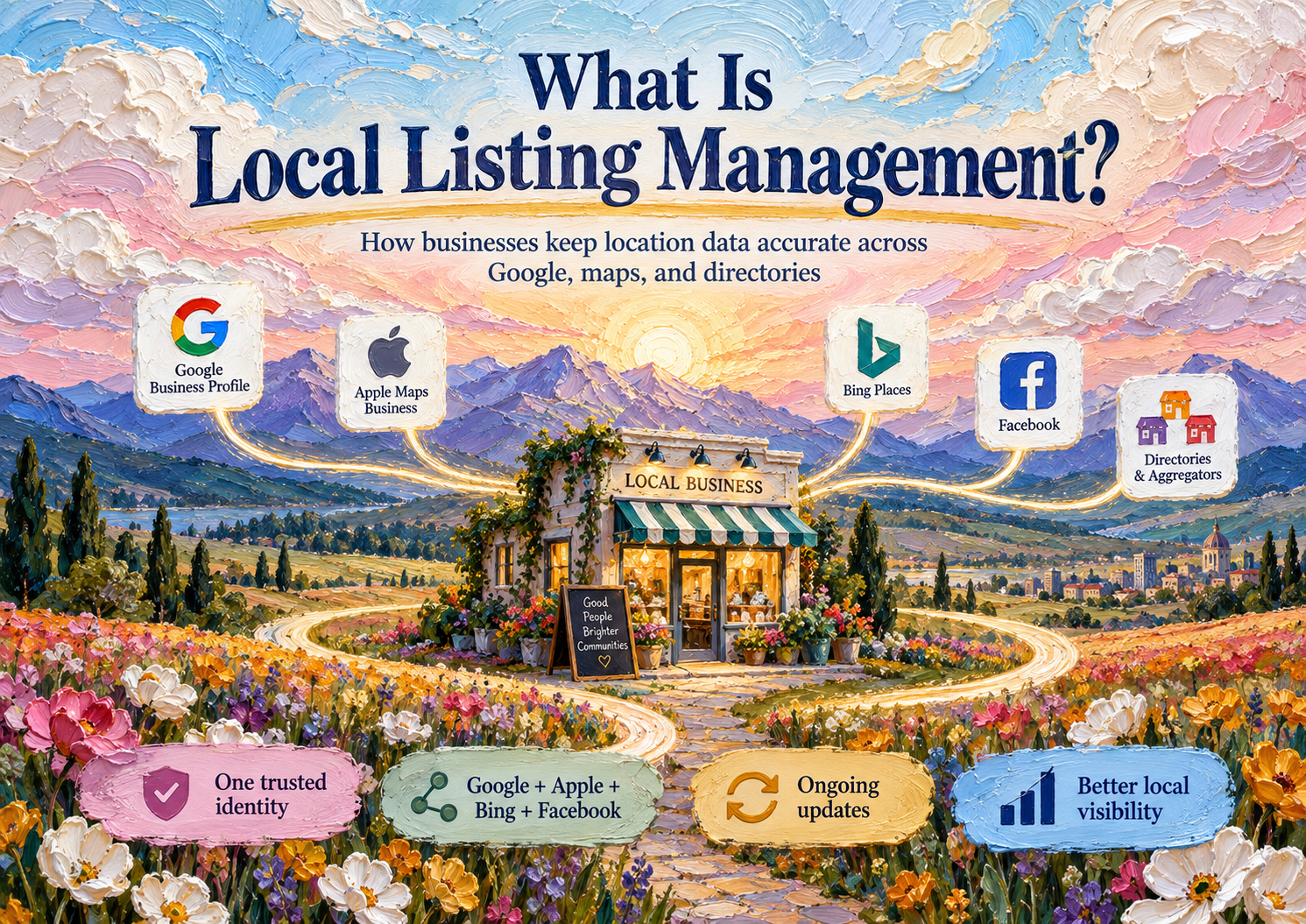
An open, move, and close playbook for local listings is the step-by-step sequence to create, relocate, or retire public place cards so maps and local directories show the correct status, address, and hours during location lifecycle events. It is a high-risk local listing management workflow. Definition hub: What is local listing management?.
This is an ops playbook — not a definition page and not a platform ranking.
Why lifecycle events need a playbook
Opening, moving, or closing a store creates duplicate pins, old addresses that keep ranking, and "open now" on dead locations. Google's representation guidelines and local ranking tips both stress accurate, real-world information. Lifecycle mistakes spread through aggregators if you only fix Google.
Open (new location)
- Freeze the canonical NAP, categories, hours, URL, and open date in the source of truth.
- Claim/create Google Business Profile with truthful data; verify ownership.
- Claim Apple Maps and Bing Places with the same identity (publisher priority).
- Hold marketing announcements until Tier 1 place cards match the approved record.
- Store ownership emails and recovery codes in the vault (RACI).
- Capture QA evidence on public cards (QA evidence).
Move (address or suite change)
- Decide whether the publisher treats this as an edit to the same entity or a new place (follow platform rules; do not invent a second Google pin "for SEO").
- Update the source of truth first; then Tier 1 publishers in the same day window when possible.
- Watch for duplicate old-address listings; suppress or mark closed per platform tools.
- Update hours if the move includes temporary closure (hours change control).
- Verify maps pins land on the correct building before running ads to the new address.
Close (temporary vs permanent)
| Close type | Local listing action | Common mistake |
|---|---|---|
| Temporary | Temporary closed + reopen date where supported | Leaving temporary closed forever |
| Permanent | Mark permanently closed; stop citations that re-open it | Only removing the website |
| Relocate brand | Move playbook + redirect customers | Creating a competing pin |
Evidence table
| Event | Must-verify surfaces | Pass criteria |
|---|---|---|
| Open | Google, Apple, Bing public cards | NAP/hours/status match source |
| Move | Same + old-address search | No live competing old suite |
| Permanent close | Same + major aggregators | Status closed; no "open now" |
Related reading (local cluster)
- What is local listing management?
- Seasonal hours change control for local profiles
- Local listing change QA evidence standard
- Local listing management publisher priority checklist
- Citation building vs local listing management
- Sibling term: What is business listing management?
Frequently asked questions
Should we create a new Google profile for every move?
Only when platform rules require a new entity. Prefer updating the existing verified profile when it is the same business continuing at a new address.
Does closing Google alone finish the job?
No. Aggregators and secondary maps can keep the old address alive. Local listings management includes the verify loop across priority publishers.